
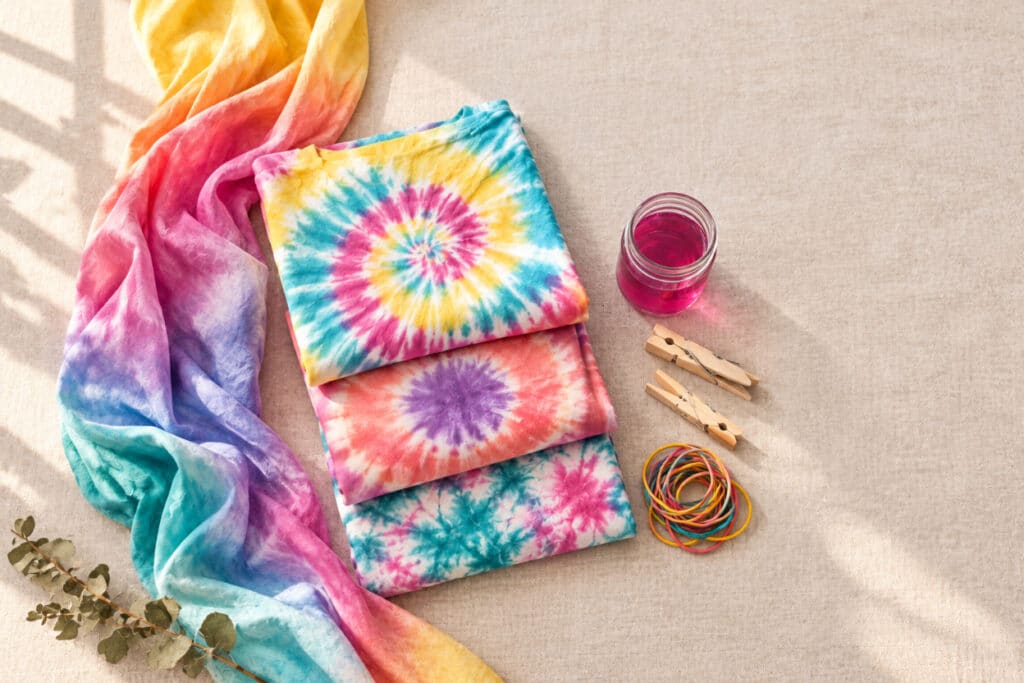
A tie dye pattern is the colour design that appears when fabric is folded, twisted or bound before it meets dye. Wherever the cloth is held tight, dye struggles to get in, so you get crisp white or pale lines next to soft, bleeding colour. The fold you choose decides the pattern: a twist gives a spiral, a pleat gives stripes, a scrunch gives random crumple.
This guide covers the main types of tie dye patterns, where the technique comes from, how to pick colours that stay bright instead of turning brown, and how to wear the look in 2026. We also explain how real hand-dyeing differs from a printed tie dye design, because we make the printed kind and you should know the difference.
Key takeaways
- Every tie dye pattern comes from one idea: resist. Folding and binding cloth blocks dye, and the shape of the fold decides the design.
- The best-known patterns are spiral, bullseye, crumple, stripe, heart, sunburst and ice dye. Each one has a fold that is easy to recognise.
- Colours that sit next to each other on the colour wheel blend cleanly. Colours from opposite sides mix into mud where they meet.
- Printed tie dye is a reproduction of the look, not hand-dyed cloth. That gives you consistent colour and precise placement, but not the one-off accidents of a real dye bath.
- Leggings are the easiest first step for wearing tie dye, because you can keep the rest of the outfit quiet.
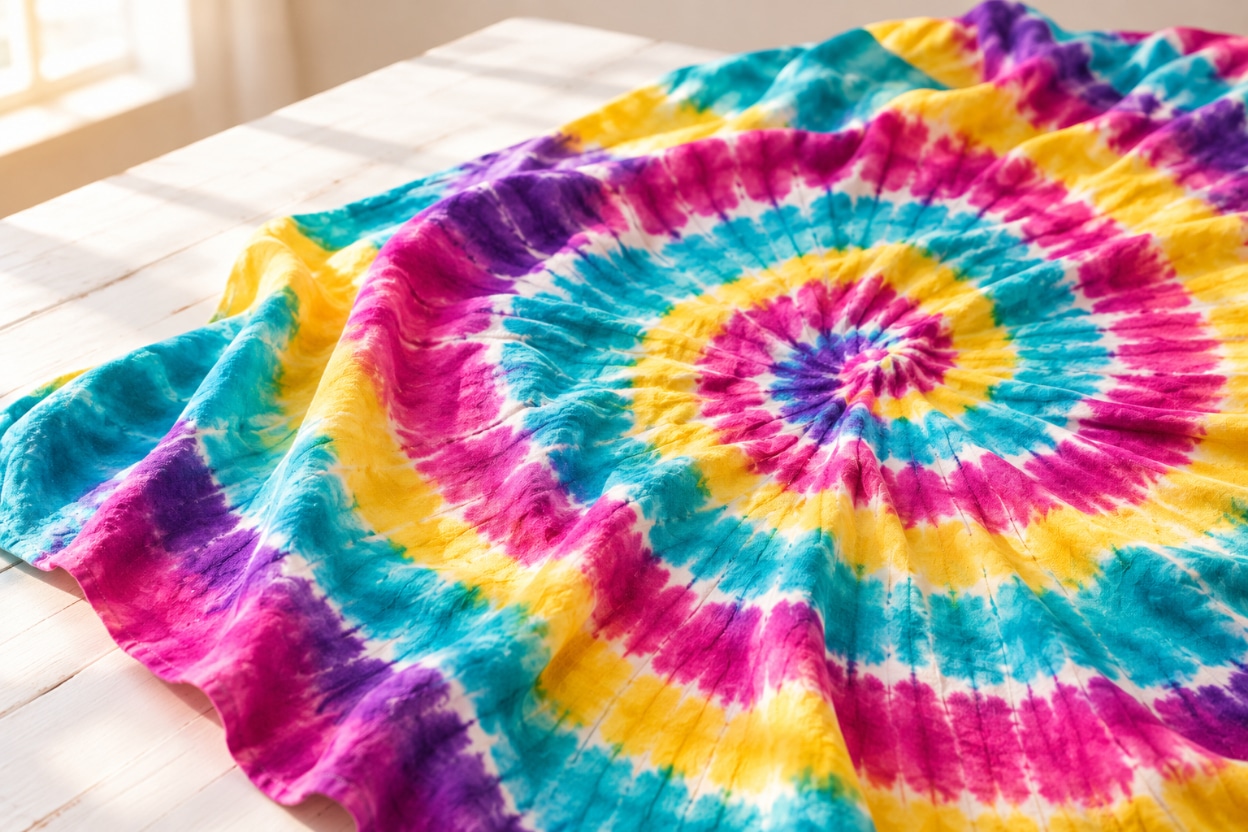
What is tie dye?
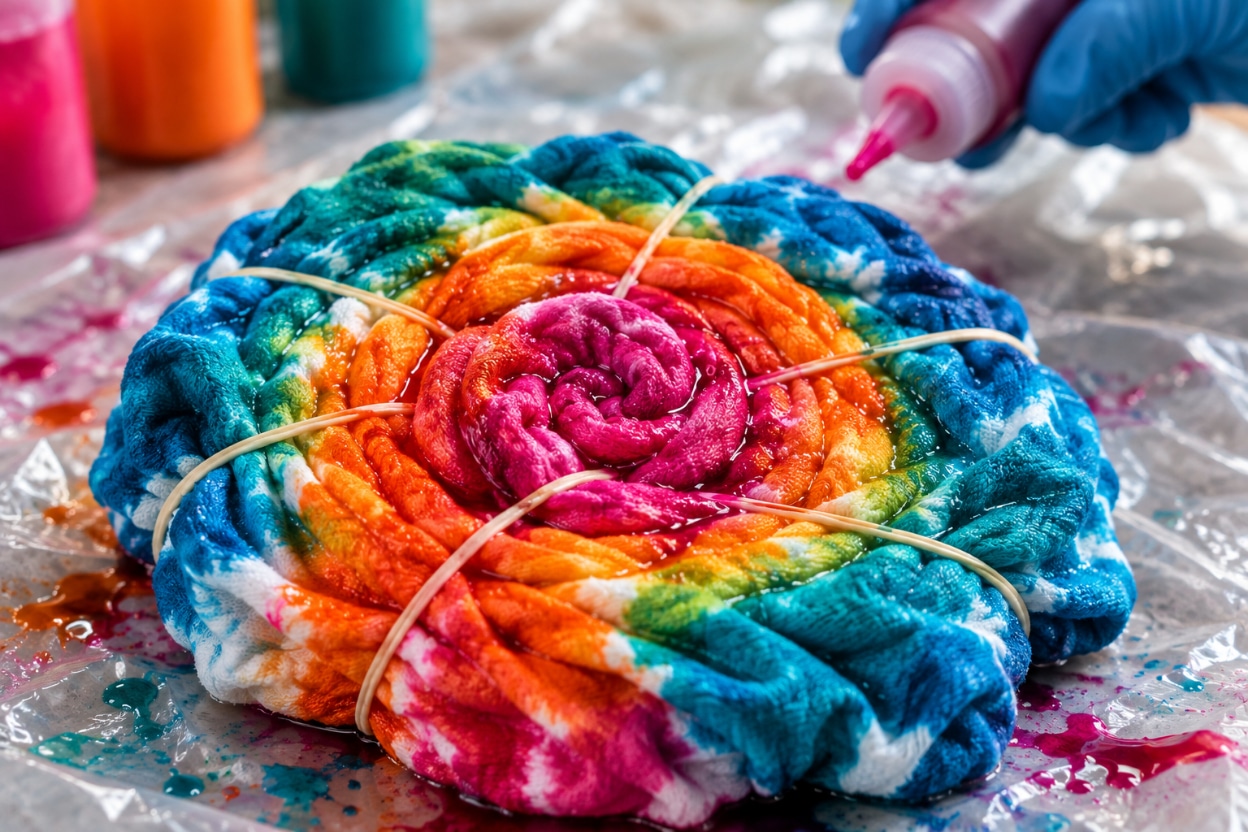
If you have ever wondered what is tie dye beyond the festival T-shirt cliché, the answer is simple. It is a resist-dyeing method. You gather cloth into a shape, hold that shape with string or rubber bands, then apply dye. The tied areas resist the colour, and the exposed areas soak it up.
The result is never fully predictable, which is the whole appeal. Dye travels along fibres, creeps under bindings and blends where two colours meet. Two people following the same steps with the same dyes will still end up with different shirts.
Three features help you recognise a real tie dye pattern:
- Soft, feathered edges where one colour fades into the next, rather than hard geometric outlines.
- Lighter or white lines that follow the folds, often radiating from a centre point or running in parallel bands.
- Colour that looks like it flowed rather than being drawn, with saturated cores and paler halos.
That last point matters later, when we talk about how a printed design can imitate the effect.
Tie dye history: where the technique comes from
Tie dye history is older and more global than most people expect. Resist dyeing, the family tie dye belongs to, developed independently in many places. The pattern you wear today has relatives in several textile traditions, and it helps to name them correctly.
Shibori in Japan
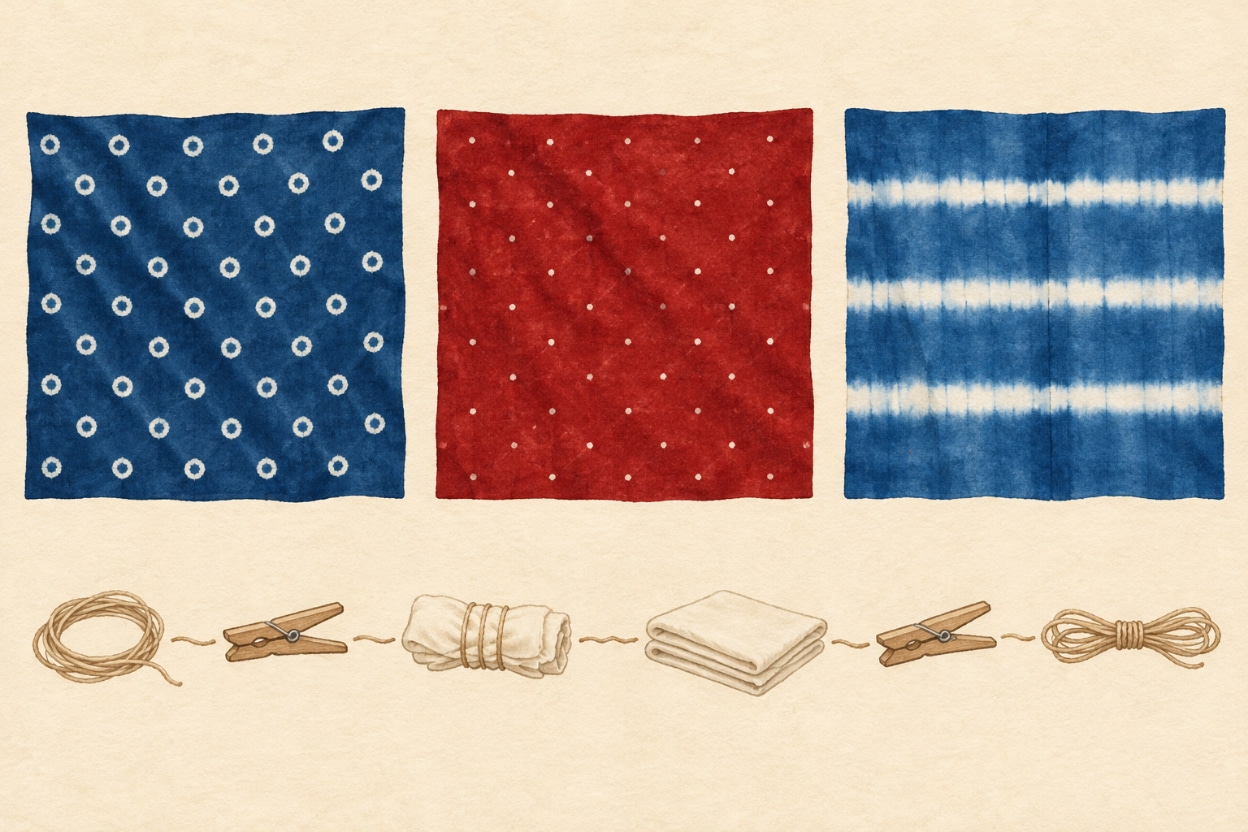
Shibori is the Japanese term for a group of shaping-and-resist techniques that includes binding, stitching, folding, twisting and clamping cloth before dyeing. It is most often associated with indigo, and its range is wide: some shibori produces tiny ring-shaped dots, some produces ruled lines or large geometric blocks. It is a craft in its own right, with regional specialities, and it is more controlled than the casual tie dye most of us picture.
Bandhani in South Asia
Bandhani, from the Indian subcontinent, involves pinching tiny points of fabric and tying them tightly with thread before dyeing. When the threads come off, each tied point leaves a small undyed dot, and thousands of dots build up into patterns. Bandhani textiles are strongly linked with regions such as Gujarat and Rajasthan, and they remain part of festive and ceremonial dress.
The 1960s revival
The look most people call tie dye surged in popularity in the United States in the late 1960s. It is commonly associated with the counterculture of that era, with music festivals and with a do-it-yourself attitude toward clothing. Home dyers could buy a packet of dye, a few rubber bands and a plain cotton shirt, and make something that no shop sold.
The style faded and returned several times afterwards. It reappeared in the 1990s, came back strongly in the late 2010s on runways and in home craft, and it is now a regular part of the pattern vocabulary rather than a costume. Where it shows up today tends to be quieter: muted palettes, tone-on-tone versions and designs on leggings and loungewear.
Types of tie dye patterns
Most types of tie dye patterns are defined by how the fabric is folded and where the bindings go. Learn the folds and you can recognise nearly any design at a glance.
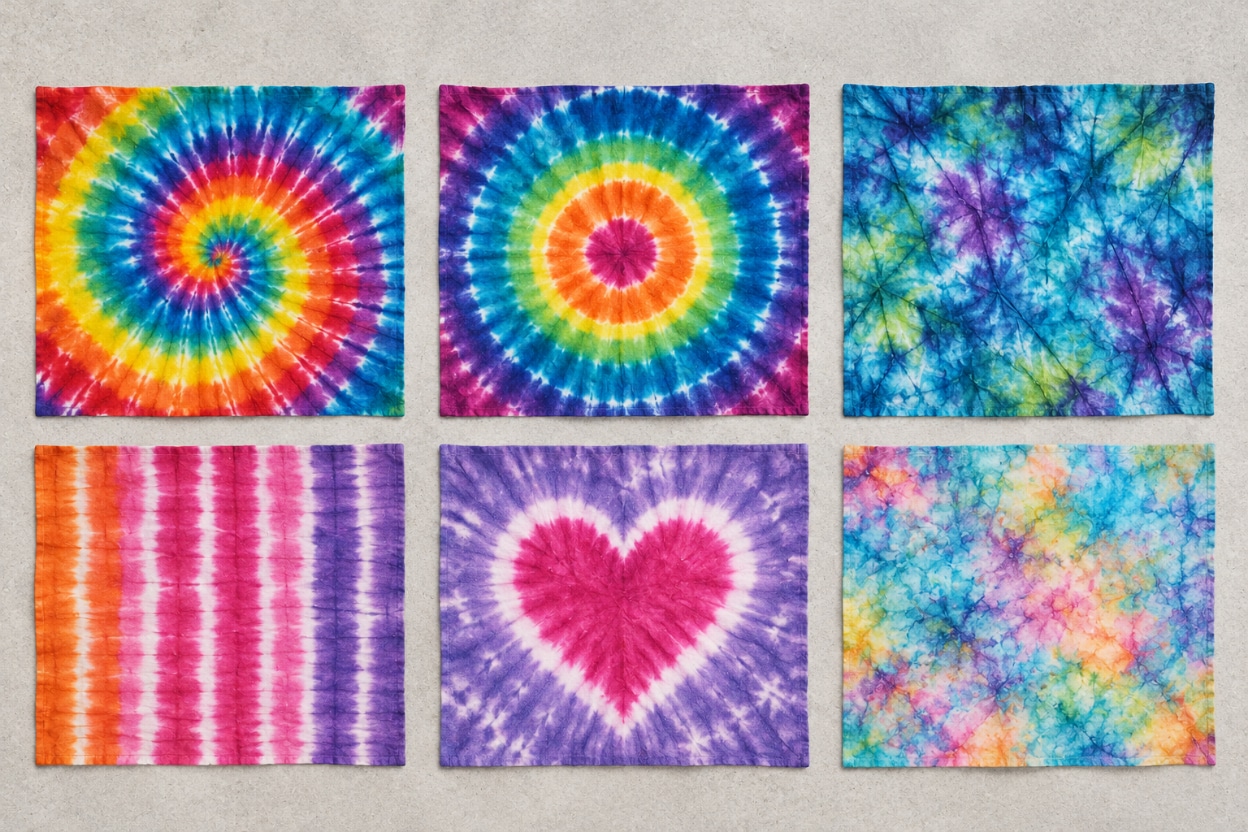
Spiral tie dye
Spiral tie dye is the classic. You pinch the centre of a flat piece of cloth and twist until it coils into a flat disc, like a cinnamon roll. Bands go around the disc to hold it, and each wedge gets a different colour.
The result is a swirl of colour arms radiating from a centre. The number of arms depends on how many sections you dye, and six is a common choice. On a printed garment, a spiral works best when the centre sits somewhere deliberate, because the eye goes straight to it.
Bullseye
Bullseye, sometimes called target, starts with pinching the cloth at one point and pulling it upward into a long cone. Bands are placed at intervals along the cone, and each section gets its own colour. When you open it, you get concentric rings.
It is a bolder, more graphic cousin of the spiral. Rings are easier to read from a distance, which is why bullseye designs often look strong on the front of a top.
Crumple
Crumple is the least controlled of all tie dye patterns. You scrunch the fabric into a ball or a loose heap, bind it lightly and dye it. The dye reaches only some surfaces, so the result is random veining and mottled patches in several colours.
Crumple is the most forgiving pattern for beginners, because there is no wrong result. Its irregular texture is also the easiest to wear: it reads as abstract colour rather than a motif.
Stripes
For stripes, you fold the cloth accordion-style in pleats, or roll it into a tube, then band it at regular intervals. Dye applied between the bands makes vertical, horizontal or diagonal stripes with soft edges.
Stripe tie dye suits people who like a tie dye pattern but not a busy one. The lines give structure, and a two-colour version looks almost like a hazy, hand-painted stripe.
Heart
A heart is made by folding the cloth in half, drawing a heart along the fold, then pleating and binding along the outline. Dye goes inside and outside the line in different colours. It is the one common tie dye motif that is truly a shape rather than a texture.
Sunburst
Sunburst is a variation of the spiral in which colour wedges meet at a bright centre and spread outward like rays. A yellow or orange core with cooler colours around the edge gives the effect its name.
Ice dye
Ice dye is a technique more than a motif. You scrunch wet fabric, cover it with ice, sprinkle powdered dye over the ice, and let the ice melt slowly. The dye dissolves gradually and travels in unpredictable ways, which creates fine, watercolour-like veining and softer blends than liquid dye.
Ice dye often gives results that look more complex than standard crumple. It is popular with experienced home dyers for that reason.
Tie dye patterns compared at a glance
If you are choosing a style for a project or a wardrobe piece, this comparison shows how the main designs differ.
| Pattern | How it is made | What it looks like | Best for |
|---|---|---|---|
| Spiral | Twist cloth from the centre into a disc | Colour wedges radiating from a point | Statement tops, hoodies |
| Bullseye | Pull a point into a cone, band at intervals | Concentric rings | Bold fronts, graphic looks |
| Crumple | Scrunch and bind loosely | Random veining and mottling | Beginners, leggings, everyday wear |
| Stripe | Pleat or roll, band at intervals | Soft-edged bands | Subtle tie dye fans |
| Heart | Fold, trace, pleat along outline | A recognisable shape | Kids’ wear, playful loungewear |
| Sunburst | Spiral with a bright centre | Rays from a warm core | Summer colour, accent pieces |
| Ice dye | Powdered dye on melting ice | Fine watercolour veining | Rich, complex texture |
How to tie dye at home: the basic steps
Plenty of readers arrive here wanting to know how to tie dye, so here is the short version. It is not a full tutorial, because dye products differ and you should always follow the instructions on the packet.
1. Start with fabric made from natural fibre. Cotton, linen, rayon and viscose take common fibre-reactive dyes well. Polyester and other synthetics do not, and they need a different type of dye.
2. Wash the fabric to remove any finish, and keep it damp.
3. Fold and bind it into your chosen shape with rubber bands or string.
4. Apply dye to each section. Many dye kits also ask you to treat cotton with soda ash first, so that the dye bonds properly.
5. Let the dye sit for the time the manufacturer recommends, usually several hours.
6. Rinse until the water runs clear, remove the bindings and wash separately from other clothes.
Wear gloves, protect your work surface and use clothes you do not mind staining. Dye gets everywhere.
Hand-dyed tie dye versus a printed tie dye look
Here we should be straight with you. Honeh does not hand-dye anything. We are a made-to-order print shop: the garments are printed with an all-over design after you order, and nothing is made in advance. A tie dye design on one of our pieces is a printed interpretation of the look, not cloth that went through a dye bath.
That difference has real consequences, and neither side is simply better.
What real hand-dyeing gives you
Real dye soaks into the fibre. The colour has depth, the edges are truly random, and no two pieces are identical. Hand-dyed cloth also shows its maker: a slightly off-centre spiral, a patch where the dye pooled, a crease that left an unexpected line. For many people that irregularity is the point.
It also takes time, mess and some practice, and results vary a lot. Natural fibres dye easily, while stretchy performance fabrics generally do not.
What a printed design gives you
A printed tie dye pattern is made from a digital file. That means the designer chooses exactly where the spiral sits, how large the rings are and which colours meet. The colours come out consistent from the first piece to the last, and the design can cover areas that are hard to dye evenly, such as a whole leg from hip to ankle.
Printing also lets a tie dye pattern run on stretch fabrics that are awkward to dye by hand. What you give up is the physical accident. A print is a picture of dye behaviour, so the best printed designs copy the feathering, the halos and the uneven saturation closely, rather than using clean gradients that look digital.
If you want the unique, imperfect object, dye it yourself. If you want a specific colour story that fits your wardrobe and arrives exactly as designed, print is the practical route. You can read more about the process in our post on how our printed leggings are made.
If you would like a printed version, our shop has all-over-print pieces you can browse for the look.


Tie dye leggings: how the pattern behaves in an all-over print
Tie dye leggings are a good example of why pattern design matters on a garment. Because we print the whole piece, a few design decisions change how the finished look reads.
Scale and seams
Leggings are made from panels joined at seams, and an all-over print has to flow across them. A spiral with a huge centre may land awkwardly on a thigh or get split by the inseam. For that reason, large motifs work best when the centre is placed deliberately, while crumple and ice dye hide seams naturally because they have no obvious centre.
Smaller repeating spirals avoid the problem. They cover the body evenly, and a seam cuts through a small motif without ruining it.
Repeat and alignment
Where one panel meets another, the pattern should continue. With a random texture such as crumple, the eye forgives a mismatch because there is nothing to line up. With stripes or bullseye rings, a misaligned seam shows quickly. When you look at a printed tie dye design, check whether the design keeps its rhythm across the leg.
Dark ground or light ground
The background colour changes everything. On a white or pale ground, tie dye looks like the original: pastel, airy and close to real dyed cotton. On a black or navy ground, the same colours look glowing and dramatic, like neon on night sky. Dark grounds also make a pattern more forgiving in daily wear, and they flatter more outfit combinations.
A deep ground and a light ground are not interchangeable, so the choice is really about mood. Light feels summery and handmade. Dark feels bolder and more grown-up.
Colour contrast and stretch
Leggings stretch when you move, so hard-edged rings or very high-contrast bands can look distorted across knees and hips. Soft, feathered transitions stay attractive.
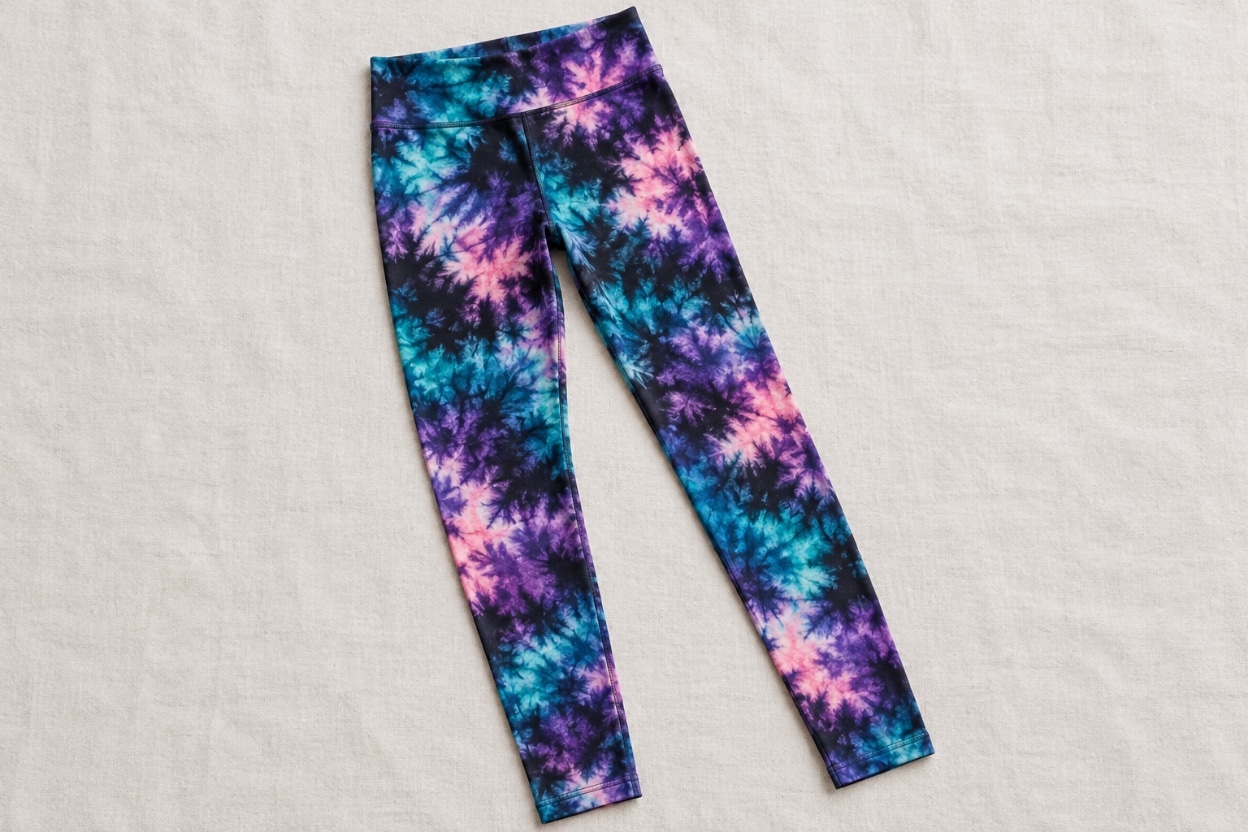
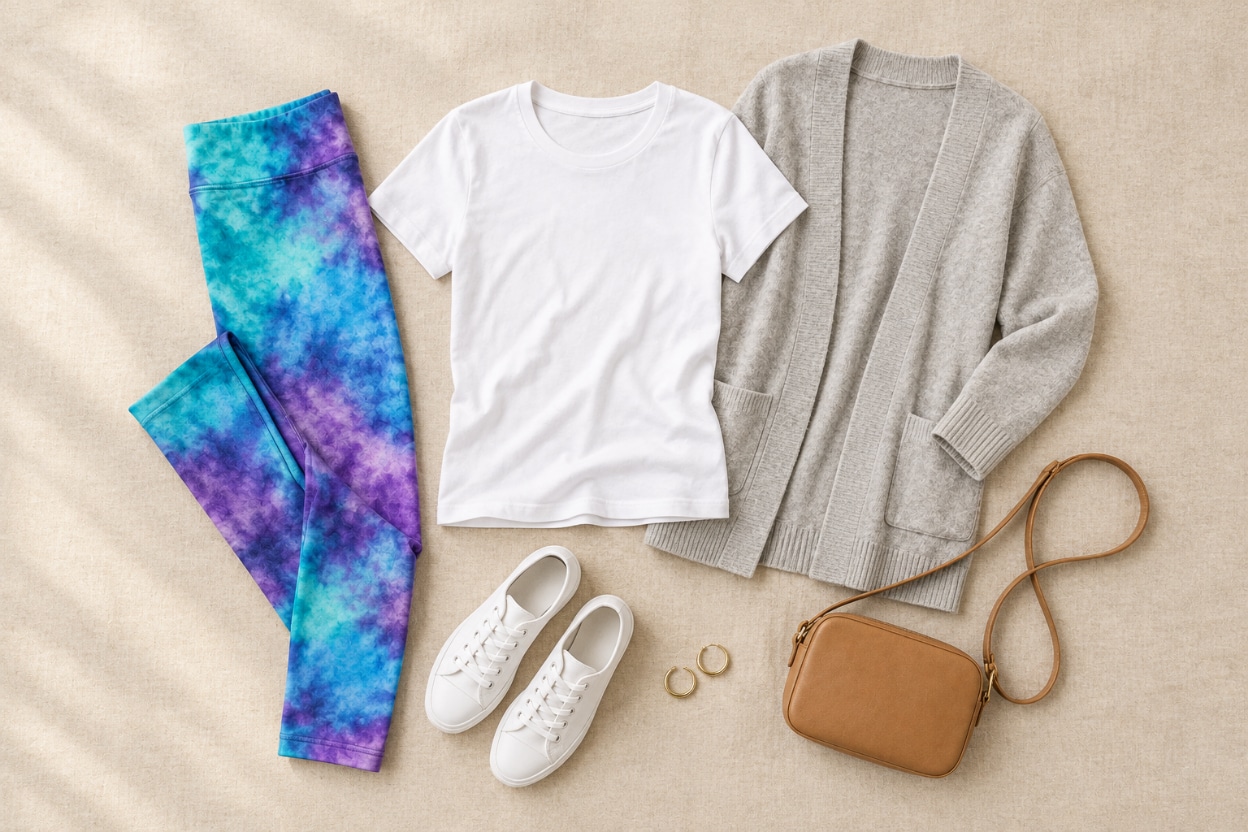
A pair of leggings is also the lowest-risk way to try tie dye. You can keep a plain top and trainers, and the pattern only does the talking from the waist down.
Tie dye color combinations that do not turn muddy
Colour is where most home projects go wrong. Dye is transparent, so when two colours flow into each other they mix, and some mixes are ugly. Good tie dye color combinations are really a matter of choosing neighbours carefully.
The mud problem
Opposite colours on the colour wheel, such as red and green, or blue and orange, cancel each other when they blend. The area where they meet turns grey or brown. If you want those pairs together, keep a white resist line between them so they never touch.
Palettes that blend cleanly
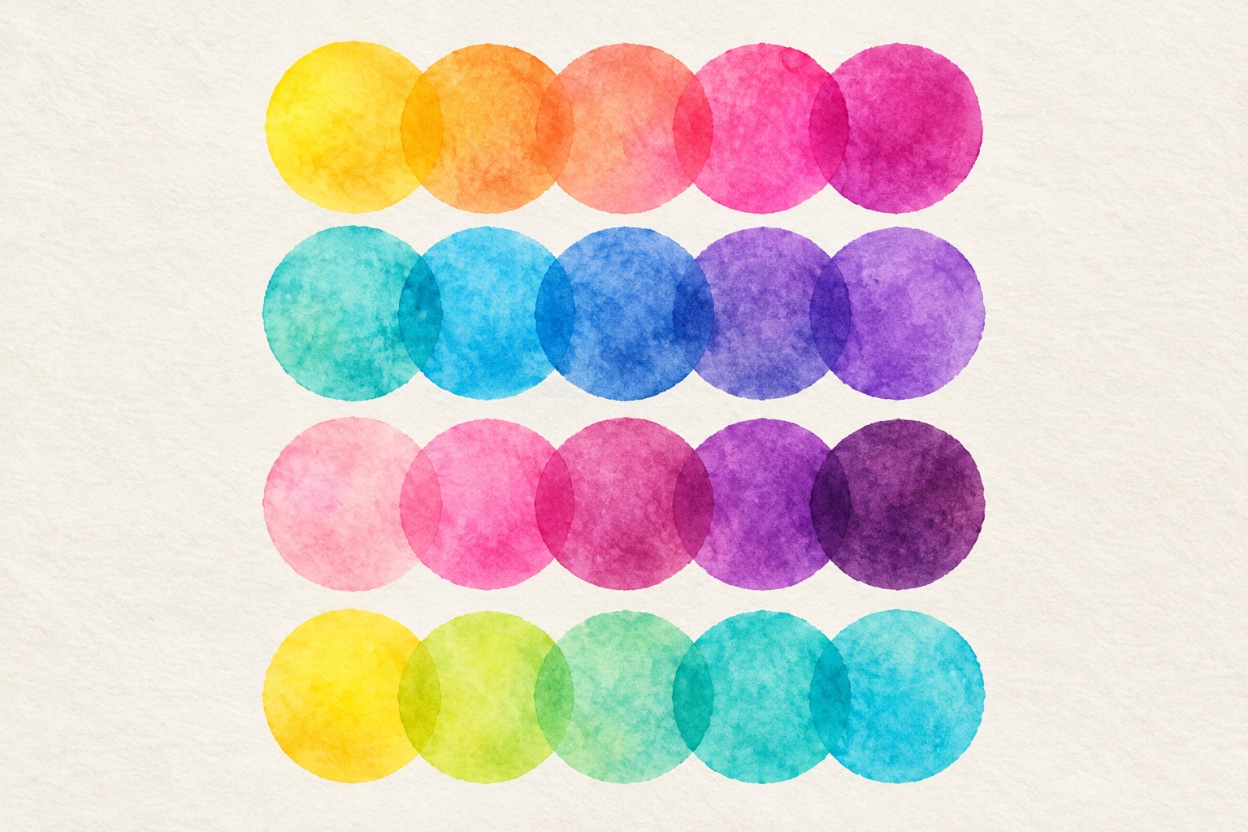
Colours next to each other on the wheel mix into new bright colours rather than brown. These palettes are reliable:
- Sunset: yellow, orange, coral, pink, magenta.
- Ocean: turquoise, teal, blue, indigo, violet.
- Berry: pink, magenta, purple, deep blue.
- Citrus: yellow, lime, green, aqua.
- Rainbow: works when each band is separated and the order follows the spectrum, since neighbours blend into each other.
Tone and mood
Keep to three or four hues, mix light and dark values so the pattern has depth, and leave some white or neutral space for the eye to rest. For a calmer look, stay inside one colour family.
How to wear tie dye without looking like a costume
The way to wear tie dye is to let it be the only loud thing. One piece carries the colour, and everything else steps back.
Keep the rest neutral
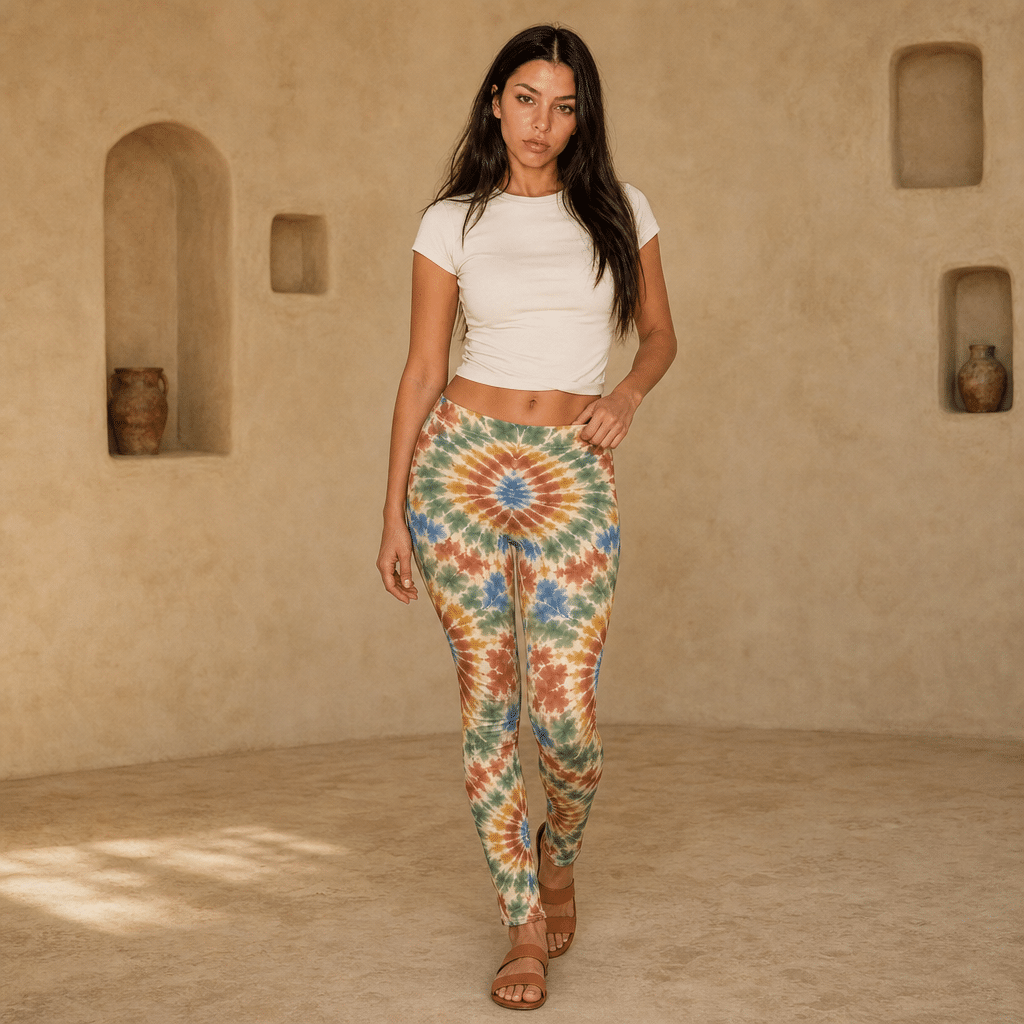
Pair tie dye leggings with a plain white, black, grey or cream top. Pull a colour from the pattern, such as teal or coral, into a small accessory, and leave it there. A matching set in the same print is also a clear, confident choice, but then keep shoes and bags plain.
Match the formality to the fabric
Tie dye has a relaxed reputation, so it suits casual and active clothes best: leggings, hoodies, loungewear, beach cover-ups. You can lift it with structure. A tailored blazer or a clean denim jacket over a tie dye top makes the look read as deliberate. Dark-ground prints dress up more easily than pale ones.
Layering for cooler weather
Tie dye is not only a summer print. A dark-ground design works under a long cardigan or oversized coat, and the same layering principles in our guide to layering a floral print dress for cooler weather apply: keep one statement layer, choose neutral outer pieces and repeat one colour near the face.
Mixing tie dye with other patterns
Tie dye is organic and soft, so it pairs best with something structured and quiet, such as a fine stripe in the same colour family. Avoid putting it next to another dense, high-colour print. For contrast, see how sharp, repeated designs like chevron, harlequin diamonds and aztec patterns differ from its soft randomness.
Tie dye hoodies and tops
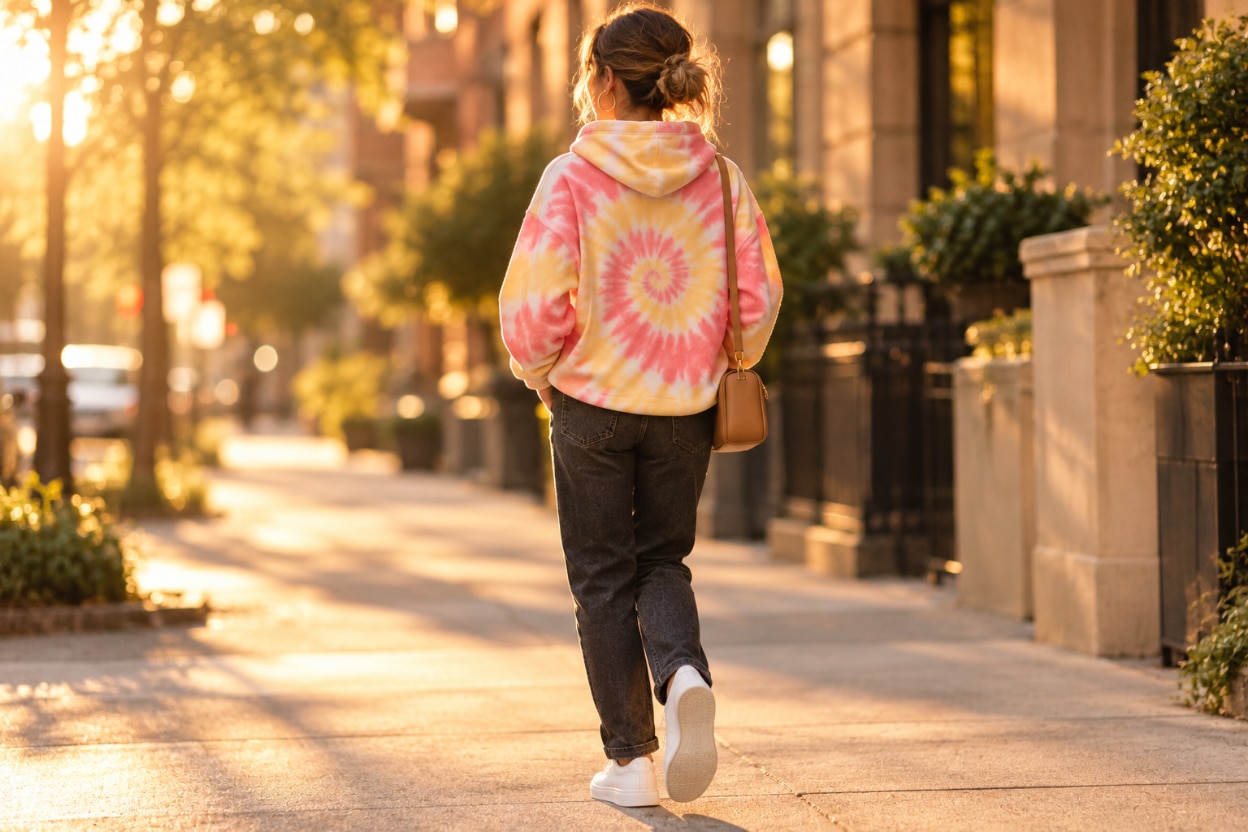
Hoodies are where tie dye often looks best at scale. A large spiral or bullseye across the chest is a statement, and jeans or black leggings keep it grounded. If you prefer subtle, choose crumple or stripe, which look softer across a big surface.


Caring for tie dye and printed tie dye
Care depends on what you own. A hand-dyed cotton shirt can bleed in its first washes, so wash it separately in cold water until the water runs clear, and keep it away from white clothes. Dyes fade with sun and heat, so dry it away from direct sunlight.
A printed garment behaves differently, because the design is part of the surface rather than a dye soaked through natural fibre. Even so, the same general habits protect it: wash inside out, use cold or cool water, choose a gentle cycle and avoid high heat in the dryer. Our guide on how to stop printed clothing from fading in the wash explains these steps in more detail.
Always follow the care label on your piece. If it says air dry, air dry it.
Common tie dye mistakes
A few errors come up repeatedly, with hand dye and printed designs alike.
- Too many colours. A busy palette turns into brown or grey where hues meet. Fewer, well-chosen colours look richer.
- Opposite colours touching. Keep red away from green and blue away from orange unless a white line separates them.
- Wrong fabric. Natural fibres take hand dye. Synthetics need a different dye, or printing.
- Skipping the rinse. Loose dye left in the cloth stains other laundry and dulls the pattern.
- Wearing three loud pieces at once. One tie dye item is a feature. Three is a costume.
- Ignoring the centre. In a spiral or bullseye, the centre draws the eye, so think about where it lands on your body.
Made to order, and where to see more
Pieces are printed after you order, not produced in advance and left in stock. If you are curious about the bigger picture, read about slow fashion versus fast fashion. When you are ready, browse all Honeh designs, or compare tie dye with the structured plaid pattern and the ornate damask pattern.

Frequently asked questions
What is a tie dye pattern?
A tie dye pattern is the design created when fabric is folded, twisted or bound before dyeing. The bound parts resist the dye, leaving pale lines beside soft, bleeding colour. The fold determines the shape, so a twist makes a spiral, rings come from a pulled cone, and a scrunch gives random crumple veining. Printed designs can imitate the same look.
What are the most common types of tie dye patterns?
The most common types are spiral, bullseye, crumple, stripe, heart and sunburst. Ice dye is a popular technique that produces fine, watercolour-like veining. Geometric and mandala folds create symmetrical designs. Spiral is the best known, while crumple is the easiest for beginners because the random result suits almost any colour combination.
How do you do a spiral tie dye?
Wet the fabric, pinch its centre and twist until it forms a flat disc. Hold it with rubber bands crossed over the top so that it divides into wedges. Apply a different dye colour to each wedge, front and back, then let it sit as the dye packet instructs. Rinse until the water is clear, then wash separately.
Is tie dye the same as shibori?
No. Shibori is a Japanese group of resist-dyeing techniques, traditionally with indigo, and it usually aims for controlled, deliberate patterns. Tie dye is the broader, more casual Western term, popularised in the 1960s. Both use folding or binding to resist dye, so they are related, but they have different histories and aesthetics.
Which colours go well together in tie dye?
Colours that sit next to each other on the colour wheel blend cleanly. Sunset shades, ocean blues and greens, and berry pinks and purples are reliable. Avoid letting opposites such as red and green or blue and orange touch, because they mix to brown. Three or four hues, with some white or neutral space, usually look best.
Can you tie dye polyester or leggings?
Common fibre-reactive dyes work on natural fibres such as cotton and do not bond with polyester. Synthetic fabrics need a different dye type and a hot process, which is difficult at home. Many stretch leggings are made from synthetic fibres, which is why tie dye leggings are often printed rather than dyed by hand.
How do you wear tie dye without it looking too loud?
Make the tie dye the only bold piece and keep everything else neutral. Pair tie dye leggings with a white, black or grey top, and pick one colour from the pattern for a small accessory. Dark-ground designs and softer styles, like crumple and ice dye, are easier to dress up than bright spirals.
How do you wash tie dye so it keeps its colour?
Wash tie dye in cold water on a gentle cycle, inside out, and keep it away from heat and strong sunlight. New hand-dyed pieces should be washed separately at first because they can release loose dye. Follow the care label on your garment, and air dry when you can to protect the colour for longer.
Final thoughts on choosing a tie dye pattern
A good tie dye pattern is easy to recognise once you know the folds: spiral, bullseye, crumple, stripe, heart, sunburst or ice dye. It has roots in shibori, bandhani and other resist-dye traditions, and its modern popularity comes from the 1960s revival. Choose neighbouring colours, keep a little white or neutral in the mix, and let one piece carry the colour. If you want real one-off cloth, dye it yourself. If you want a specific design on a garment that is printed after you order, a printed tie dye look is a sound choice, and leggings are the easiest place to start.

-
 Price range: $22.33 through $29.17
-
 Price range: $21.38 through $28.27
-
 Price range: $22.33 through $29.17
-
 Price range: $21.38 through $28.27
-
 Price range: $22.33 through $29.17
-
 Price range: $21.38 through $28.27
-
 Price range: $22.33 through $33.99
-
 Price range: $22.33 through $29.17
-
 Price range: $22.33 through $29.17
-
 Price range: $37.58 through $41.67
Recent Comments