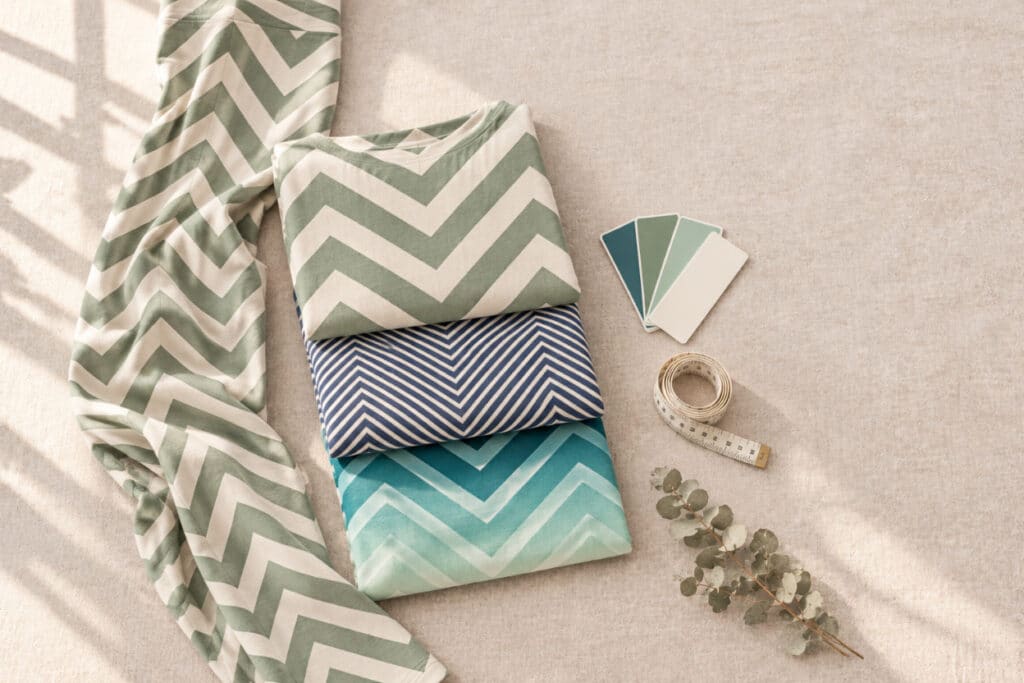
The chevron pattern is a repeating design of V-shaped stripes that point in one direction and meet at a sharp, continuous peak. Picture a row of arrowheads stacked on top of each other, or the sleeve stripes on a military uniform repeated across a whole surface. That is chevron. It is bold, graphic and easy to recognise from across a room.
This guide covers what the chevron pattern means and where the name comes from, the main variations, how it differs from herringbone and zigzag, and how to wear it without looking busy. We also look at something most guides skip: how the V-shapes line up (or do not) across the seams of printed leggings, and why pattern scale decides whether a chevron print looks sharp or awkward.
Key takeaways
- A chevron is a V-shape. The chevron pattern repeats that V in parallel bands so the points line up in a clean, continuous zigzag.
- Herringbone looks similar but is built from offset rectangular blocks, so its V-shapes are broken. Zigzag is a looser, more general term.
- The name is linked to rafters and to heraldry, and later to the rank stripes on uniforms.
- On printed leggings, pattern scale and seam placement matter more than the colours you pick.
- Two or three colours with strong contrast give the cleanest result. Keep the rest of the outfit quiet.
What is the chevron pattern?
If you are asking what is chevron pattern in the simplest terms: it is a series of inverted or sideways V-shapes, repeated in parallel rows. Each stripe bends at a sharp angle in the middle and continues in a mirror-image direction on the other side. Because every row has the same angle and the same width, the eye reads the whole thing as one continuous zigzag band.
Three features separate a true chevron from its relatives:
- The point of each V meets cleanly at a single peak, with no gap or step.
- Both arms of the V are the same length and the same angle, so the design is symmetrical.
- The rows repeat in parallel, so the stripes keep their spacing across the whole surface.
Chevron stripes are what most people picture first, but the idea works with thin lines, thick bands, outlined shapes and solid fills. The V can point up, down or sideways, and it can be wide and lazy or tight and steep. That flexibility is why the pattern shows up on everything from floor tiles and wallpaper to knitwear and swimwear.
Chevron pattern meaning and where the name comes from
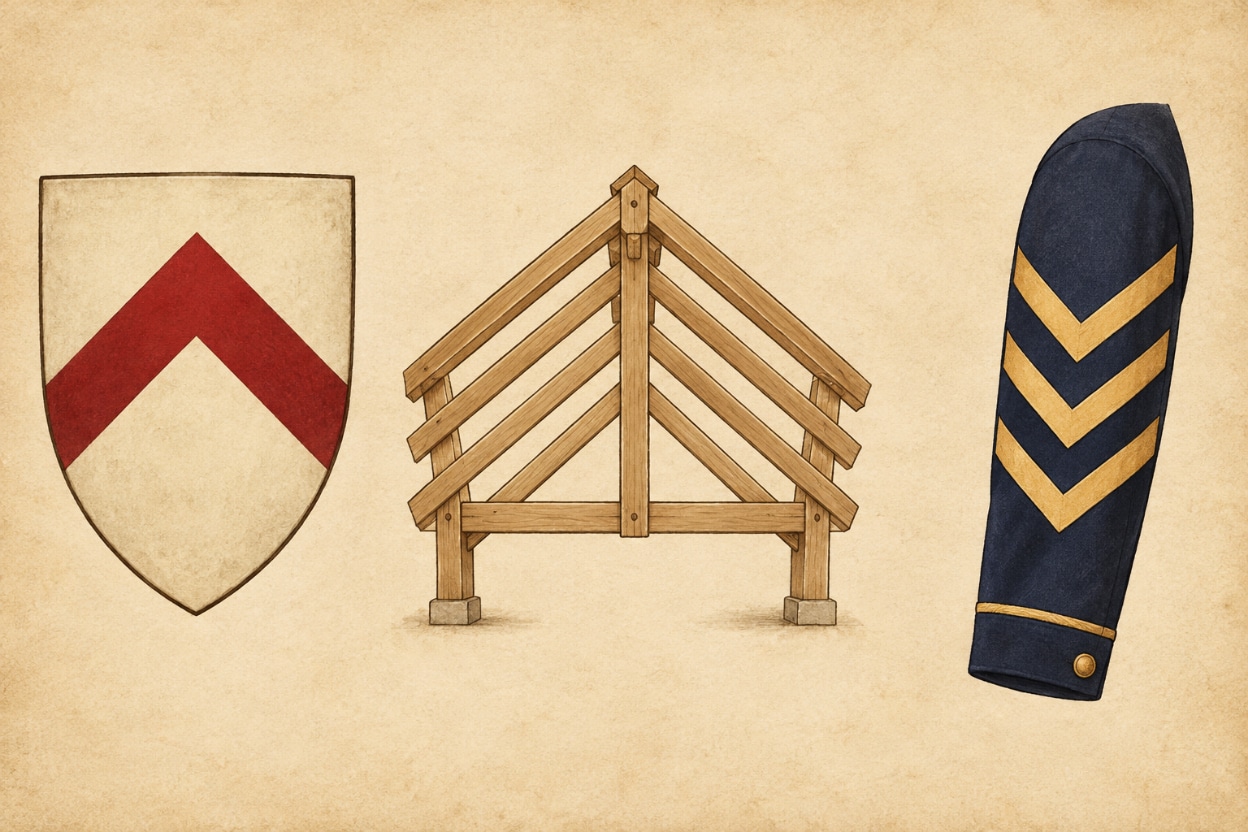
The word chevron comes into English from Old French, where it meant a rafter, one of the angled timbers that meet at the ridge of a roof. The French word is generally traced back to a Latin root related to goats, probably because rafters resembled the crossed horns of a goat. Treat the goat link as the commonly cited explanation rather than a settled one, but the rafter meaning is clear, and it explains the shape perfectly: two beams leaning together to form a peak.
From there the word moved into heraldry. In coats of arms, a chevron is one of the basic shapes, called an ordinary, and it looks like an inverted V across the shield. Heraldic descriptions of it often link it to roofs, shelter and building, though the symbolism varied by family and region, so it is safer to say it was a popular, readable shape than to claim one fixed meaning.
The most familiar modern use is military and police insignia. Rank chevrons, the V-shaped stripes worn on sleeves, are a standard way to show rank in many armed forces. Road signs use the same shape too: the sharp arrow-like chevrons on a bend tell drivers which way the road turns.
So the chevron pattern meaning depends on context. On a uniform it signals rank. On a shield it is a traditional emblem. On a legging or a cushion it is mostly about direction and energy, because a V-shape pulls the eye along a line. Do not read more into it than that.
Chevron variations worth knowing
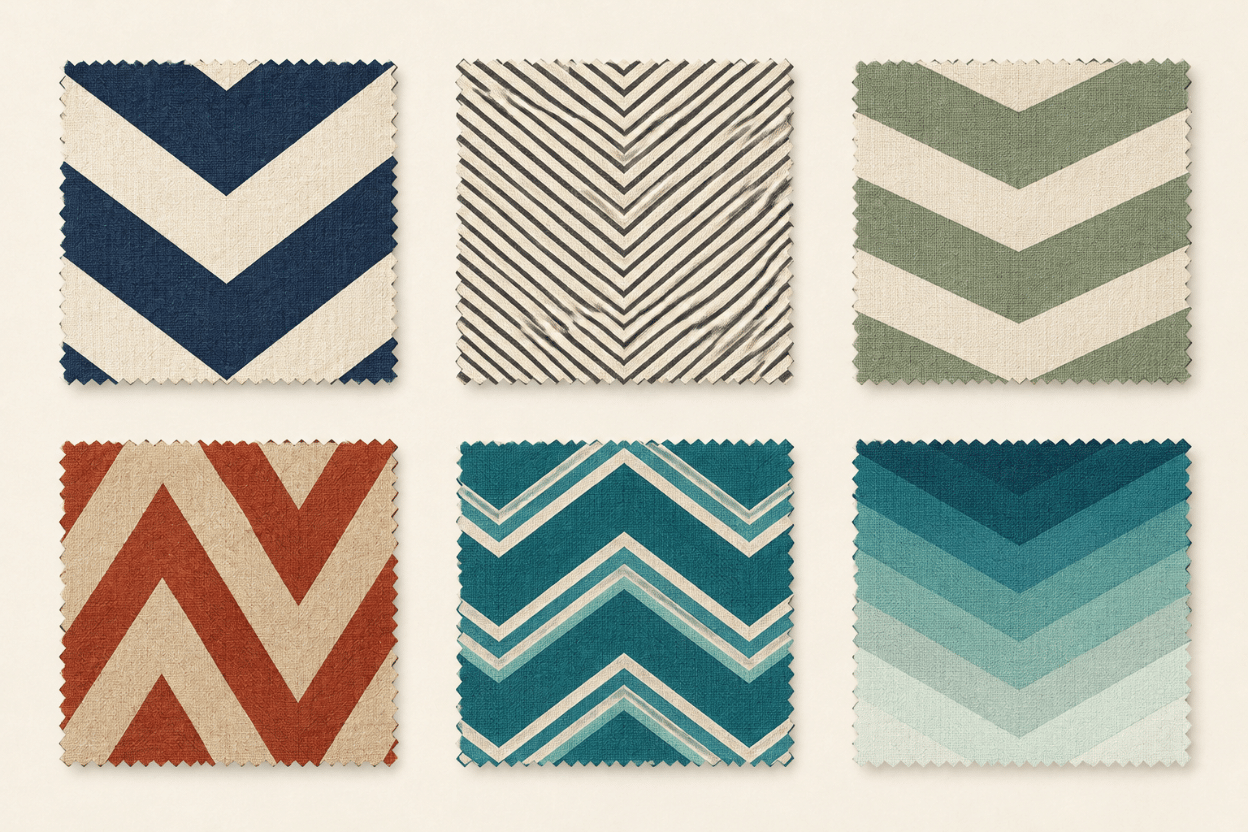
Not every chevron looks the same. The differences come down to angle, width, spacing and how much of the V is filled in. These are the versions you will meet most often.
Classic chevron stripes
Wide, evenly spaced bands in two alternating colours, with a medium angle of roughly 45 degrees on each arm. This is the version most people mean when they say chevron stripes. It works on almost anything and is the easiest to pair with plain clothes.
Skinny or pinstripe chevron
Thin lines, close together, with a steep or shallow angle. At a distance the pattern softens into a subtle texture, which makes it a good entry point if bold graphics feel like too much.
Wide-angle and flat chevron
The arms of the V are spread almost flat, so the pattern reads as a gentle wave of angles rather than sharp arrows. It feels calmer and more modern, and it is forgiving on a moving body.
Steep or tall chevron
The opposite: narrow, upright Vs that stretch vertically. These create a strong sense of direction and can have a lengthening effect on the eye, because the lines lead up and down the body.
Outline and multi-line chevron
Instead of solid bands, each V is drawn as a thin line, sometimes repeated three or four times in graduated colours. It looks lighter and more decorative than solid stripes.
Ombre and gradient chevron
The colour shifts gradually from row to row, for example from deep teal to pale mint. The shape stays rigid while the colour moves, so the result feels both structured and soft.
Broken, scattered and mini chevron
Small chevrons spaced out like tiny arrows, or arranged in a loose all-over scatter rather than continuous rows. These are closer to a motif than a stripe, and they sit comfortably on tops and dresses where a full-bleed stripe would overwhelm.
Chevron vs herringbone: what is the real difference?
This is the comparison people search for most, and it trips up even experienced designers, because the two patterns look related and are often mislabeled in shops.
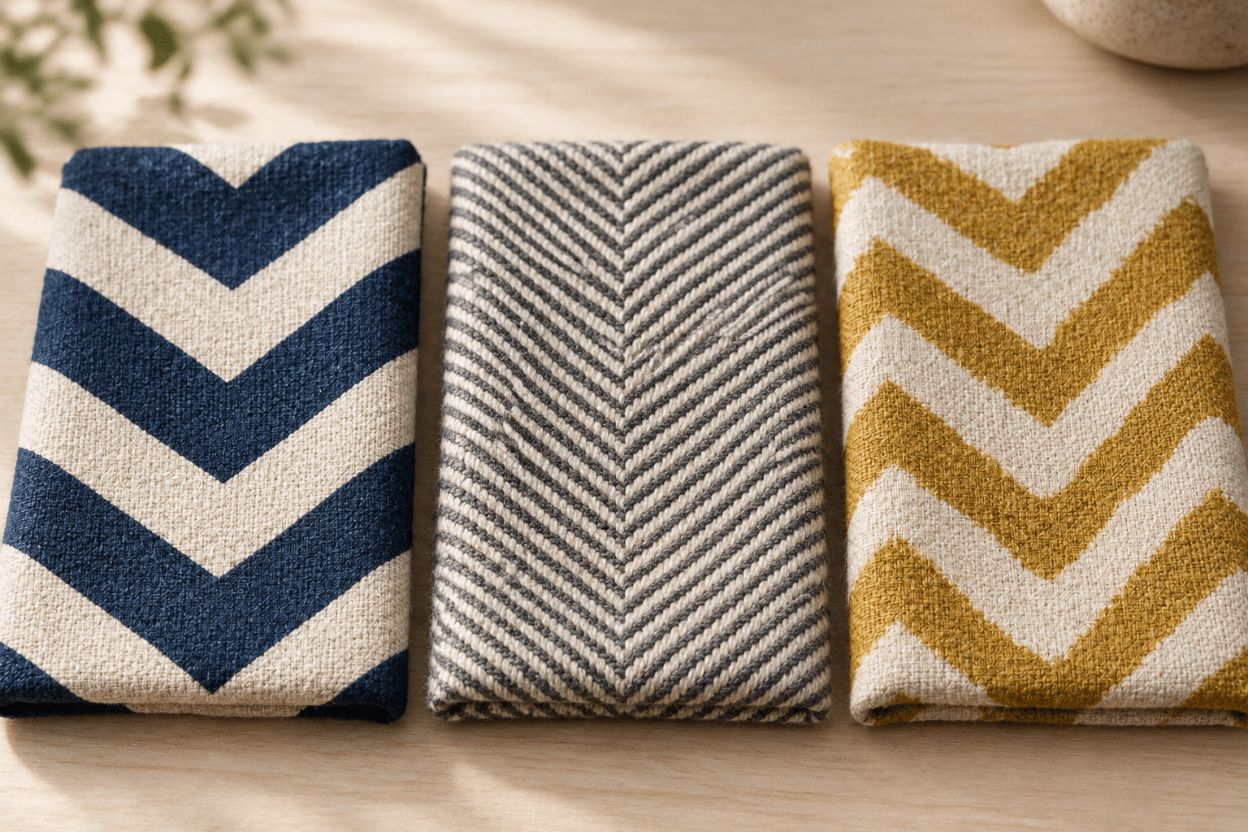
A herringbone is built from rectangular blocks or short, narrow strokes laid at an angle, each row offset so the tops of the Vs do not quite meet. The result is a V-like pattern with a visible step or break down the centre line. The name comes from the resemblance to the skeleton of a herring. In woven cloth it is a twill structure where the direction of the diagonal reverses at regular intervals; in flooring it is bricks or planks laid at right angles.
A chevron has no break. The two arms meet at a clean point, so you get a continuous zigzag line. In flooring the planks are cut at an angle so the ends meet exactly; in print the shapes are simply drawn that way.
Here is an easy test. Look at the centre line where the two directions meet. If it is a crisp, unbroken point, it is chevron. If it is a jagged, stepped seam, it is herringbone.
Chevron vs zigzag: are they the same?
Not quite, although the overlap is large. Zigzag is a general word for any line that turns sharply back and forth. It can be a single line, a thick band, or an irregular sequence of different-sized angles. Chevron is the more specific, orderly version: parallel bands, equal angles, a repeating rhythm.
In everyday shopping language the two get swapped constantly. A listing for zigzag leggings may well show a perfect chevron, and the reverse is also true. The practical difference is this: zigzag can be irregular and hand-drawn in feel, while chevron implies precision and symmetry. If you want the strictly regular look, check the product images rather than trusting the label.
Chevron, herringbone and zigzag at a glance
Here is a quick side-by-side so you can identify each one on sight.
| Feature | Chevron | Herringbone | Zigzag |
|---|---|---|---|
| Shape | Continuous V-shaped stripes | Offset blocks forming broken Vs | Any line with sharp back-and-forth turns |
| Centre point | Clean, unbroken peak | Stepped or staggered line | Varies |
| Regularity | Strict, symmetrical | Strict, with offset rows | Can be loose or irregular |
| Typical look | Bold, graphic | Textured, classic | Energetic, playful |
| Common uses | Prints, knits, flooring, insignia | Tweed, suiting, brick floors | Rugs, knitwear, retro prints |
| Best on a small garment area | Wide-angle or mini scale | Fine scale | Medium scale |
How to wear chevron without it taking over
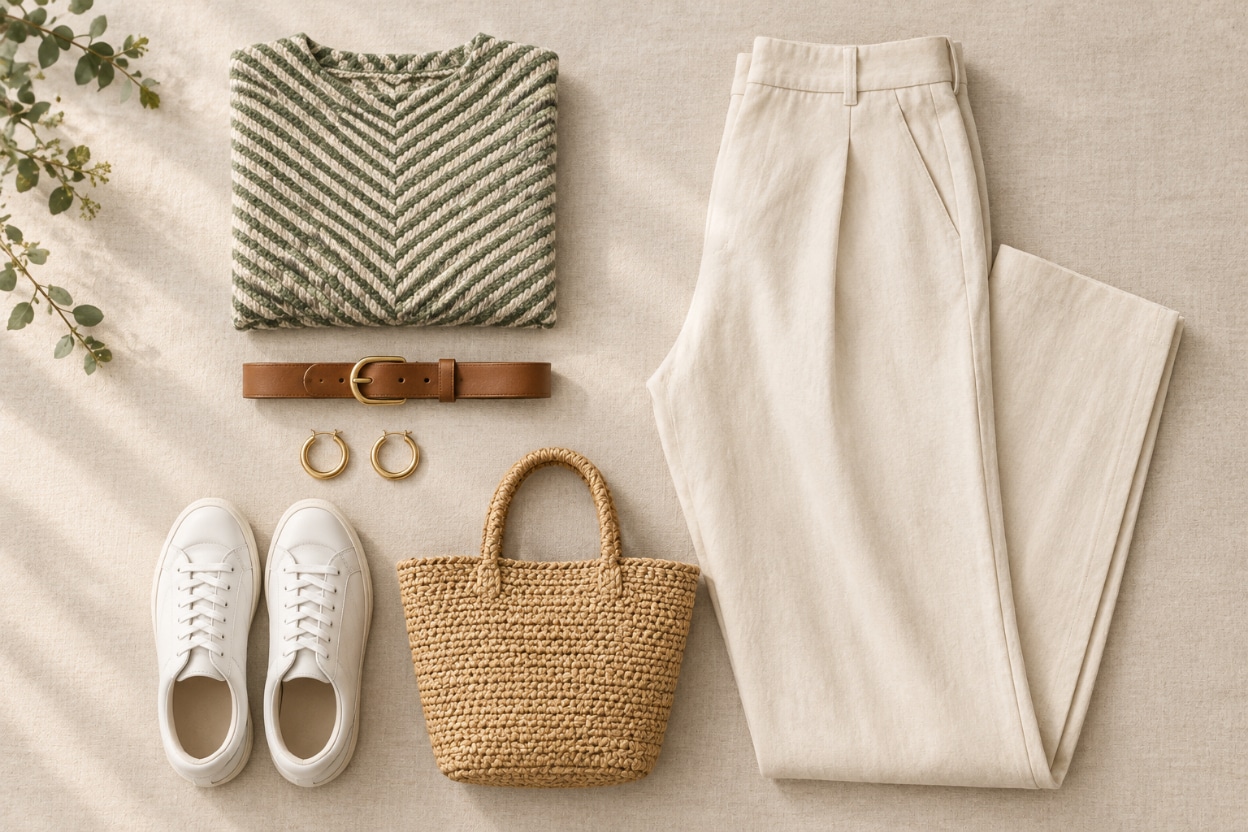
Chevron is a loud pattern by nature. The good news is that a few simple rules keep it looking deliberate instead of chaotic. If you have been wondering how to wear chevron, start with these.
Let one piece carry the pattern
Pick a single chevron item and keep everything else plain. A chevron top with solid trousers, or chevron leggings with a long, quiet jumper, reads as confident. Two chevron pieces at once usually compete.
Match the scale to the body area
Large, wide stripes suit large surfaces, such as a dress or a long cardigan. On a smaller area, like a sleeve or a calf, a tighter chevron looks tidier because you see several repeats rather than half of one.
Use direction on purpose
Vertical-pointing Vs (peaks facing up or down along the leg) tend to lengthen the line of the body. Sideways Vs, where the points face left or right, add width and movement. Neither is better. They simply say different things, so choose based on the effect you want.
Break the pattern with a solid layer
A plain denim jacket, a long cardigan or a belted coat gives the eye somewhere to rest. This is also the easiest way to wear chevron in cooler weather, when layering is natural anyway. The same layering logic applies to other prints, and our guide to layering a floral print dress for cooler weather uses principles that carry over directly.
Mix with other patterns carefully
Chevron can sit next to other prints if you control the scale. Pair a large-scale chevron with a much smaller pattern, such as a fine stripe, and keep both in the same colour family. If you enjoy checks, a muted plaid pattern in a neutral tone can work with a chevron in the same two or three colours, because the angles of the plaid and the zigzag echo each other. For something more geometric, you could look at the diamond pattern, which shares the same crisp angles.
Chevron colour combinations that work
Colour does as much work as the shape. Because chevron is built from sharp, repeated stripes, contrast determines how visible the pattern is. A high-contrast pair announces the V-shapes loudly. A low-contrast pair makes them a quiet texture.
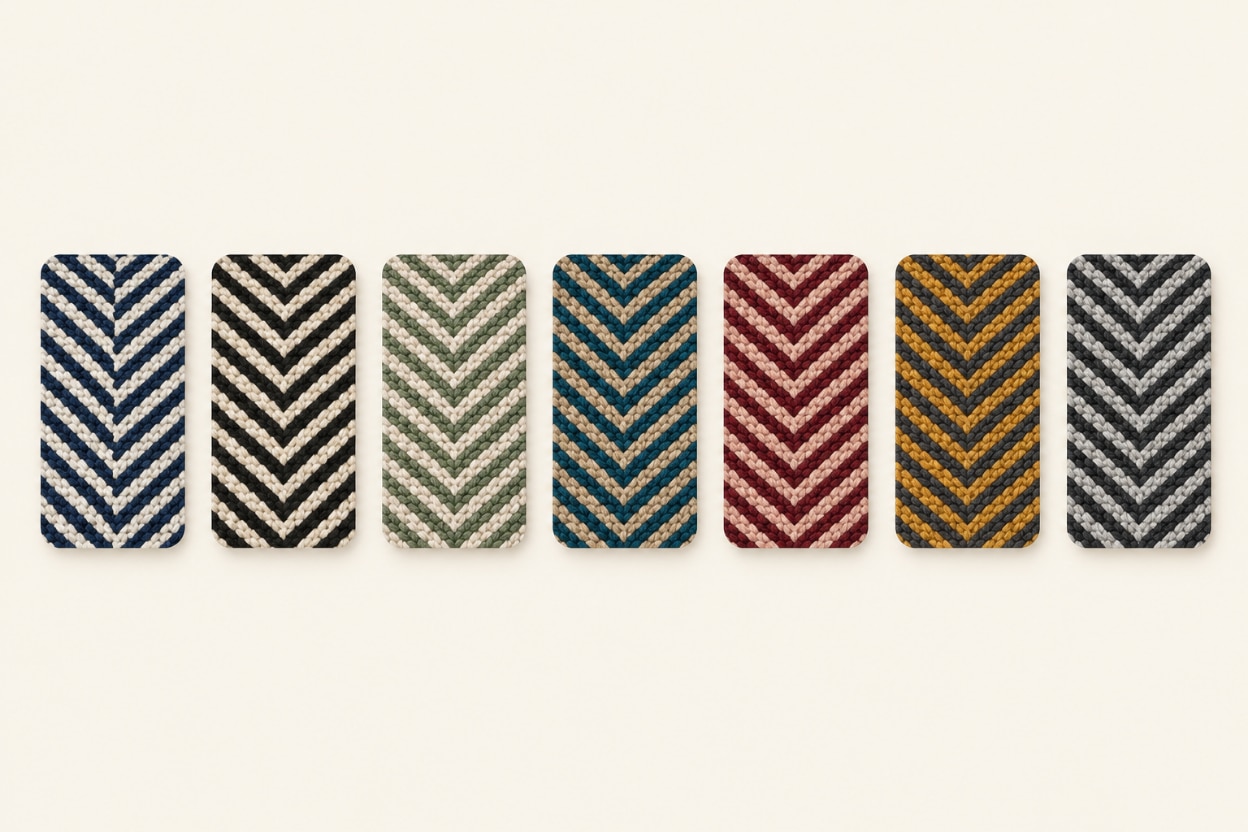
Here are chevron colour combinations that tend to look good and are easy to wear:
- Navy and white: clean, nautical-leaning and very versatile.
- Black and cream: softer than black and white, and still graphic.
- Sage green and ivory: gentle and earthy, a good everyday choice.
- Deep teal and sand: calm with a slight retro feel.
- Burgundy and blush: warm, and it suits autumn and winter wardrobes.
- Mustard and charcoal: stronger and more playful, best worn with plain neutrals.
- Charcoal and light grey: a low-contrast option when you want the pattern to whisper.
Three colours is a sensible upper limit for a wearable chevron. Beyond that, the stripes begin to blur and the shape loses its strength. If you want more colour, an ombre chevron, where one hue fades into another row by row, gives variety without breaking the structure.
Dark ground or light ground?
In printing, the base colour behind the pattern changes the whole mood. A dark ground with lighter stripes feels dressy and slimming, and it hides small imperfections in fabric better. A light ground with darker stripes looks fresher and more casual, but every flaw in the print alignment shows more clearly. If you are choosing your first chevron garment, a dark ground with one softer contrast colour is the safest route.
Chevron leggings: how the pattern behaves on a real garment
Leggings are where chevron gets interesting, and where a bit of print knowledge saves you from disappointment. At Honeh, everything is made to order with all-over printing, so we think about the pattern as it will sit on a three-dimensional shape, not as a flat rectangle on a screen.
Why seams change everything
All-over printed leggings are typically cut from several fabric panels, then sewn together along the inner leg, outer leg and often a waistband and gusset. The print is laid across those panels before sewing. A chevron makes any misalignment obvious, because your eye expects the Vs to continue from one panel to the next.
In practice, you should expect the V-shapes to be close but not guaranteed to match perfectly across every seam. Sewing, stretching and the way fabric sits on the body all introduce tiny shifts. A good design plans for this, rather than promising a perfect join.
Why pattern scale matters
Scale is the most important decision on a chevron legging. If the stripes are very wide, a single V may span most of the leg, so a seam sliced through the middle of one arrives as a visible mismatch. If the stripes are very thin and close together, a small shift disappears, because the eye reads the pattern as a texture.
A medium-to-small scale is usually the most forgiving. It gives you the bold look of chevron while letting seams and body curves interrupt the pattern without looking like an error. Very large chevrons can look dramatic, but they need more careful placement and you should accept that the seams will interrupt them.
What stretch does to the shape
Leggings stretch around the hips, thighs and knees. A chevron that looks perfectly symmetrical when flat will widen slightly where the fabric stretches and tighten where it relaxes. That is normal. It is another reason why a mid-scale pattern in a dark ground tends to look smooth: it tolerates the small distortions of a moving body.
Choosing direction for the leg
Vs pointing down the leg create a long vertical rhythm, a bit like an arrow towards the ankle. Sideways Vs wrap the leg and read as horizontal movement. Try the downward direction first if you want a slimmer look, and the sideways direction if you like a more graphic, sporty feel.
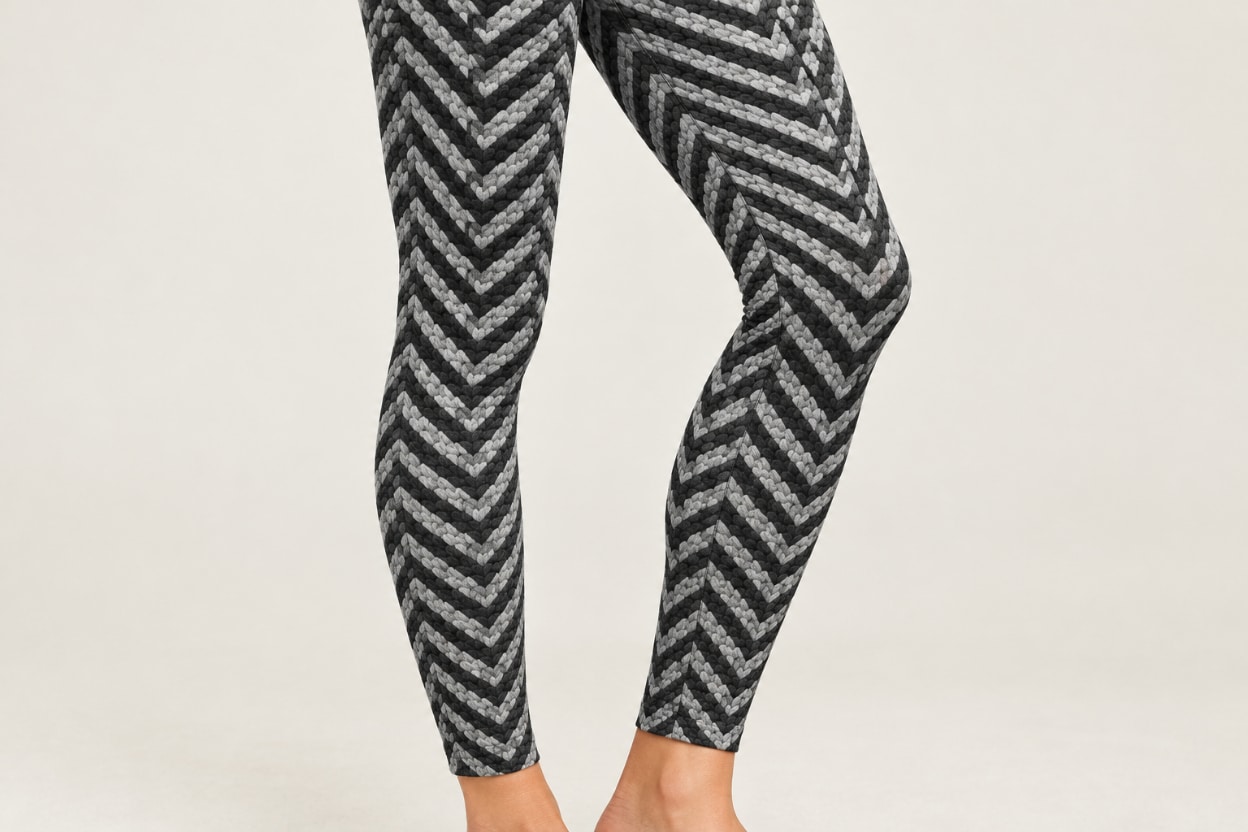
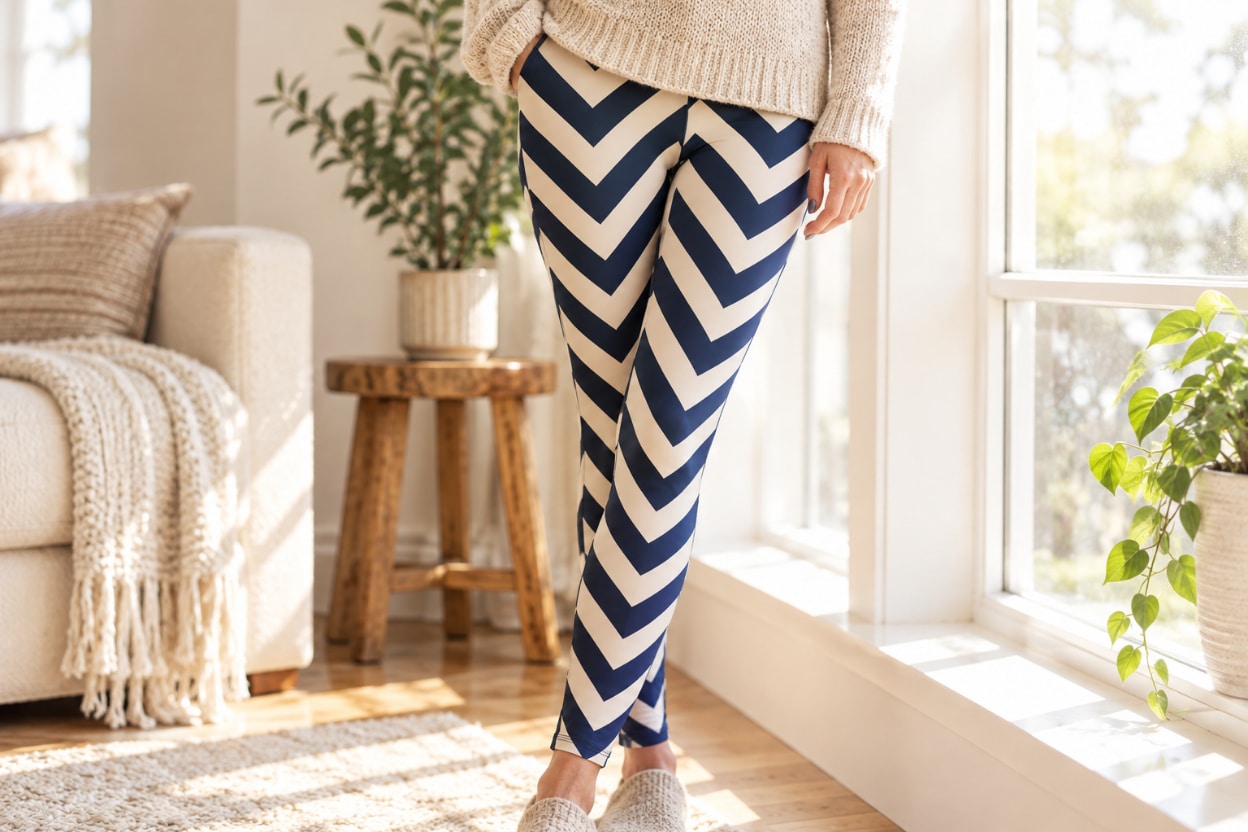
If you would like to see how a mid-scale chevron sits on the leg, this is the kind of design we have in mind for our leggings.


Leggings are the lowest-risk way to try a bold pattern. They are one piece, they pair with whatever you already own, and if you decide chevron is not for you, the commitment was small. Every pair at Honeh is printed after you order, so you are choosing a design rather than picking from a warehouse shelf. For more on that process, see how our printed leggings are made.
Chevron beyond leggings
Once you are comfortable with the pattern, it travels well to other pieces.
A chevron hoodie or long top is a good place for the wide-angle version, because the broad surface gives the V-shapes room to breathe. A dress works best in a fine or ombre chevron, where the shape moves with the fabric instead of fighting it. Smaller items, like a tote or a scarf, suit a mini scatter.
If you like the structure of chevron, you might also enjoy tartan for its heritage feel, or the harlequin pattern for a bolder, diamond-driven look. Both rely on the same idea: a simple repeat that gets its character from contrast and scale.
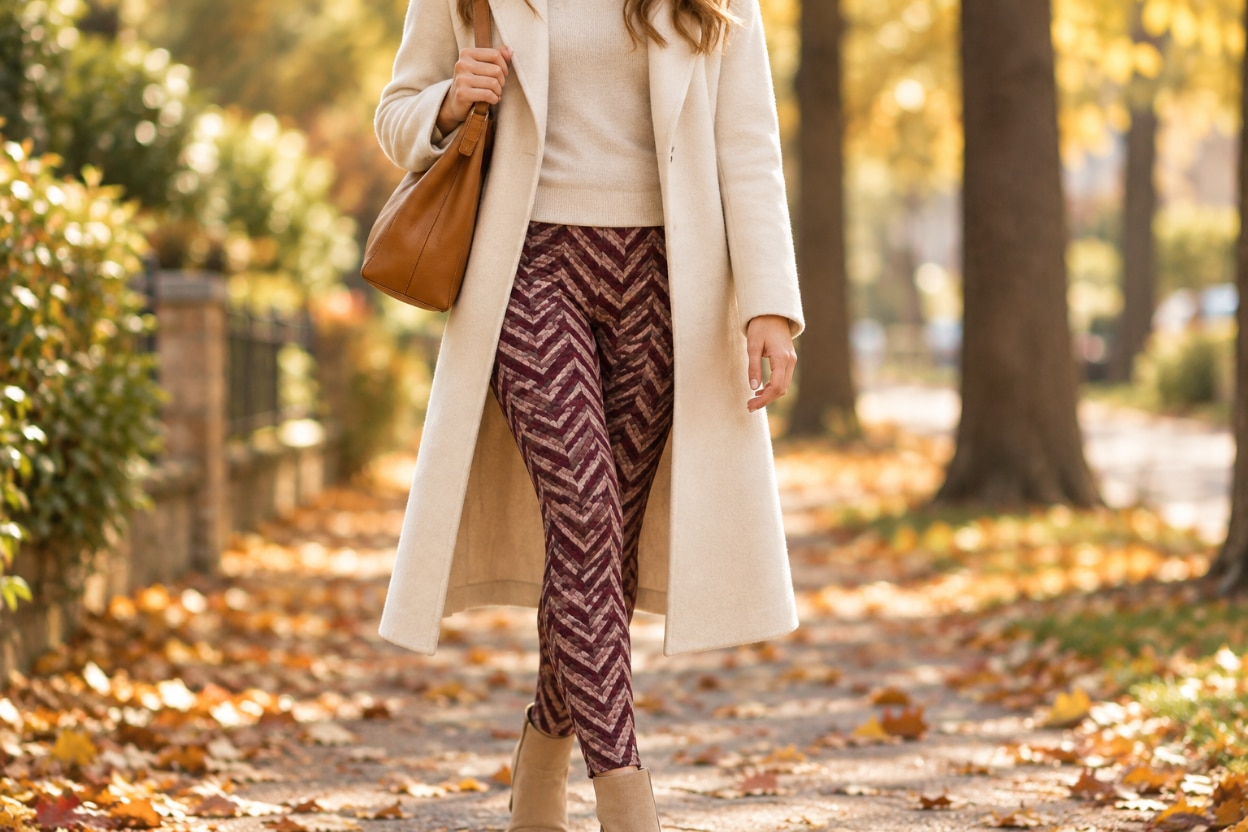
Here is a small set of ideas for building a chevron outfit around a single piece.


Common chevron mistakes to avoid
A few small choices separate a polished chevron look from a messy one.
- Wearing two competing prints at the same scale. If both are bold, neither wins.
- Choosing a stripe width that is wrong for the garment. Huge chevrons on a small area look cropped; tiny chevrons on a large area look like noise.
- Ignoring contrast. Very low contrast makes the pattern invisible; very high contrast with too many colours makes it tiring to look at.
- Expecting seams to match perfectly on every garment. Plan for close, not identical.
- Matching every accessory to the pattern. One accent colour pulled from the stripes is plenty.
How to care for chevron prints
Sharp stripes show wear faster than a busy floral, so good care helps the pattern stay crisp. Wash printed pieces inside out, use a gentle cycle and avoid very hot water. Dry flat or on a low heat setting, since high heat can dull colour and strain the fabric. We have written a practical guide on how to stop printed clothing from fading in the wash that covers this in more detail.
Dark grounds with strong stripes are especially sensitive to rubbing, so avoid abrasive surfaces and heavy friction where possible.
Is chevron a trend or a classic?
Chevron has been around far longer than any single fashion season. The shape appears in historic architecture, textiles, heraldry and military insignia, and it keeps returning because it is simple and readable. It tends to feel more modern in wide-angle, muted versions and more retro in bright, high-contrast ones.
Because the pattern is so geometric, it also fits a slower way of buying clothes: choose a design you will wear repeatedly rather than a novelty you will tire of. Our piece on slow fashion versus fast fashion explains why that matters.
If you are curious what a single pattern looks like when it is designed for a specific garment shape, start with something small and wearable.


Here are chevron hoodies for readers who prefer a single, statement piece.


Frequently asked questions
What is the chevron pattern?
The chevron pattern is a repeating design made of V-shaped stripes that meet at a clean, continuous point. The arms of each V are the same length and angle, so the pattern is symmetrical. The V can point up, down or sideways, and the stripes can be thick, thin, solid or outlined, but the unbroken peak is what makes it chevron.
What is the difference between chevron and herringbone?
A chevron has a clean, unbroken point where the two arms meet. A herringbone is made of offset blocks or short strokes, so the centre line looks stepped or staggered. Chevron looks sleek and graphic; herringbone looks more textured and traditional, as in tweed and brick floors.
Is chevron the same as zigzag?
Not exactly. Zigzag is a general term for any line that turns sharply back and forth, and it can be irregular. Chevron is a more orderly version, with parallel bands and equal angles. Shops often use the words interchangeably, so check the product image rather than relying on the label.
Where does the word chevron come from?
It comes from an Old French word meaning rafter, the angled roof beams that meet at a peak. The word later became a heraldic term for an inverted V on a shield and a name for V-shaped rank stripes on uniforms. The goat link in the Latin root is a commonly cited explanation.
What colours go well with chevron?
Navy and white, black and cream, sage and ivory, and teal and sand are dependable pairings. Limit yourself to two or three colours so the stripes stay clear. High contrast makes the pattern bold, while low contrast, such as charcoal and light grey, makes it quiet and easy to wear.
How do you wear chevron leggings?
Let the leggings be the only pattern in the outfit. Pair them with a long solid jumper, an oversized shirt or a plain tunic, and keep accessories neutral. In cooler weather, add a plain coat or cardigan. Dark ground chevron is the easiest to style and the most forgiving if the seams do not match perfectly.
Do chevron patterns match across seams on printed leggings?
They usually come close, but a perfect match at every seam is not something anyone can guarantee, because stretching and sewing shift the fabric slightly. Medium or small stripe widths hide these shifts best. Very large chevrons make any mismatch more visible, so plan around them.
Final thoughts on the chevron pattern
The chevron pattern is one of the simplest ideas in design and one of the most effective: a V, repeated. Know the differences from herringbone and zigzag, keep your palette to two or three colours, and match the stripe scale to the garment. Those three decisions do most of the work.
If you want to try it, start small. A pair of chevron leggings under a quiet layer is an easy way to find out whether the pattern suits you. When you are ready to see what is available, you can browse the Honeh shop and pick a design that is printed after you order.

-
 Price range: $22.33 through $29.17
-
 Price range: $21.38 through $28.27
-
 Price range: $22.33 through $29.17
-
 Price range: $21.38 through $28.27
-
 Price range: $22.33 through $29.17
-
 Price range: $21.38 through $28.27
-
 Price range: $22.33 through $33.99
-
 Price range: $22.33 through $29.17
-
 Price range: $22.33 through $29.17
-
 Price range: $37.58 through $41.67
Recent Comments