
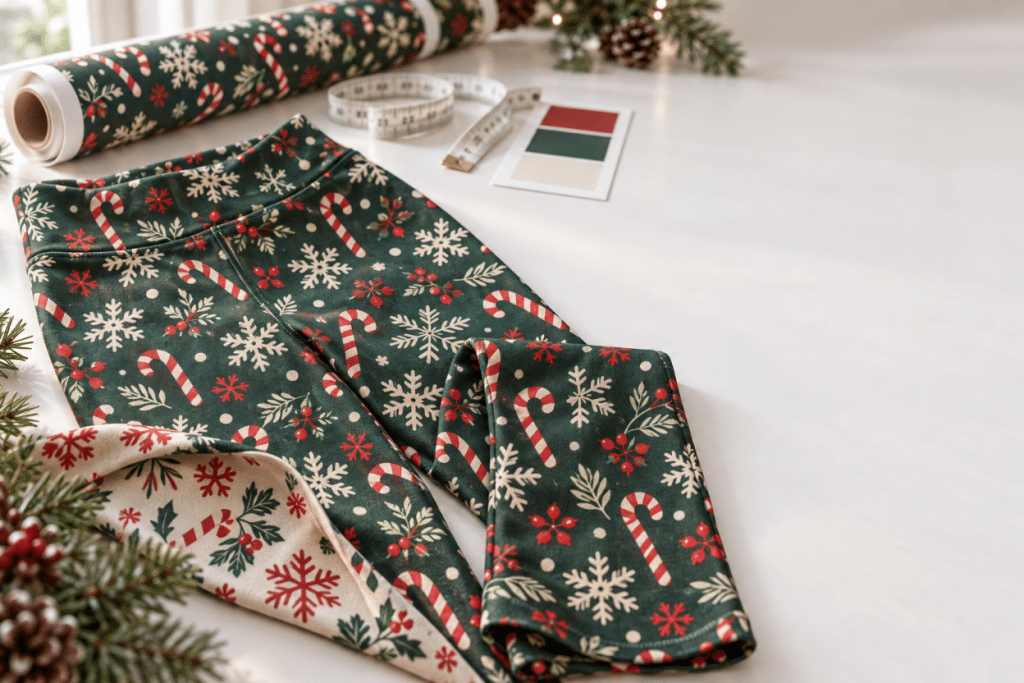
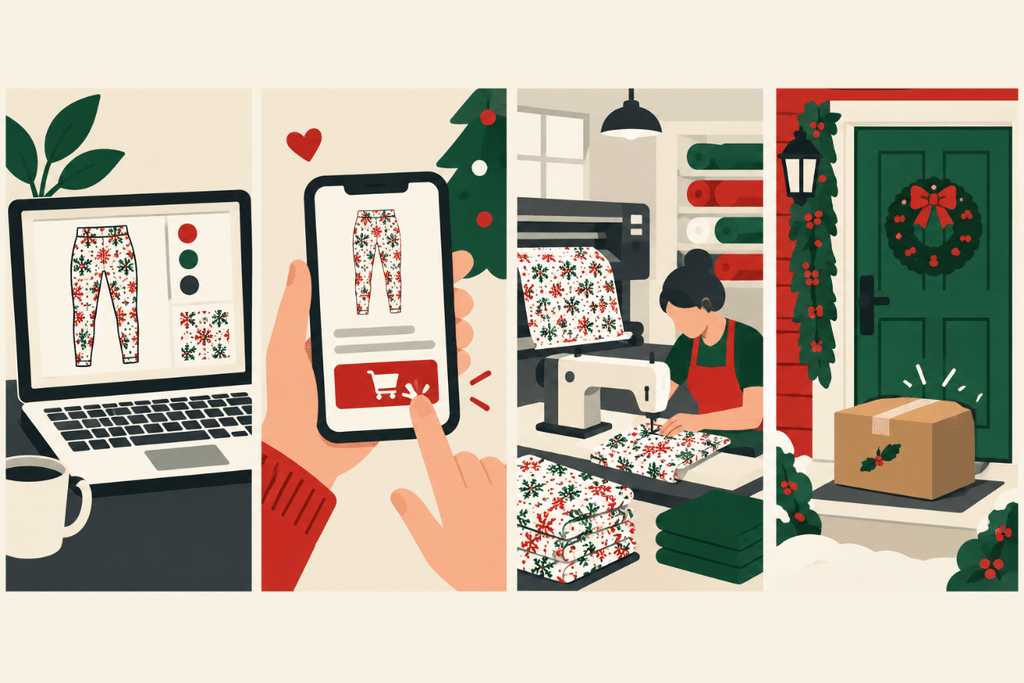
Christmas leggings with an all-over print are made in five steps: the artwork is prepared, printed in reverse onto transfer paper with special dye inks, heat-pressed into polyester fabric (dye-sublimation), cut and sewn into leggings, and then checked, packed and shipped. Honeh’s leggings are print on demand and made to order: production starts after you order, and in the US it takes about three days, followed by standard shipping of 2 to 5 business days.
This guide answers the questions people usually have before buying festive leggings online: how the pattern gets onto the fabric, why it does not sit on top like a sticker, whether “3D printed” clothing is the same thing (it is not), how long production and delivery take, how the method compares with screen printing and other options, and how to wash the leggings so the design lasts. It is written for shoppers in the US, and it is also useful if you are curious about print on demand clothing as a business model.
Key facts at a glance
- Method: all-over dye-sublimation printing on polyester-based fabric
- Production model: print on demand, made to order
- Typical timing for US orders: about 3 days production plus 2 to 5 business days standard shipping
- Not 3D printed: the print is flat, two-dimensional ink, applied with heat and pressure
- Best care: wash inside out, cold water, no bleach, low heat or air dry
Last reviewed: October 3, 2026. We update this guide when production methods, care advice or shipping information change.
Shop our Christmas leggings
What does all-over print mean on Christmas leggings?
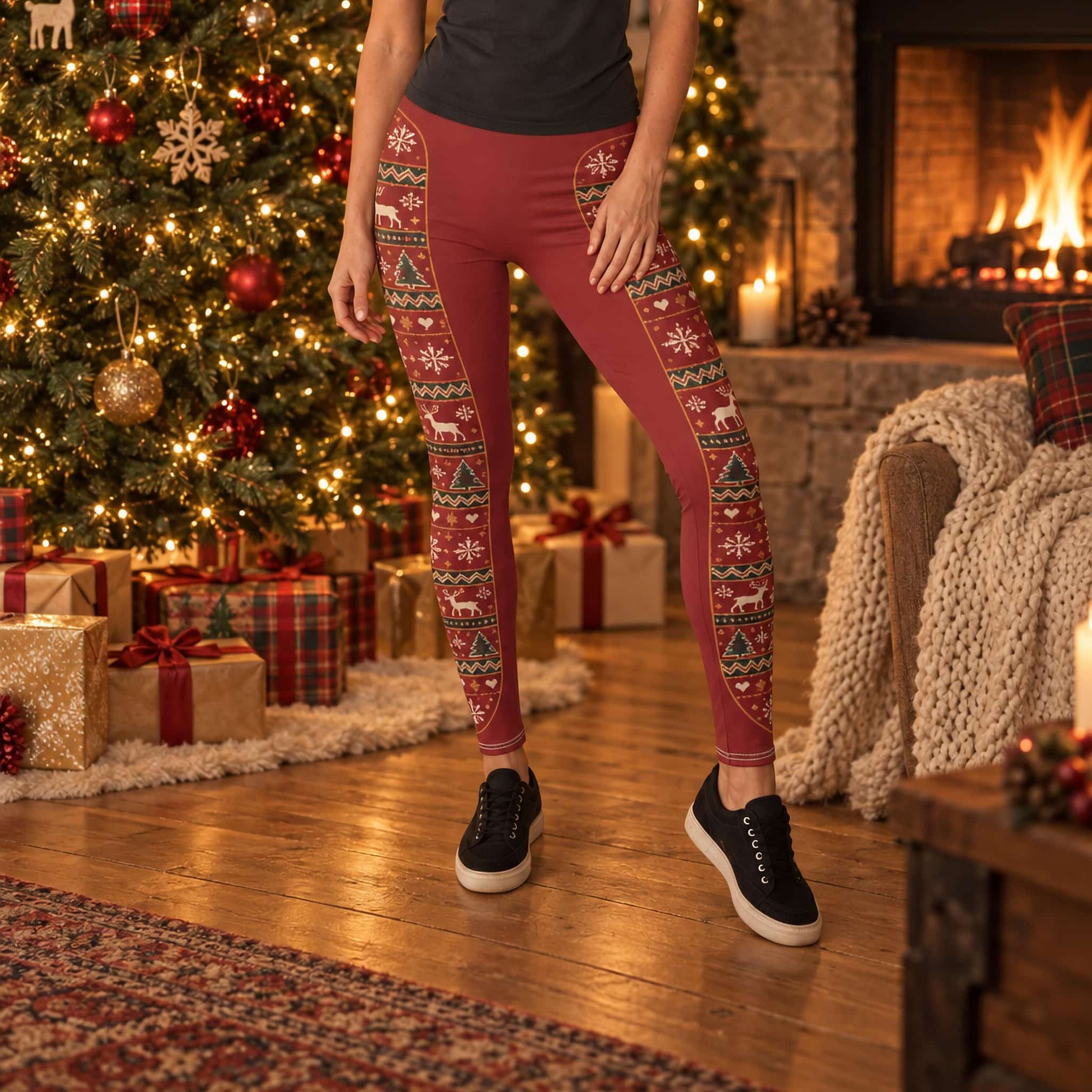
All-over print means the design covers the entire garment from seam to seam, including areas a normal print would never reach: the sides, the inner leg, the back of the knee and the waistband. Instead of printing a motif onto a finished piece, the pattern is printed onto the fabric panels first, and the leggings are sewn together afterwards. That is why a snowflake, reindeer or candy cane pattern can run uninterrupted around the whole leg.
The term appears in many forms in product titles and search results: all-over print leggings, allover print, full print, sublimated leggings and festive or holiday leggings. They all describe the same idea, a continuous design across the full surface of the garment.
How all-over print differs from a front print
A front print, such as a logo on a T-shirt, is applied to a finished garment in one area. All-over print is applied to flat fabric or flat panels, which is why the result looks seamless and why the pattern is often matched or mirrored at the seams. The trade-off is that the position of the pattern on each panel depends on how the panels are cut, so small pattern shifts at the seams are normal.
Are Christmas leggings 3D printed?
No. “3D printed clothing” and “3D printed textiles” are real search terms, and they describe something different. 3D printing builds an object layer by layer from plastic, resin or flexible filament. It is used for experimental fashion pieces, accessories and some shoe parts, and the results are usually stiff and expensive.
All-over print leggings are flat, two-dimensional prints. The ink is not built up in layers, and there is no printed structure you can feel on the surface. The design is a dye that has become part of a polyester fabric.
| Term | What it means | Applies to printed leggings? |
|---|---|---|
| All-over print | Design covers the whole garment | Yes |
| Dye-sublimation | Dye turns to gas under heat and bonds with polyester fibers | Yes |
| Print on demand | Item is produced after the order is placed | Yes, for made-to-order items |
| 3D printing | Object is built in layers from plastic or resin | No |
| Digital print | Design printed from a digital file, no screens | Yes, the transfer paper is digitally printed |
If you arrived here searching for 3D printed clothing, the practical answer is that the leggings you can buy online today are printed flat, and the three-dimensional look comes from the pattern, not from the manufacturing method.
How are all-over print Christmas leggings made, step by step?
The process below describes the common dye-sublimation workflow used for print-on-demand leggings. Details vary between production partners, but the order of the steps is the same.
Step 1: Design and file preparation
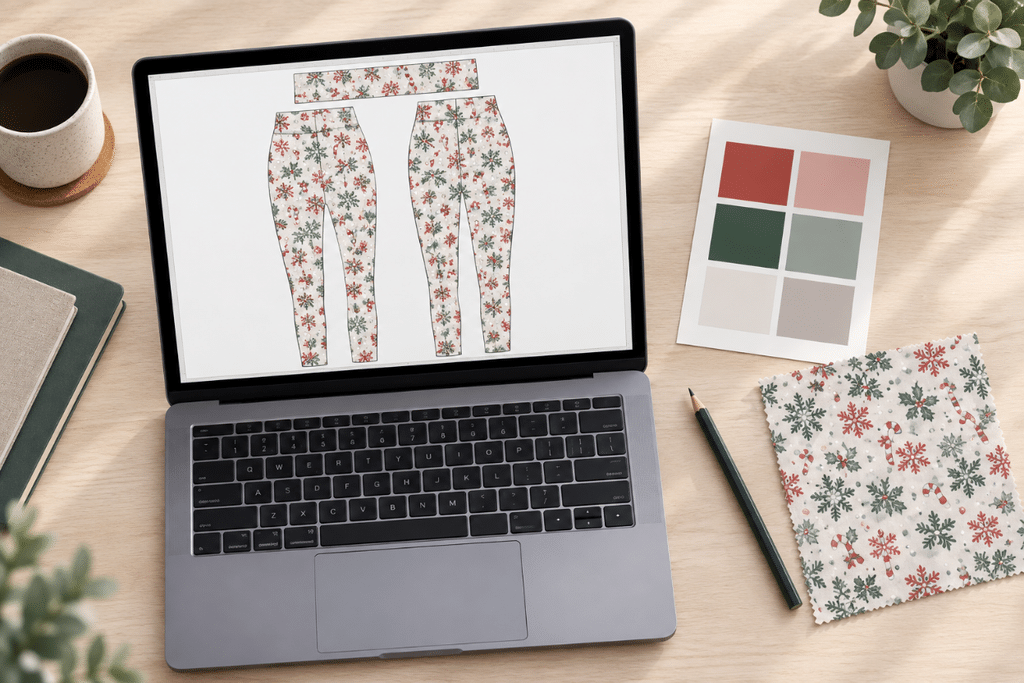
Every pair starts as a digital file. The designer builds a repeating or placed pattern, for example snowflakes, plaid, gingerbread or reindeer, on a template that matches the flat shape of each legging panel. Templates include the left leg, right leg and waistband, with a margin around each piece called bleed so that no unprinted edge shows after sewing.
Three technical points decide whether the result looks good:
- Resolution: print files are usually prepared at around 150 to 300 pixels per inch at final size, so fine details such as dots and thin lines stay sharp.
- Color profile: screens show colors with light, fabric shows them with dye. Designers soften neon or very saturated shades because sublimation inks cannot reproduce every screen color exactly.
- Pattern repeat: a seamless repeat prevents visible breaks where the pattern meets itself across the leg.
Step 2: Printing the design onto transfer paper
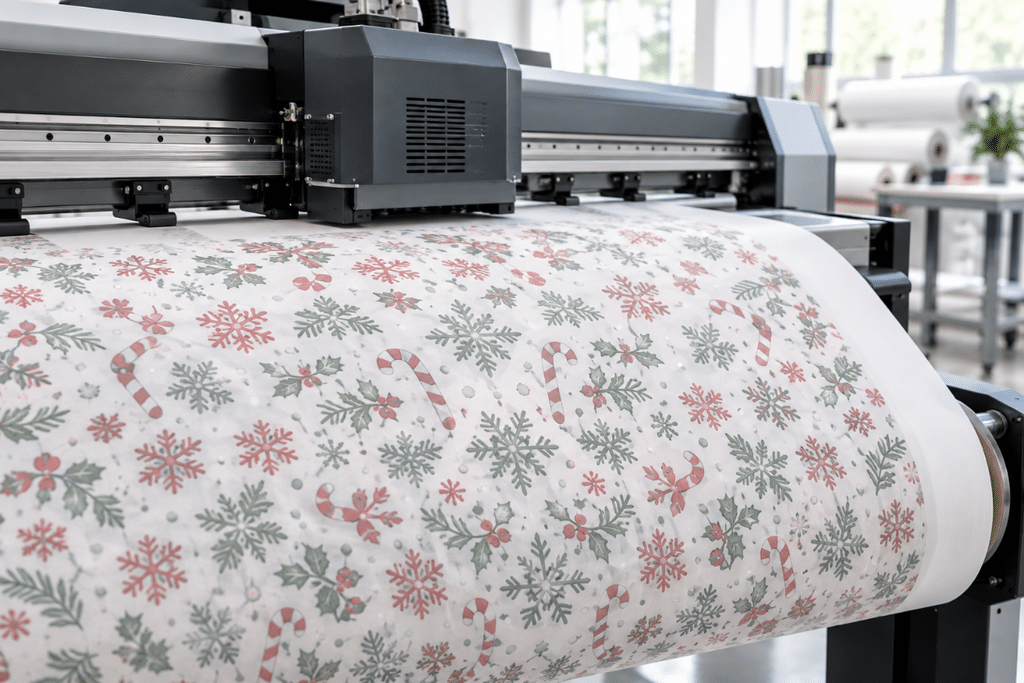
The file is printed with a large-format printer onto special heat transfer paper. Two details surprise most people. First, the design is printed as a mirror image, because it is flipped when pressed onto the fabric. Second, the inks look dull on the paper. They are sublimation dyes, which only reach their true color when heated.
The paper is coated so that it holds the dye on the surface until heat releases it. Printers in this category work with water-based dye inks, usually in four colors (cyan, magenta, yellow and black), which are mixed to create the full color range.
Step 3: Heat transfer with sublimation
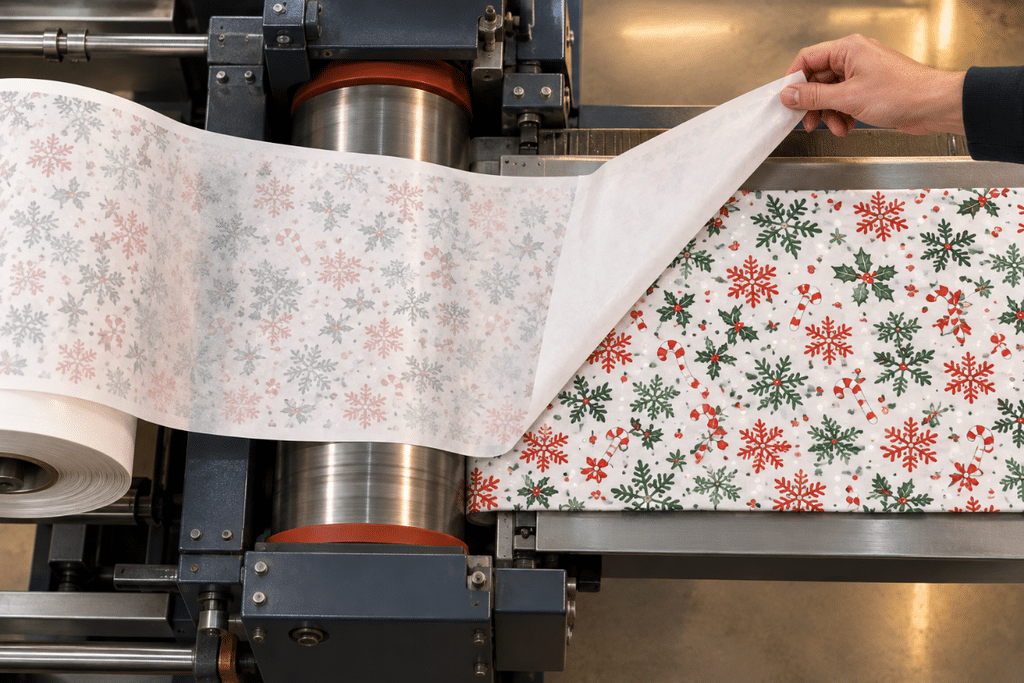
This is the step that gives the method its name. Sublimation is the change from a solid directly into a gas, skipping the liquid stage. In the heat press, the printed paper lies face down on the fabric panel. Under heat and pressure, the dye on the paper turns into a gas, enters the fibers of the polyester and then returns to a solid inside the fiber.
Typical settings for polyester are around 190 to 205 degrees Celsius (about 375 to 400 degrees Fahrenheit) for roughly one minute, though exact values depend on the equipment and fabric. Because the dye ends up inside the fiber rather than on top of it, the print has no raised layer. It does not crack or peel, and it does not add stiffness to the leggings. This is also why the method needs polyester or a high polyester blend: cotton fibers do not bond with sublimation dye.
Industrial lines often use a calender, a heated rotating drum that presses paper and fabric together as they move through, which allows long panels to be printed without a break.
Step 4: Cutting and sewing
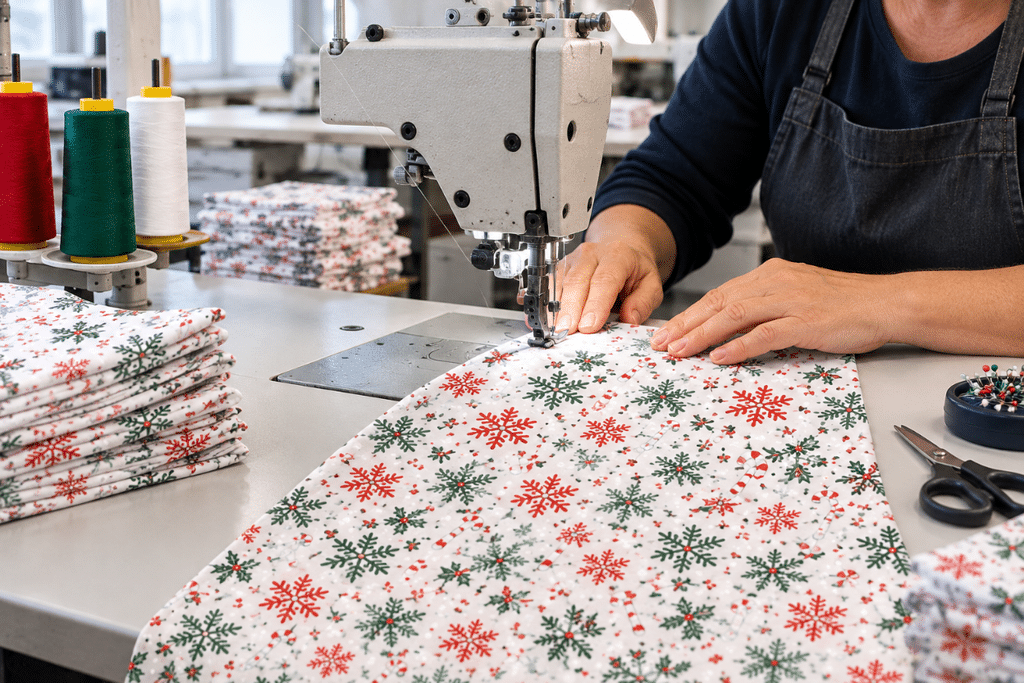
Once the panels are printed and cooled, the transfer paper is peeled off and the fabric is cut along the pattern outlines. Seamstresses then sew the pieces together. Leggings usually have an inner leg seam, an outer seam or a center back seam, a gusset in the crotch for comfort and movement, and an elastic or fabric waistband. Stretch seams, typically flatlock or overlock stitching, let the garment stretch without breaking threads.
Two cutting approaches exist. In “print then cut,” the fabric is printed first and cut afterward, which gives the best edge-to-edge pattern. In “cut then print,” the panels are cut first and then printed, which can give more consistent placement. Both are common in print on demand, and both can leave small white edges or slight pattern shifts at seams. Those are normal for all-over printing.
Step 5: Quality check, packing and shipping
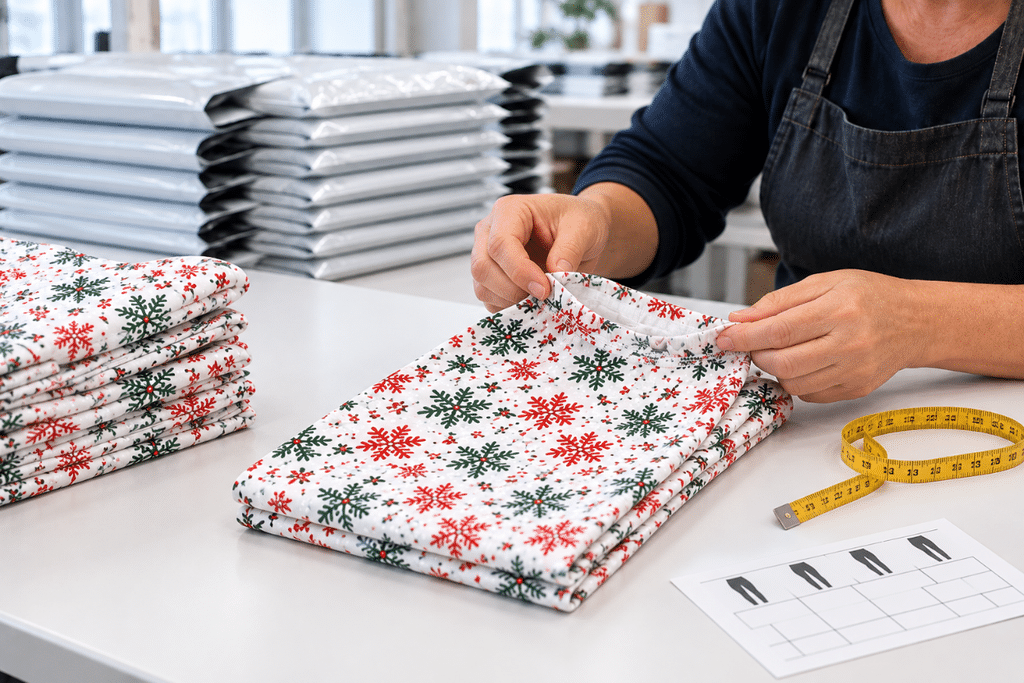
Finished leggings are inspected for print defects, loose threads, seam strength and size accuracy against the size chart. Our production partner runs a quality control program that checks incoming materials, work in progress and finished products, and uses the results for continuous improvement. Items that pass are poly-bagged with a suffocation warning label and shipped in approved mailer bags or boxes.
For US orders, production takes about three days on average, and standard shipping takes 2 to 5 business days, so most orders arrive in roughly a week. Shipping to Alaska, Hawaii, Puerto Rico and US territories can take an additional 7 to 12 business days. Delivery is slower in the holiday season, so always check the estimate on the product page before ordering gifts.
What does made to order and print on demand mean for you?
Print on demand means a product is produced only after a customer orders it. The shop owner designs the product and sets the price, a production partner prints, sews and ships it, and no inventory is stored in advance. For customers, this model has a few practical consequences.
- Delivery includes production time. Production of about three days is added to shipping, so US orders typically arrive in about a week, a little longer than for items that are already in stock. Order Christmas gifts early, ideally by the end of the first week of December or sooner.
- Sizes and designs are broader. Because nothing is pre-made, a shop can offer many patterns and the full size range without stocking each combination.
- Less unsold stock. Items are produced against real orders, which reduces overproduction compared with large seasonal runs. This is a benefit of the model, but it does not make the garment itself sustainable, and fabric choice and shipping still matter.
- Returns follow the shop’s policy. Because each item is made for you, return rules for made-to-order items can be stricter than for stock items. Read our shipping and return policy before ordering.
Who actually makes the leggings?
Honeh works with a print-on-demand production partner through Printify, which connects shops to independent print providers. Our provider uses dye-sublimation and direct-to-fabric printing equipment with water-based inks. Because providers differ, two shops selling similar-looking leggings can deliver different fabric weight, stitching quality and delivery times. When you compare shops, look for a clear size chart, real product photos, a stated production time and a plain return policy.
Sublimation vs screen printing vs DTG vs heat transfer vinyl: which print method is best?
If you search for how clothes are printed, you will find four methods again and again. Each has a place, and sublimation is the one that makes all-over designs on polyester practical.
| Method | How the design is applied | Fabric | All-over coverage | Feel on the fabric | Typical use |
|---|---|---|---|---|---|
| Dye-sublimation | Dye turns to gas and bonds with fibers | Polyester or high polyester blend | Yes, edge to edge | No raised layer | Leggings, sportswear, blankets, mats |
| Screen printing | Ink pushed through a stencil onto the surface | Cotton, blends, many others | Rarely, one screen per color | Noticeable ink layer | Large runs of T-shirts, merchandise |
| DTG (direct to garment) | Inkjet printer prints on a finished garment | Mostly cotton | Limited by print area | Soft, slightly flat ink layer | Single T-shirts and hoodies, full-color front prints |
| Heat transfer vinyl (HTV) | Cut vinyl pressed onto the garment | Many fabrics | No | Plastic-like layer | Names, numbers, simple designs |
Why sublimation suits leggings
Leggings need to stretch, recover and move with the body. A layer of ink or vinyl on the surface can crack or lose its shape as the fabric stretches. Sublimation avoids this because the dye is inside the fiber. Polyester also holds shape, resists wrinkles and dries quickly, which is why it is common in leggings and activewear.
Limits of sublimation
- It works only on polyester or high polyester blends, so cotton leggings cannot be sublimated.
- Light fabrics take the color best. Dark fabrics cannot be sublimated because the dye is transparent.
- Very bright screen colors may print slightly softer than they appear on a monitor.
- Small white edges can appear at the seams, because stretched fabric exposes unprinted fibers at the stitching line.
Being open about these limits matters when you buy online. They are properties of the method, not defects, and they apply to almost every all-over print legging on the market.
What fabric are printed leggings made of, and how do you wash them?
Most sublimated leggings are made of polyester, often blended with a small share of elastane (also called spandex or Lycra) for stretch. A common blend is around 90 to 95 percent polyester and 5 to 10 percent elastane, though the exact composition is listed on each product page. Polyester gives the fabric its shape and color retention. Elastane gives the stretch and recovery.
What to look for in the fabric
- Weight: fabric weight is often given in grams per square meter (gsm). Lightweight fabric around 150 to 200 gsm feels breathable, while heavier knits around 220 gsm and above are more opaque and warmer.
- Four-way stretch: the fabric stretches both across and along the length, which helps leggings stay opaque when you bend.
- Opacity: hold the fabric to the light or do a squat test in front of a mirror. Light colors and thin fabric show more.
- Seams: flat, even stitching and a secure waistband matter more than the print for long-term comfort.
How long does a sublimated print last?
Because the dye is inside the fiber, the print does not peel, crack or flake. Over many washes, polyester can pill, and the colors can fade slowly with heat, harsh detergent and sunlight, but the design does not wear off the way a screen print or vinyl can. The care steps below slow down that fading.
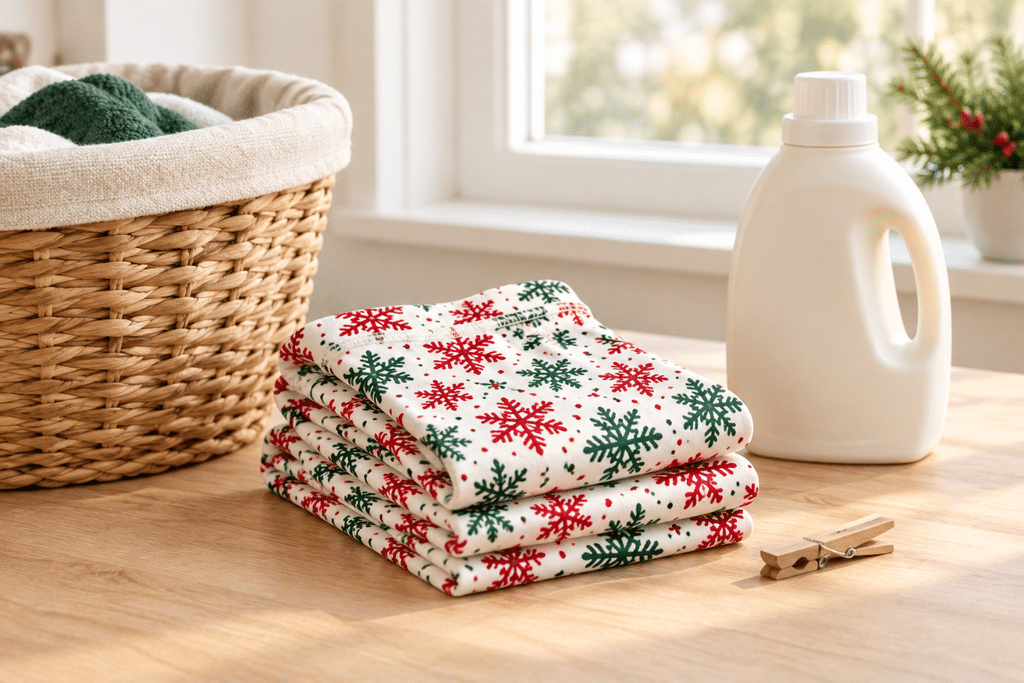
Care instructions for printed Christmas leggings
- Turn the leggings inside out before washing to reduce friction on the printed side.
- Wash in cold water on a gentle cycle with a mild detergent.
- Wash with similar colors for the first two washes, since a small amount of loose dye can occasionally release.
- Skip bleach and fabric softener. Softener can leave a film on polyester and reduce stretch.
- Air dry flat or hang, or use low heat in the dryer. High heat can damage elastane and speed up fading.
- Do not iron the printed side. If needed, iron inside out on a low setting.
Always follow the care label on your own pair, since the production partner’s instructions take priority.
How do you choose good festive leggings online?
Buying printed leggings online means you cannot touch the fabric, so the product page has to do that work. This checklist helps you compare festive leggings from any shop.
- The fabric blend is stated (for example polyester and elastane), with weight if available
- A size chart with measurements in inches and centimeters is shown, not only size letters
- Photos show the real product on a body, including the back and the waistband
- The pattern placement is explained, for example all-over print with seams that may shift slightly
- Production time and shipping time are stated separately, with an estimate for the US
- The return and exchange policy is clear for made-to-order items
- Care instructions are available before you buy
Sizing tips
Compare your waist, hip and inseam measurements with the size chart rather than choosing your usual size. If you are between sizes, the stretch of an elastane blend usually makes the smaller size snug and the larger size relaxed. All-over prints can look larger or smaller depending on the size, because the pattern scales with the panels.
Pattern and styling ideas
- Small repeats such as snowflakes or dots read as a subtle texture and work with a plain sweater or long tunic.
- Bold motifs such as reindeer or large candy canes are the statement piece. Pair them with solid, neutral tops.
- Plaid and tartan works for dinners and office parties, and pairs well with boots and a blazer.
- Color planning: choose one or two colors from the leggings for the rest of the outfit to keep it balanced.
Christmas leggings as a gift
Because leggings are made to order, a gift needs a little lead time. Order early, check the size carefully, and consider including a note about the size so the recipient knows what to expect. If you are unsure of the size, a gift card can be the safer choice.

Frequently asked questions about how Christmas leggings are made
Are all-over print leggings the same as sublimated leggings?
Usually yes. All-over print describes the look, a design across the whole garment. Sublimation is the most common method used to achieve it on polyester.
Is the print on Christmas leggings 3D printed?
No. The print is flat. 3D printing builds objects layer by layer from plastic or resin, which is a different technology.
Will the design wash out or peel?
A sublimated design does not peel or crack because the dye is inside the fibers. Colors can fade gradually with heat, harsh detergent and sun, so wash cold and air dry when you can.
Why are the colors on my screen different from the leggings?
Screens emit light, and fabric reflects it. Dye inks also cover a smaller color range than a screen. Small differences in shade are normal, and very bright neon colors are the hardest to match.
Why is there a white line at the seam?
Fabric stretches when you wear it, and the unprinted fibers at the stitching line can show. This is a known property of all-over printing, not a sign of a defective pair.
How long does a made-to-order pair take to arrive?
For the US, plan for about three days of production plus 2 to 5 business days of standard shipping, so roughly one week. Orders to Alaska, Hawaii, Puerto Rico and US territories can take an additional 7 to 12 business days. Allow more time in November and December.
Can I print on cotton leggings with sublimation?
No. Sublimation dye bonds with polyester. Cotton needs another method such as DTG or screen printing, which cannot easily cover the whole garment.
Are print on demand leggings good quality?
Quality depends on the production partner and the fabric, not on the model itself. Check fabric composition, stitching, reviews and the size chart before buying.
Is made-to-order clothing better for the environment?
It reduces unsold stock because items are made only when ordered. The environmental impact still depends on the fabric, the dyes, the energy used in production and shipping distance. Polyester is a synthetic fiber, so washing less often and at low temperatures helps limit microfiber release.
How should I care for printed leggings?
Wash inside out in cold water, avoid bleach and softener, and air dry or tumble dry on low.
Shop our Christmas leggings
About the author
Written by the Honeh team at Boudmedia LLC, which runs honeh.com, a US-focused online shop for print-on-demand home and fashion products. Product details in this guide are based on information from our production partner.

-
 Price range: $22.38 through $29.07
 -
 Price range: $22.38 through $29.07
 -
 Price range: $22.38 through $29.07
 -
 Price range: $21.43 through $28.17
 -
 Price range: $22.38 through $29.07
 -
 Price range: $22.38 through $29.07
 -
 Price range: $22.38 through $29.07

Recent Comments