
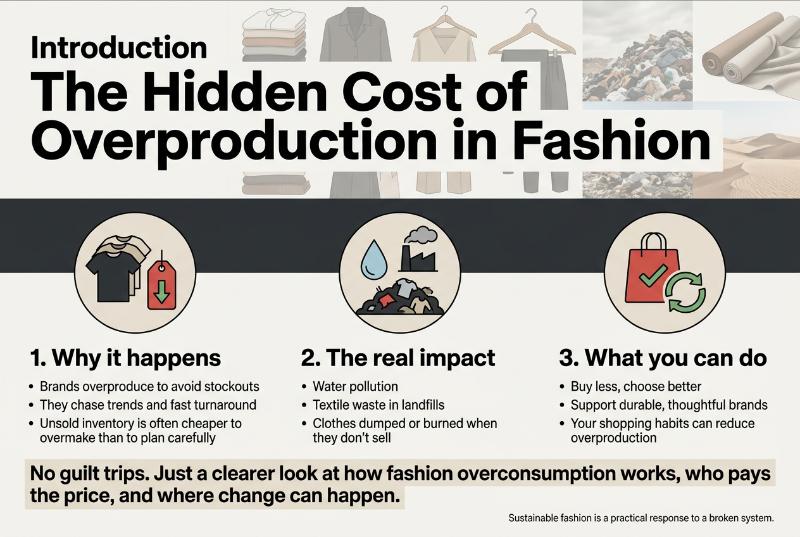
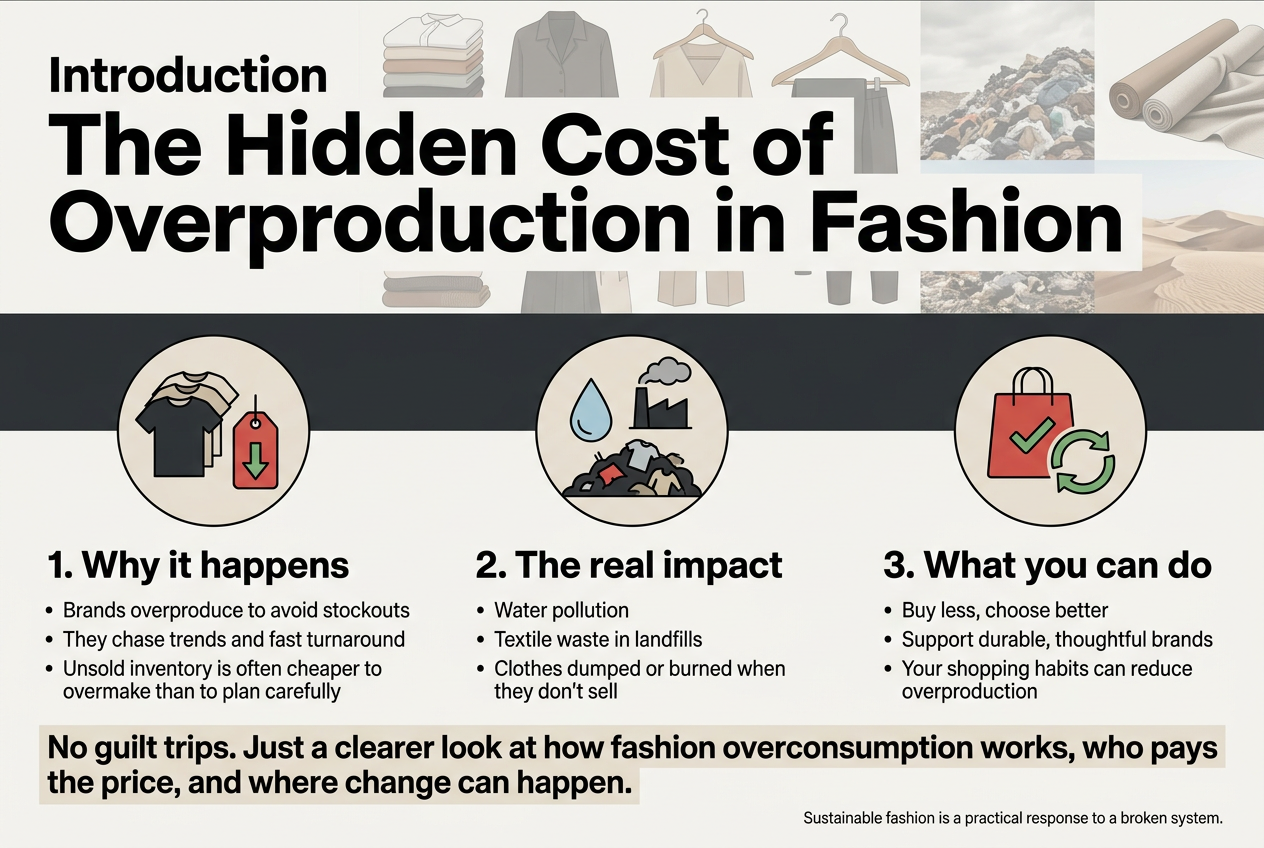
The hidden cost of overproduction in the fashion industry.
The Hidden Cost of Overproduction in Fashion
You’ve probably seen the headlines — mountains of unsold clothing dumped in deserts, fast fashion hauls gone viral, and brands quietly burning stock they can’t move. But the hidden costs of fast fashion go way deeper than a shocking photo.
This post is for you if you shop clothes regularly, work in retail, or just want to understand why the fashion industry waste problem keeps getting worse despite all the “sustainability” talk.
Here’s what you’ll walk away knowing:
- Why fashion overproduction happens and why brands keep doing it even when the math doesn’t add up
- The real environmental impact of fashion — from water pollution to the textile waste problem piling up in landfills
- What you can actually do about it — because your shopping habits have more power over overproduction in the fashion industry than you might think
No guilt trips here. Just a straight look at how fashion overconsumption works, who pays the price, and where things can realistically change. By the end, you’ll see sustainable fashion less as a buzzword and more as a practical response to a system that’s genuinely broken.
Let’s get into it.
Key Takeaways
- The fashion industry produces 80-150 billion garments a year — far more than the market actually needs.
- Unsold clothing ends up in landfills, incinerators, or discount channels — none of them a real fix.
- Print-on-demand and made-to-order models eliminate unsold inventory by only producing what’s already bought.
- Your purchasing choices are one of the few real levers you have on how much gets overproduced.
Understanding Overproduction in the Fashion Industry
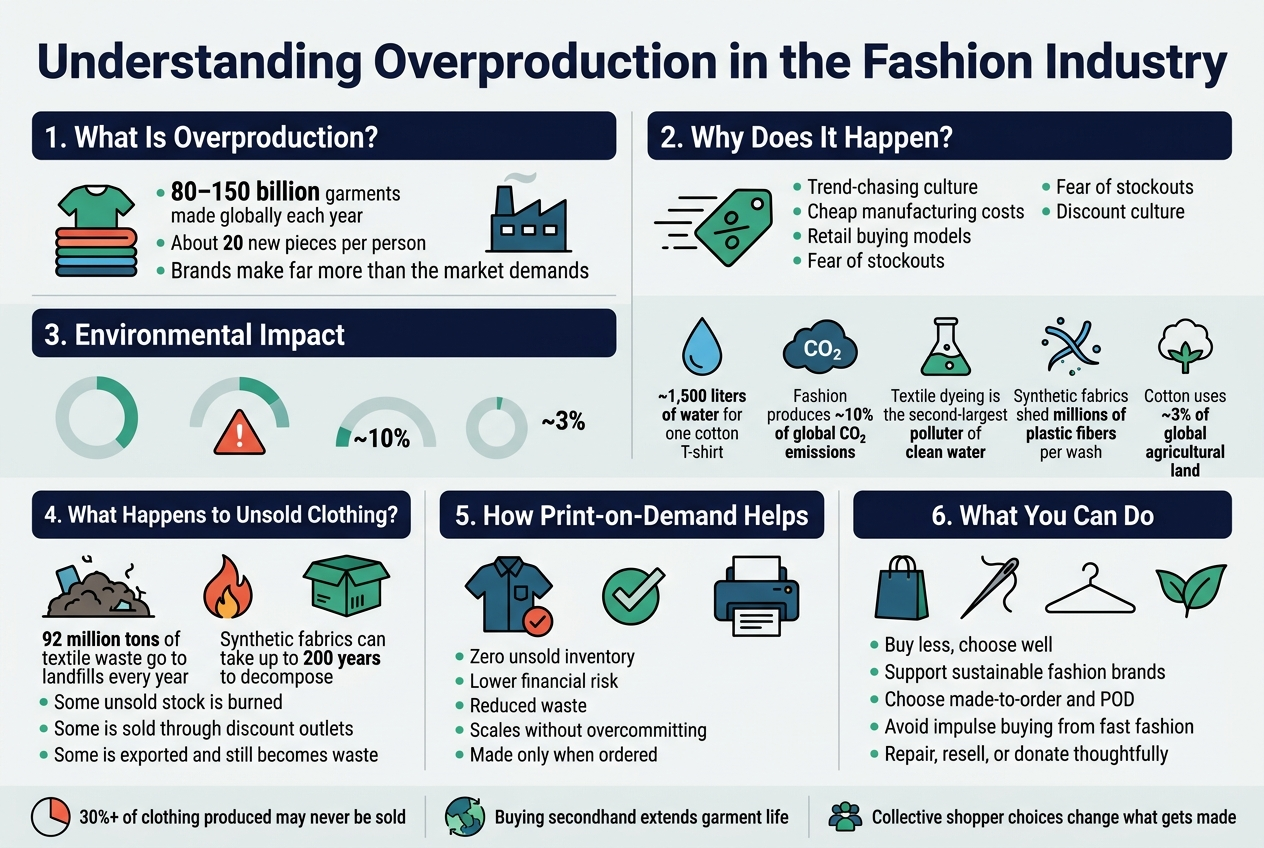
Understanding what overproduction means and how it impacts fashion manufacturing.
What Is Overproduction in Fashion?
Every year, the fashion industry produces somewhere between 80 and 150 billion garments globally. That’s roughly 20 new pieces of clothing for every single person on Earth. When you think about it that way, something clearly doesn’t add up.
Fashion overproduction happens when brands manufacture far more clothing than the market actually demands. Fast fashion labels churn out new collections every few weeks, betting on volume over precision. The logic is simple — produce more, sell more. But the reality is that a massive chunk of what gets made never gets worn, or gets worn just once and discarded.
You’re not imagining it when your favorite store seems to have endless stock that never runs out. That abundance isn’t a supply chain miracle — it’s a deliberate strategy that comes at a serious cost.
Why Does Overproduction Happen?
A few key forces drive this cycle:
- Trend-chasing culture — Brands compete to be first with the latest look, pushing production timelines so tight that accuracy takes a back seat to speed.
- Cheap manufacturing costs — When it costs next to nothing to produce a garment overseas, overordering feels like a safe buffer rather than a gamble.
- Retail buying models — Traditional retailers order in bulk months ahead of season, often guessing wrong about what shoppers will actually want.
- Fear of stockouts — Brands would rather have too much than too little, since an empty shelf feels worse than a full warehouse.
- Discount culture — Overproduction feeds the cycle of sales, which trains you to wait for markdowns, which then pushes brands to produce even more to protect their margins.
The fashion overconsumption problem isn’t just about you buying too much. A huge part of it starts long before anything even hits the shelf.
The Environmental Impact of Overproduction
The environmental impact of fashion goes well beyond the clothes you donate or throw away.
Here’s a snapshot of what the production process alone does:
| Environmental Issue | Scale of Impact |
|---|---|
| Water consumption | ~1,500 liters to produce a single cotton t-shirt |
| Carbon emissions | Fashion accounts for ~10% of global CO₂ emissions |
| Chemical pollution | Textile dyeing is the second-largest polluter of clean water globally |
| Microplastic pollution | Synthetic fabrics shed millions of plastic fibers per wash |
| Land use | Cotton farming uses ~3% of global agricultural land |
When you factor in that a significant portion of those resources go into clothing that never gets sold or worn, the waste becomes almost incomprehensible. The hidden costs of fast fashion aren’t abstract — they show up in depleted water tables, polluted rivers, and a warming climate.
What Happens to Unsold Clothing?
This is the part the fashion industry would rather you didn’t think about too hard.
When clothes don’t sell, brands have a few options — and none of them are great:
- Landfill — An estimated 92 million tons of textile waste ends up in landfills every year. Synthetic fabrics can take up to 200 years to decompose.
- Incineration — Some luxury brands have been caught burning unsold stock to protect brand exclusivity. H&M, Burberry, and others have faced public backlash for exactly this.
- Discount channels and overstock outlets — Some inventory gets offloaded at deep discounts, which deflates brand value and still requires transportation and energy.
- Export to developing countries — Massive bales of used and unsold Western clothing get shipped to markets in Ghana, Kenya, and Chile, where they often overwhelm local textile industries and still end up as waste.
The textile waste problem isn’t a neat, invisible process. It’s a global chain of consequences that eventually lands somewhere — and somewhere is usually already marginalized.
How Print-on-Demand Solves the Overproduction Problem
Print-on-demand (POD) flips the traditional model. Instead of producing thousands of units upfront and hoping they sell, a garment is only made when someone actually orders it.
For you as a brand, designer, or creator, this means:
- Zero unsold inventory — You don’t carry stock, so there’s nothing to discard.
- Lower financial risk — You’re not betting money on bulk orders that may not move.
- Reduced waste — Production happens on demand, which cuts down unnecessary manufacturing significantly.
- Scalability without overcommitting — You can offer a wide range without producing a single item until it’s purchased.
For shoppers, it means the item you’re buying was made specifically for you — not pulled from a warehouse of thousands of identical pieces that may eventually be burned or buried.
It’s not a perfect system, and shipping and packaging still carry a footprint. But when you compare it to the scale of traditional fashion overproduction, it’s a meaningful step in the right direction. It’s exactly why we at Honeh build our own collections around made-to-order production instead of guessing at demand months in advance.
“Designer Tip: Before buying anything new, ask if you’d still want it if it took two weeks to arrive instead of two days. If the answer is no, that’s worth paying attention to.” — Elena M.
What You Can Do as a Conscious Shopper
You have more leverage than you might think. Here’s how to use it:
- Buy less, choose well — Prioritize quality over quantity, and ask yourself if you’ll actually wear something 30+ times before buying.
- Support sustainable fashion brands — Look for labels that are transparent about their production processes and supply chains.
- Choose made-to-order and POD options — When available, these are inherently lower-waste choices.
- Avoid impulse buying from fast fashion — The fast fashion consequences aren’t just environmental; the workers in the supply chain carry much of that cost too.
- Repair, resell, or donate thoughtfully — Extend the life of what you own before it enters the waste stream.
FAQ
Q: How much clothing goes unsold each year?
Estimates suggest 30% or more of all clothing produced never gets sold.
Q: Is sustainable fashion more expensive?
Often yes, upfront — but cost-per-wear is usually far lower, making it better value over time.
Q: Does buying secondhand help?
Absolutely. It extends garment life and reduces demand for new production.
Q: Can one person’s choices actually make a difference?
Your individual choices signal demand to brands. Collective shifts in buying behavior genuinely change what gets made.
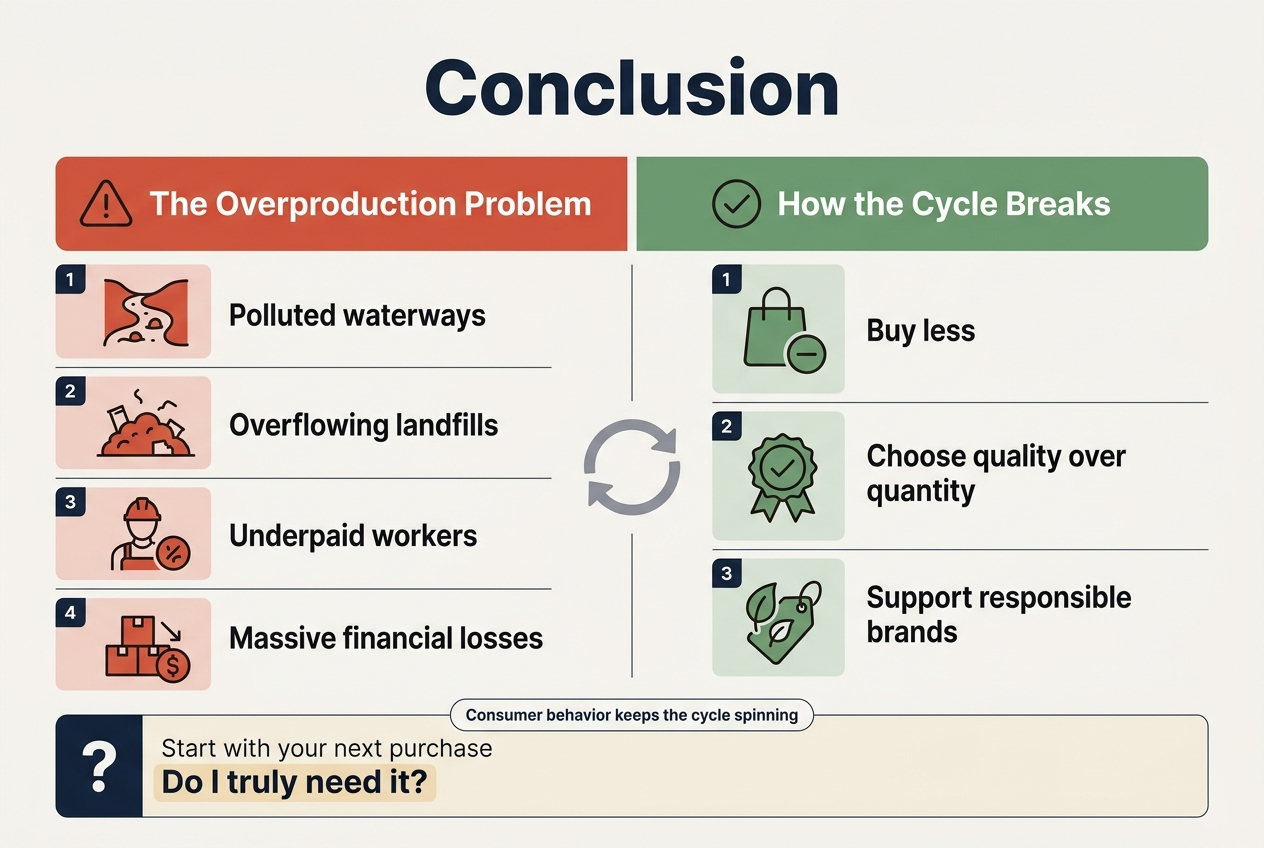
Made-to-order and print-on-demand clothing as practical ways to reduce fashion overproduction.
The fashion industry’s overproduction problem runs deeper than most people realize. Every unsold garment comes with a price — polluted waterways, overflowing landfills, underpaid workers, and brands quietly absorbing massive financial losses. And at the center of it all is consumer behavior, which keeps the cycle spinning. Knowing how your shopping habits connect to these bigger issues is the first step toward changing things.
The good news is that breaking this cycle doesn’t require a dramatic lifestyle overhaul. Small, intentional choices — buying less, choosing quality over quantity, supporting brands that produce responsibly — actually make a difference. The power to slow down the overproduction machine is more in your hands than you might think. Start with your next purchase and ask yourself if you truly need it. That one question can go a long way.
Tell Us What You Think
Have you changed how you shop after learning how much gets overproduced? Share your thoughts in the comments — we’d love to hear them.

-
 Price range: $22.38 through $29.07
 -
 Price range: $22.38 through $29.07
 -
 Price range: $22.38 through $29.07
 -
 Price range: $21.43 through $28.17
 -
 Price range: $22.38 through $29.07
 -
 Price range: $22.38 through $29.07
 -
 Price range: $22.38 through $29.07

Recent Comments