

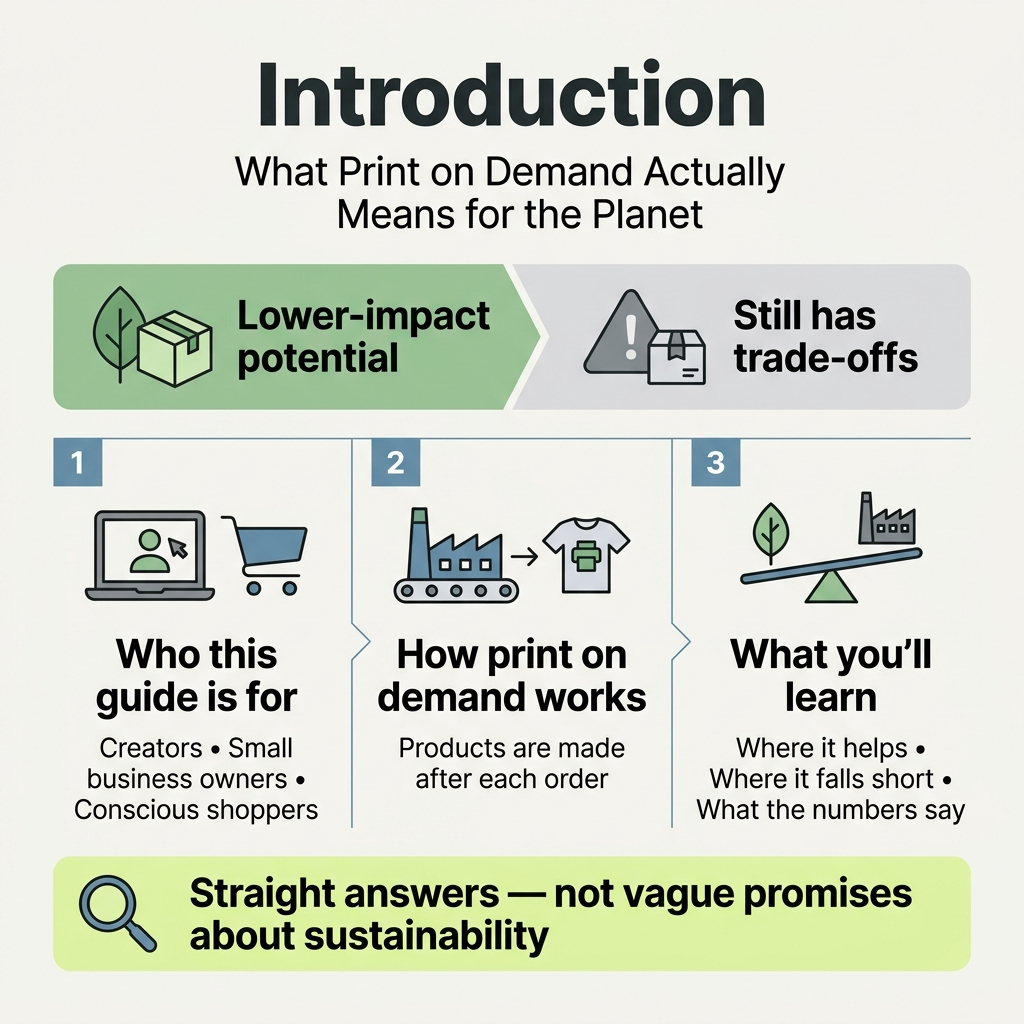
Print on demand clothing production and what it actually means for the environment.
What Print on Demand Actually Means for the Planet
If you’ve been curious about whether print on demand is genuinely better for the environment or just another green-sounding trend, you’re in the right place.
This guide is for creators, small business owners, and conscious shoppers who want straight answers — not vague promises about sustainability.
Here’s what you’ll walk away knowing: how the print on demand model actually works behind the scenes, where it holds up as a lower-impact alternative to traditional manufacturing, and where it still falls short despite the hype. No cheerleading, no doom-scrolling — just an honest look at what the numbers and trade-offs actually tell you.
Key Takeaways
- Print on demand eliminates unsold inventory by only manufacturing an item after it’s ordered.
- It’s a meaningful improvement over mass production, but not a zero-impact solution — shipping, dyes, and base fabrics still carry a footprint.
- Fabric quality matters as much as the production model — a shirt that falls apart fast isn’t sustainable no matter how it was made.
- Comparing print on demand to fast fashion shows the real gap is in waste, not in perfection.
How Print on Demand Actually Works
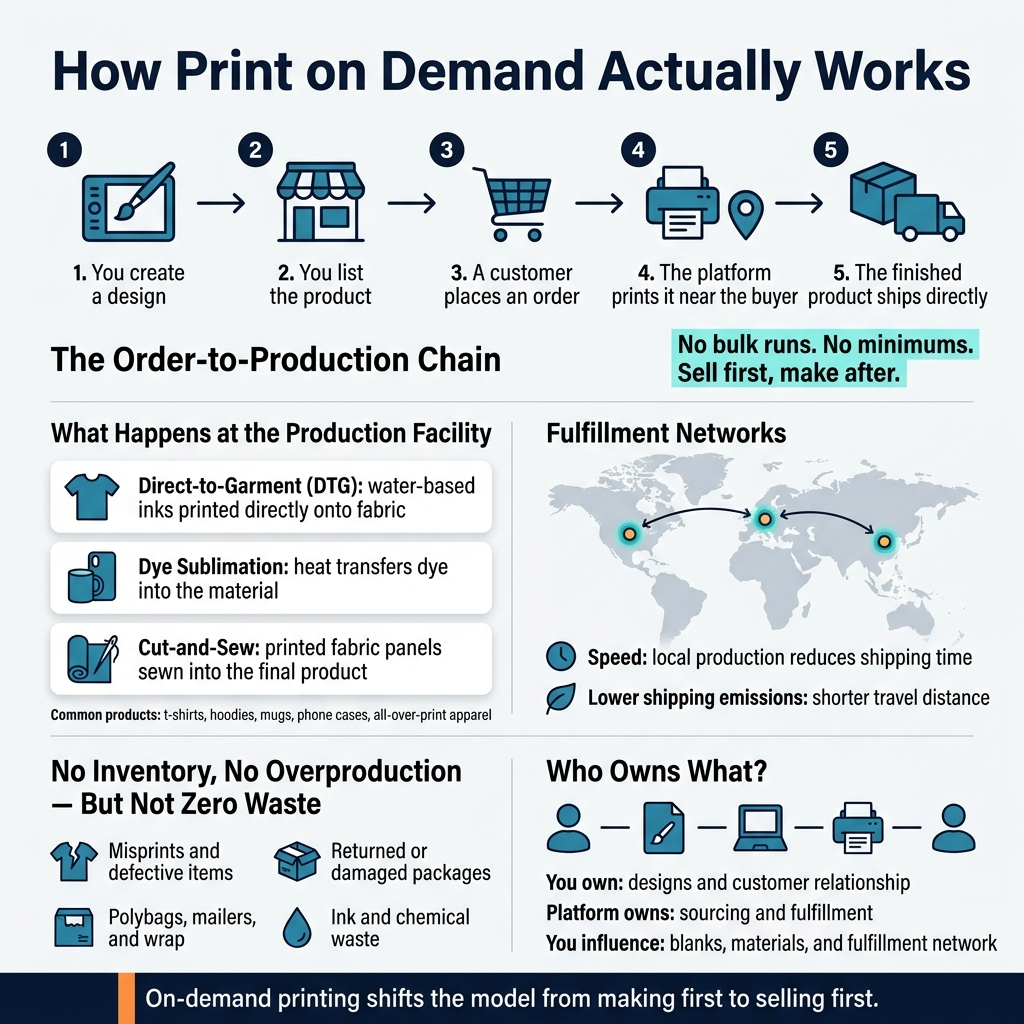
The order-to-production chain that defines how print on demand clothing manufacturing works.
The Order-to-Production Chain
When someone buys a t-shirt, a mug, or a tote bag from a print on demand store, something pretty different happens compared to traditional retail. Nothing gets made until you — or your customer — actually places an order. There’s no warehouse stacked floor-to-ceiling with unsold hoodies. There’s no factory running overnight shifts to fill a purchase order that may or may not pan out.
Here’s the basic flow of how it works:
- You create a design and upload it to a print on demand platform (think Printful, Printify, Gelato, or similar services).
- You list the product in your online store — Shopify, Etsy, or wherever you sell.
- A customer places an order.
- The platform prints the item at a production facility, usually one geographically close to the customer.
- The finished product ships directly to the buyer, often without you ever touching it.
That’s it. No bulk manufacturing runs. No minimum order quantities. No guessing how many units will sell this quarter.
This on-demand model flips the traditional production logic on its head. Instead of making first and selling later, you’re selling first and making after.
What Actually Happens at the Production Facility
The printing itself uses a few different technologies depending on the product type. The most common method you’ll encounter is Direct-to-Garment (DTG) printing, where a specialized inkjet printer applies water-based inks directly onto fabric. Think of it like printing a document, but the “paper” is a cotton t-shirt.
For hard goods — phone cases, mugs, canvas prints — you’re more likely to see dye sublimation, where heat transfers dye into the material at a molecular level, creating vibrant, durable prints.
Other items might use cut-and-sew production, where fabric panels are printed individually before being sewn into the final garment. This is common for all-over-print apparel.
Each method has its own environmental footprint, which is worth understanding:
| Printing Method | Common Products | Key Inputs |
|---|---|---|
| Direct-to-Garment (DTG) | T-shirts, hoodies, tote bags | Water-based inks, electricity, water for pre-treatment |
| Dye Sublimation | Mugs, phone cases, polyester apparel | Heat, sublimation inks, polyester-coated substrates |
| Cut-and-Sew | All-over-print garments | Fabric rolls, dye inks, labor for sewing |
| Embroidery | Hats, bags, patches | Thread, backing material, electricity |
The Role of Fulfillment Networks
One of the less obvious parts of the print on demand model is where production actually happens. Platforms like Gelato have built global fulfillment networks with production partners in dozens of countries. When your customer in Germany orders a poster, it doesn’t get printed in New Jersey and shipped across the Atlantic — it gets produced at a facility in Europe.
This matters for two reasons: speed and shipping emissions. Local production dramatically cuts down the distance a package travels, which is one of the more meaningful environmental variables in the whole supply chain.
That said, not every platform operates this way. Some still rely on a handful of centralized production hubs, which means a customer in Australia might still receive something shipped from the United States. If you care about minimizing your store’s carbon footprint, the geographic distribution of your fulfillment partner’s network is actually worth paying attention to when choosing a platform.
No Inventory, No Overproduction — But Not Zero Waste
The no-inventory model sounds like a clean solution, and in many ways it is. You’re not sitting on 500 units of a design that stopped selling in March. You’re not sending leftover stock to landfill at the end of a season. Every item that gets produced has already been paid for by a real buyer.
But “no inventory waste” doesn’t mean “zero waste.” There are still:
- Misprints and defective items that get discarded during quality control
- Returned or damaged packages that often can’t be resold and end up destroyed
- Packaging materials — polybags, cardboard mailers, plastic wrap — that vary widely in recyclability depending on the fulfillment partner
- Ink and chemical waste from the printing process itself
The scale of these issues is much smaller than traditional bulk manufacturing, but they’re not invisible. A well-run print on demand operation minimizes waste at nearly every stage, but it doesn’t eliminate it entirely.
Who Actually Owns What in This Model
Something that surprises a lot of people new to print on demand: you don’t own the blank products, the machinery, or the production facility. You own the designs and the customer relationship. The platform handles everything from sourcing blanks (the unprinted garments or products) to fulfillment to, in many cases, customer service.
This means your environmental impact is partially tied to decisions made by your fulfillment partner — the blank suppliers they work with, whether those blanks are made from organic or recycled materials, how their facilities manage energy and water use. You have influence here through the platform you choose and the specific product options you select, but you’re not in full control.
That’s a real distinction from running your own production. Your sustainability choices as a print on demand seller are less about operations and more about curation — picking the right platforms, the right blanks, and the right fulfillment networks that align with the environmental standards you care about.
The Environmental Case for Print on Demand
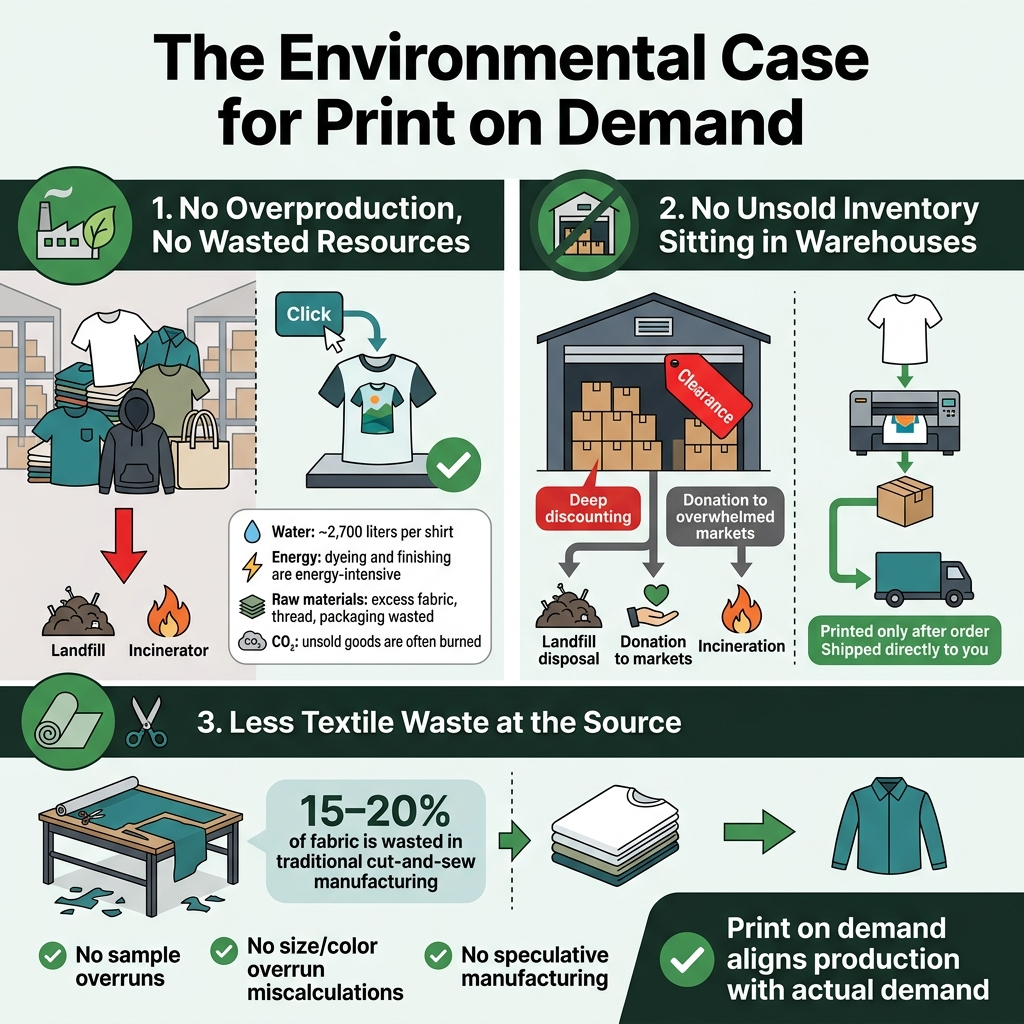
Print on demand production avoiding the overproduction and wasted resources common in traditional manufacturing.
No Overproduction, No Wasted Resources
The fashion and merchandise industry has a massive overproduction problem. Brands routinely manufacture far more than they can sell, betting on demand that never fully materializes. When you buy a print on demand product, that item is only made because you ordered it. There’s no factory running overnight to stock shelves that might sit half-empty for months.
This matters more than it might seem at first glance. Every t-shirt, hoodie, or tote bag that gets made but never sold still consumed water, energy, dye, and raw materials to exist. Those resources are gone — and the product ends up in a landfill or incinerator anyway. Print on demand cuts that equation off at the root.
Here’s a quick breakdown of what overproduction actually costs:
| Resource | Impact of Overproduction |
|---|---|
| Water | Cotton production uses ~2,700 liters per shirt |
| Energy | Dyeing and finishing are highly energy-intensive |
| Raw materials | Excess fabric, thread, and packaging go to waste |
| CO₂ emissions | Unsold goods are often burned, releasing carbon |
When your order triggers production, you’re essentially telling the supply chain: make exactly this, nothing more. That’s a fundamentally different relationship between demand and output — and it’s one that traditional retail has never been able to pull off at scale.
No Unsold Inventory Sitting in Warehouses
Warehouses are not neutral spaces. They cost energy to run, require climate control in many cases, and represent a physical commitment to goods that may or may not ever move. In traditional retail, unsold inventory piles up across distribution centers, brand warehouses, and store back rooms. At the end of a season, someone has to decide what to do with all of it.
The answers are rarely good for the planet:
- Deep discounting that floods the market with cheap goods, encouraging more consumption
- Donation that often ends up in overseas secondhand markets already overwhelmed with Western cast-offs
- Landfill disposal — more common than most brands publicly admit
- Incineration — used by luxury brands to protect brand value, releasing CO₂ directly into the atmosphere
With print on demand, you sidestep this entire cycle. There’s no end-of-season clearance problem because there was never a season’s worth of pre-made stock to begin with. Products are fulfilled from fulfillment centers that carry raw blanks and materials — not finished goods — which means the waste profile looks completely different.
Your purchase also doesn’t sit in a regional warehouse waiting for you. Once it’s printed, it’s shipped directly to you, cutting out several legs of the traditional logistics chain. Fewer stops mean fewer opportunities for goods to get lost, damaged, or redirected to disposal.
Less Textile Waste at the Source
Textile waste is one of the least visible parts of the fashion industry’s environmental footprint, but it’s enormous. Before a garment even reaches a consumer, a significant amount of fabric is already lost in the cutting and production process. Estimates suggest that 15–20% of fabric is wasted during traditional cut-and-sew manufacturing. That’s fabric that was grown, spun, woven or knit, dyed, and treated — only to be swept off a factory floor.
Print on demand doesn’t eliminate this entirely, since the blank garments used by POD suppliers are still manufactured using conventional processes. But the model does reduce waste in a few specific ways:
- Blank garments are standardized, which means they’re cut more efficiently than custom fashion pieces with complex patterns or seasonal silhouettes
- No sample overruns — traditional fashion requires physical samples at multiple stages of development, most of which never become products
- No color or size miscalculations — brands that pre-manufacture have to guess which sizes and colorways will sell; they often guess wrong, leaving runs of specific variants that never move
When you’re running a POD store, you also don’t have to guess. You list a product in every size and color combination your supplier offers, and only the ones that actually get ordered ever get made. If size XS in forest green never sells, no XS forest green shirts exist in the world — because they were never made.
This is a genuinely different logic from how apparel has historically worked. Traditional brands have always had to manufacture ahead of demand, accepting waste as the cost of being ready when customers show up. Print on demand flips that — the customer shows up first, and then the product comes into existence.
The environmental upside here isn’t just about the trash that doesn’t get created. It’s also about the upstream resources — water, energy, raw fiber — that were never consumed to make something no one wanted. That’s a savings you can’t see on a landfill report, but it’s real.
Some key waste reduction advantages at a glance:
- ✅ No unsold finished goods heading to incinerators
- ✅ No seasonal inventory requiring disposal
- ✅ No sample production waste
- ✅ No size/color overrun miscalculations
- ✅ No speculative manufacturing based on trend forecasts
These aren’t minor efficiencies. They represent a structural shift in how products come into existence — one that aligns production with actual human demand rather than projected demand. And that alignment, when it works, is genuinely better for the planet.
Where Print on Demand Still Has Trade-Offs
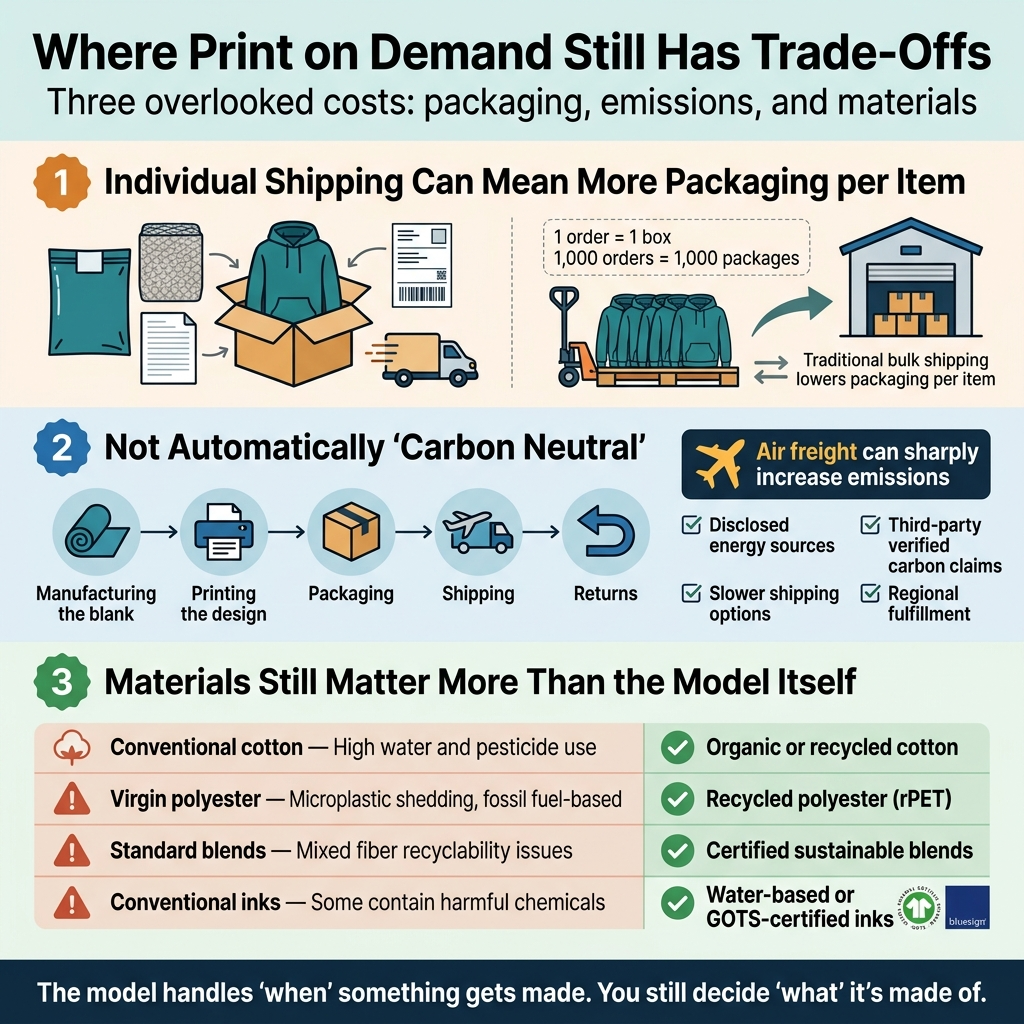
The individual shipping and packaging trade-off that comes with print on demand clothing.
Individual Shipping Can Mean More Packaging per Item
Here’s something worth thinking about: when you order a single custom hoodie, it travels to your door in its own box, with its own packaging materials. Compare that to a retailer shipping 500 hoodies in one bulk pallet to a warehouse, and you can see where the math gets complicated.
Each individual order in print on demand requires its own:
- Poly mailer or cardboard box
- Protective filler or wrapping
- Shipping label and documentation
- Last-mile delivery trip (often by van or truck)
When orders consolidate in traditional retail, the packaging-per-item ratio drops significantly. A single truck delivering 1,000 units to a store creates far less packaging waste per product than 1,000 separate deliveries going to 1,000 different addresses.
This doesn’t erase print on demand’s other environmental advantages, but it does mean you shouldn’t assume the model is automatically lean on waste. If you’re running a print on demand store, choosing suppliers who use minimal, recyclable, or compostable packaging makes a real difference. Some platforms have already moved toward polybags made from recycled materials or reduced-size boxes that fit products more snugly. These details are worth asking about before you commit to a fulfillment partner.
If you’re a customer buying print on demand products, opting to order multiple items at once (when the platform consolidates shipments) cuts down on how many individual packages get generated on your behalf.
Not Automatically “Carbon Neutral”
The phrase “sustainable business model” gets thrown around a lot in print on demand circles, and it can give you a false sense of security. Printing only what gets ordered does reduce waste, but the carbon footprint of each product doesn’t disappear just because there’s no unsold inventory sitting in a warehouse.
Here’s what still generates emissions in a typical print on demand order:
| Stage | Carbon Source |
|---|---|
| Manufacturing the blank | Energy use in textile production, fiber processing |
| Printing the design | Electricity consumption at the print facility |
| Packaging | Production and disposal of packaging materials |
| Shipping | Fuel burned by courier vehicles and air freight |
| Customer returns | Additional transport trips if items are sent back |
Air freight is the big one to watch. If your supplier ships internationally using air transport to meet fast delivery times, that can spike the carbon cost of a single item dramatically compared to slower ground or sea shipping.
Some print on demand platforms have started investing in carbon offset programs or partnering with climate-conscious carriers. That’s a step in the right direction, but offsets are not the same as actually reducing emissions. If a platform is offsetting but still relying heavily on air freight or coal-powered facilities, you’re paying for a number on paper rather than a real reduction in harm.
When you’re evaluating a print on demand partner, look for:
- Disclosed energy sources at production facilities
- Shipping speed options that let you choose slower, lower-emission delivery
- Third-party verified carbon claims rather than vague marketing language
- Regional fulfillment that shortens the distance between production and your customer
None of these things are guaranteed just because a company uses the print on demand model.
Materials Still Matter More Than the Model Itself
This is probably the most overlooked trade-off in the whole conversation. Print on demand solves the overproduction problem beautifully, but it doesn’t automatically determine what gets produced. And what gets produced matters enormously.
A conventional cotton t-shirt can use up to 2,700 liters of water to grow and process—enough for one person to drink for two and a half years. Polyester fabrics shed microplastics every time they’re washed, contributing to ocean pollution in ways that don’t show up on any carbon calculator. The base materials you or your supplier choose can completely overshadow the efficiency gains from producing on demand.
Here’s a quick breakdown of how common print on demand materials compare:
| Material | Key Concern | More Sustainable Alternative |
|---|---|---|
| Conventional cotton | High water and pesticide use | Organic or recycled cotton |
| Virgin polyester | Microplastic shedding, fossil fuel-based | Recycled polyester (rPET) |
| Standard blends | Mixed fiber recyclability issues | Certified sustainable blends |
| Conventional inks | Some contain harmful chemicals | Water-based or GOTS-certified inks |
If you’re selling through a print on demand platform, you often get to choose which blank products to offer your customers. Picking a slightly more expensive organic cotton tee over a conventional one, or opting for suppliers who use water-based inks rather than plastisol, creates a meaningful impact that the print on demand model alone never could.
If you’re shopping print on demand products, look for transparency around what the item is actually made from. Phrases like “sustainably made” or “eco-friendly” without any specifics are marketing, not evidence. Certifications like GOTS (Global Organic Textile Standard), OEKO-TEX, or Bluesign are the kinds of third-party markers that actually tell you something real about what went into making the product.
The model handles when something gets made. You still get to decide—or demand—what it’s made of.
Print on Demand vs. Fast Fashion: A Direct Comparison
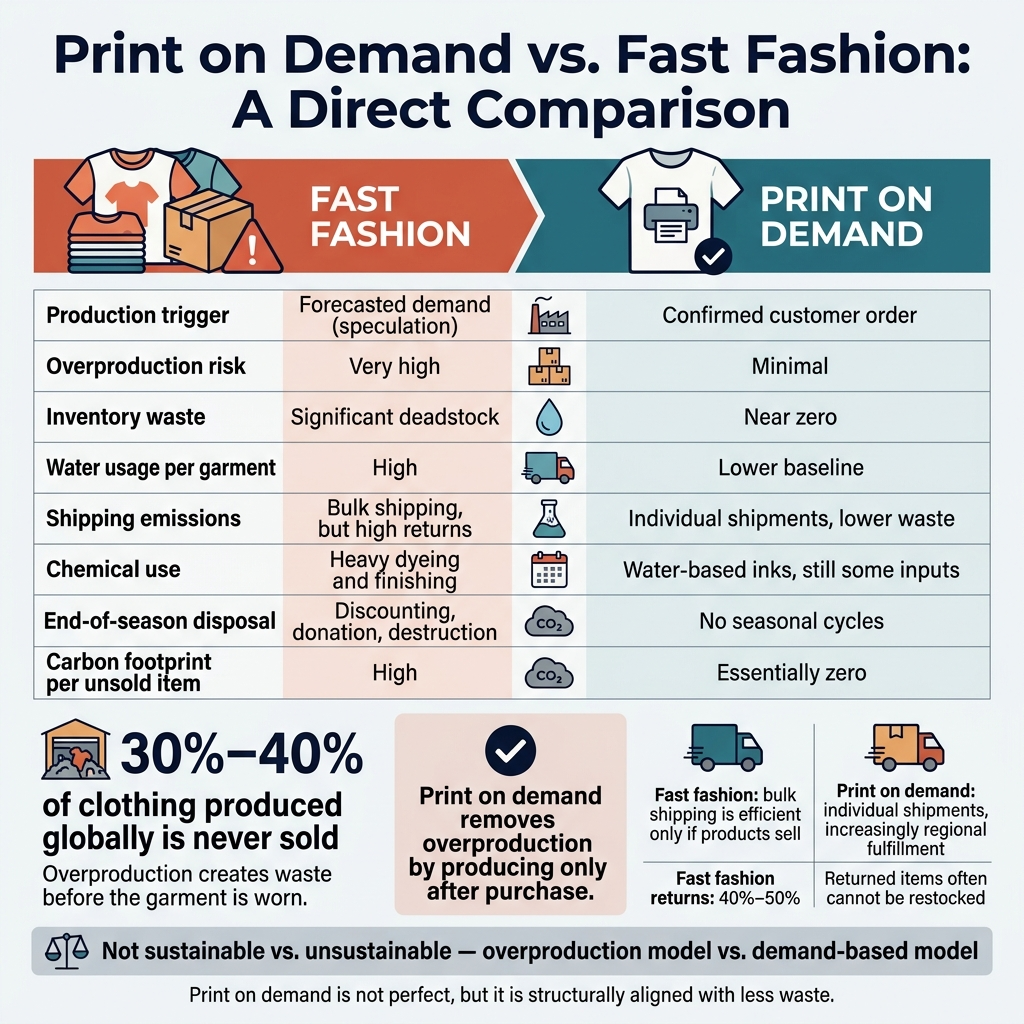
Comparing the waste created by print on demand clothing to the waste problem in fast fashion.
The Waste Problem You Don’t See in Fast Fashion
When you buy a graphic tee from a fast fashion brand, you’re probably only seeing the finished product. What you don’t see is everything that got thrown away before that shirt ever reached a shelf.
Fast fashion runs on a model built around speculation. Brands predict what will sell, manufacture thousands of units ahead of demand, and then deal with the fallout when their forecasts miss the mark — which happens constantly. Industry estimates suggest that somewhere between 30% and 40% of all clothing produced globally is never sold. That’s not a rounding error. That’s a business model with waste baked directly into it.
Print on demand flips that model entirely. Your product doesn’t exist until someone orders it. There’s no warehouse full of unsold hoodies, no season-end purge, no markdown spiral that ends with perfectly good garments in a landfill. The production trigger is a real customer making a real purchase.
Side-by-Side: How the Two Models Stack Up
Here’s a practical look at how print on demand and fast fashion compare across the factors that actually shape environmental impact:
| Factor | Fast Fashion | Print on Demand |
|---|---|---|
| Production trigger | Forecasted demand (speculation) | Confirmed customer order |
| Overproduction risk | Very high — unsold stock is common | Minimal — nothing is made without a sale |
| Inventory waste | Significant — deadstock is a known industry problem | Near zero |
| Water usage per garment | High — dyeing and finishing processes are water-intensive | Lower baseline, though dyeing still occurs |
| Shipping emissions | Often bulk shipping (lower per unit), but higher return rates | More individual shipments, but no bulk waste logistics |
| Chemical use | Heavy dye baths, chemical finishing agents at scale | DTG printing uses water-based inks; still has chemical inputs |
| End-of-season disposal | Frequent discounting, donation, or destruction | No seasonal cycles to manage |
| Carbon footprint per unsold item | High — resources used with no economic or functional return | Essentially zero — unordered items don’t exist |
The table above isn’t saying print on demand is perfect. It’s showing you where the structural advantages actually sit — and where the trade-offs live.
Why Overproduction Is the Real Villain
You’ve probably heard the statistic that fashion is one of the most polluting industries in the world. A big chunk of that pollution doesn’t come from the clothes people wear — it comes from the clothes no one ever wears.
When a fast fashion brand destroys unsold inventory (which has been documented at companies like Burberry and H&M), every resource that went into those garments — the water, the energy, the cotton, the dye — gets written off as pure waste. There’s no value recovery. The environmental cost was already spent.
With print on demand, that scenario doesn’t happen. If your store doesn’t make a sale, nothing gets produced. You’re not sitting on 500 units of a design that didn’t connect with your audience. The planet isn’t paying for your bad prediction.
The Shipping Trade-Off You Should Know About
Here’s where it gets more nuanced, and you deserve the honest version.
Fast fashion brands often ship products in bulk. One container ship moving 10,000 units from a factory in Bangladesh to a distribution center in the US has a lower per-item carbon footprint than 10,000 individual packages shipped separately.
Print on demand works differently. Each order typically ships as an individual package from a fulfillment center. If your customer in California orders a shirt, and your print partner fulfills from a facility in North Carolina, that’s a cross-country shipment for a single item.
So on a per-shipment basis, print on demand can look less efficient. But here’s what that framing misses:
- Fast fashion’s bulk shipping efficiency only looks good if the product sells. When unsold goods have to be shipped again — to discount retailers, to donation centers, or to incineration facilities — that “efficient” bulk shipment stops looking so clean.
- Print on demand networks are increasingly regional. Many major fulfillment platforms now route orders to the nearest production facility, which meaningfully cuts shipping distances.
- Returns in fast fashion are a massive, underreported problem. Online fast fashion return rates can hit 40–50%. Those returned items often can’t be restocked and get discarded. Print on demand sees far fewer returns, partly because customers are making considered purchases rather than impulse buys.
What You’re Actually Choosing Between
When you compare these two models, you’re not really choosing between “sustainable” and “unsustainable.” You’re choosing between a system designed around overproduction and one designed around demand.
Fast fashion’s environmental footprint isn’t just about the fabric or the dye or the factory conditions — though all of those matter. It’s about a model that deliberately produces more than it expects to sell, because the alternative (running out of stock) is seen as a bigger business risk than wasting resources.
Print on demand’s core advantage is structural. The model itself removes overproduction as a category. You can’t accidentally over-order 10,000 units if units are only produced when someone pays for them.
That doesn’t make every print on demand product automatically green. The blank garments still come from supply chains with their own footprints. The printing process uses energy and ink. Shipping has emissions. But the fundamental logic of the model is aligned with less waste — and that’s a meaningful difference worth understanding before you assume all apparel production is equally problematic.
What Makes Print on Demand Actually Sustainable
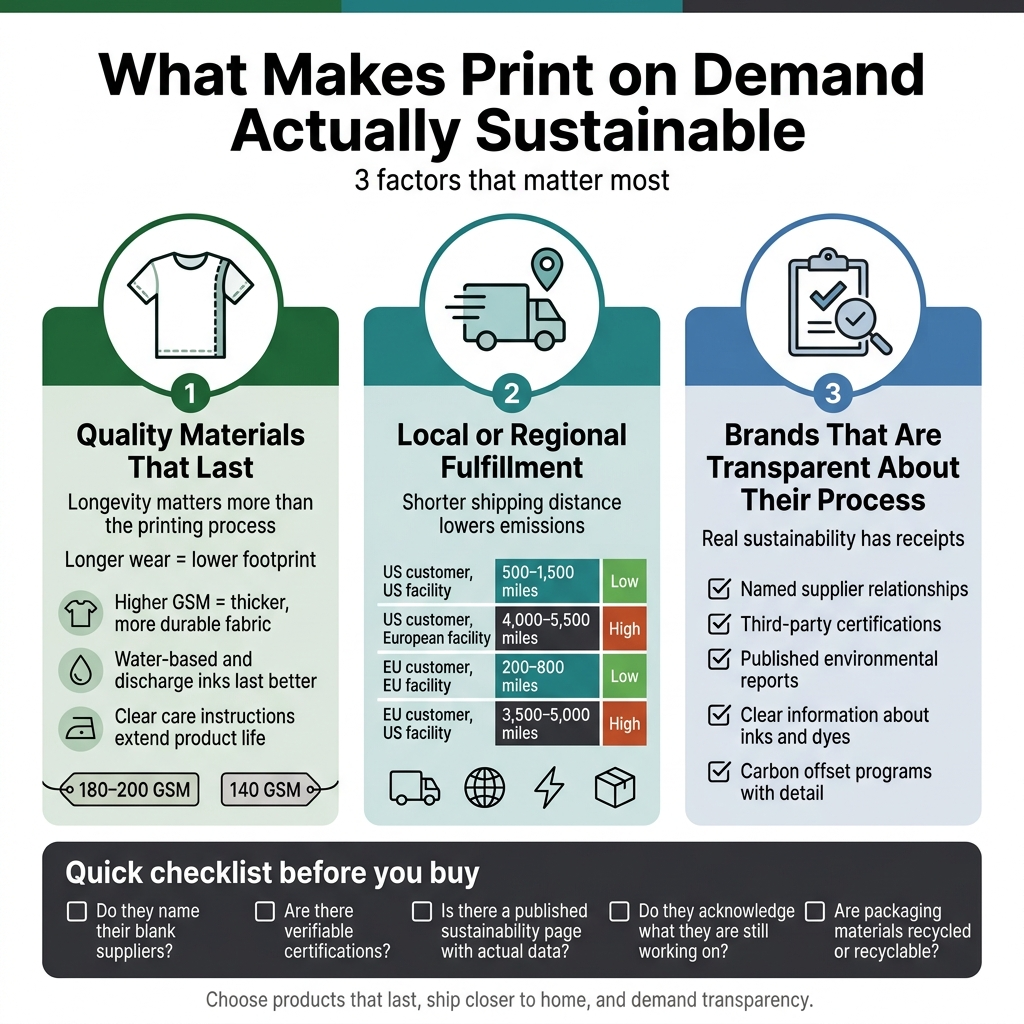
Quality, long-lasting materials that make print on demand clothing more sustainable.
Quality Materials That Last
“Designer Tip: A sustainable-sounding production method can’t fix a fabric that pills after three washes. Check the material first, the process second.” — Elena M.
The single most overlooked sustainability factor in print on demand isn’t the printing process — it’s the product itself. A shirt that falls apart after six washes isn’t sustainable no matter how it was made. It’s why we at Honeh choose fabric quality first and treat the print-on-demand model as a starting point, not the whole story. If you’re building a print on demand brand or shopping from one, the longevity of the item matters enormously.
When you choose products made from higher-quality materials — thicker cotton blends, reinforced stitching, colorfast inks — you’re directly reducing the number of times that item needs to be replaced. A garment someone keeps and wears for three years has a fundamentally smaller footprint than one that ends up in a landfill after a season.
Here’s what to actually look for when evaluating material quality in print on demand:
- GSM (grams per square meter): For apparel, higher GSM typically means a heavier, more durable fabric. A 180–200 GSM shirt will outlast a 140 GSM one in most cases.
- Ink type: Water-based and discharge inks tend to feel softer and hold up better over repeated washing compared to standard plastisol inks.
- Blank supplier reputation: Print on demand platforms source blanks from manufacturers like Stanley/Stella, Bella+Canvas, or AS Colour — brands known for ethical sourcing and better durability standards.
- Care instructions clarity: Brands that provide clear washing guidance are helping you extend the life of the product. That’s a small but real sustainability contribution.
If you’re selling through print on demand, don’t default to the cheapest product option. The small margin difference rarely justifies selling something your customers will throw away. And if you’re buying, it’s worth spending a few extra minutes checking what the item is actually made of before you click purchase.
Local or Regional Fulfillment
Shipping is one of the biggest environmental costs in e-commerce, full stop. A product manufactured in one country, warehoused in another, and shipped internationally to a customer generates significantly more emissions than one fulfilled close to where the buyer actually lives.
This is where local and regional fulfillment networks make a genuine difference. Many print on demand platforms — Printful, Printify, SPOD, and others — operate production facilities across multiple continents. When you set up your store or place an order, the system can route it to the facility closest to your customer’s location.
Here’s how that plays out in practice:
| Fulfillment Scenario | Estimated Shipping Distance | Carbon Impact |
|---|---|---|
| US customer, US facility | 500–1,500 miles | Low |
| US customer, European facility | 4,000–5,500 miles | High |
| EU customer, EU facility | 200–800 miles | Low |
| EU customer, US facility | 3,500–5,000 miles | High |
The difference isn’t trivial. Air freight in particular carries a carbon cost that can dwarf the production footprint of the item itself.
If you’re running a print on demand store, here’s what you can do right now to keep fulfillment greener:
- Check which platforms have facilities near your primary customer base. If most of your buyers are in Europe, make sure you’re using a platform with strong EU fulfillment capacity.
- Avoid splitting shipments where possible. Some platforms let you consolidate items from the same order into one package, cutting per-item shipping emissions.
- Be upfront with your customers about where products ship from. Some customers genuinely care about this, and transparency builds trust.
Local fulfillment also has a side benefit you might not expect: faster delivery times. Which means less pressure to use expedited (and higher-emission) shipping methods just to meet customer expectations.
Brands That Are Transparent About Their Process
Transparency is how you separate brands that are genuinely doing the work from those just using sustainability as a marketing angle. You’ve probably seen the vague claims — “eco-conscious,” “mindfully made,” “planet-friendly” — with nothing behind them. Real sustainability has receipts.
When a print on demand brand or platform is actually committed to reducing its impact, you’ll see specific, verifiable information rather than fuzzy language. Here’s what that actually looks like:
What genuine transparency includes:
- Named supplier relationships. They tell you exactly which blank manufacturers they use, not just “ethically sourced partners.”
- Third-party certifications. Look for GOTS (Global Organic Textile Standard), OEKO-TEX, or Fair Trade certifications — these require audits, not just self-reporting.
- Carbon offset programs with detail. Not just “we offset our shipping” but which offset program, verified by which body, covering which portion of emissions.
- Published environmental reports. Annual or regular reporting on waste, water usage, and emissions targets — even when the numbers aren’t perfect yet.
- Clear information about inks and dyes. Water-based, PVC-free, or discharged inks have a lower chemical footprint. Brands that care will say so explicitly.
If you’re building your brand around sustainability, your own transparency matters just as much as your suppliers’. That means telling your customers what products you chose and why, what platform you’re printing through, and what trade-offs still exist. People respond well to honesty — “we’re not perfect but here’s what we’re actively doing” is far more credible than polished green marketing copy.
A quick checklist you can run through when evaluating a print on demand partner or brand:
- Do they name their blank suppliers?
- Are there verifiable certifications on the products?
- Is there a published sustainability page with actual data?
- Do they acknowledge what they’re still working on?
- Are their packaging materials recycled or recyclable?
If most of those boxes go unchecked, that tells you something. You have more leverage as a buyer or business owner than you might think — and the brands paying attention are the ones worth supporting.
The Bigger Picture: Print on Demand Isn’t a Silver Bullet
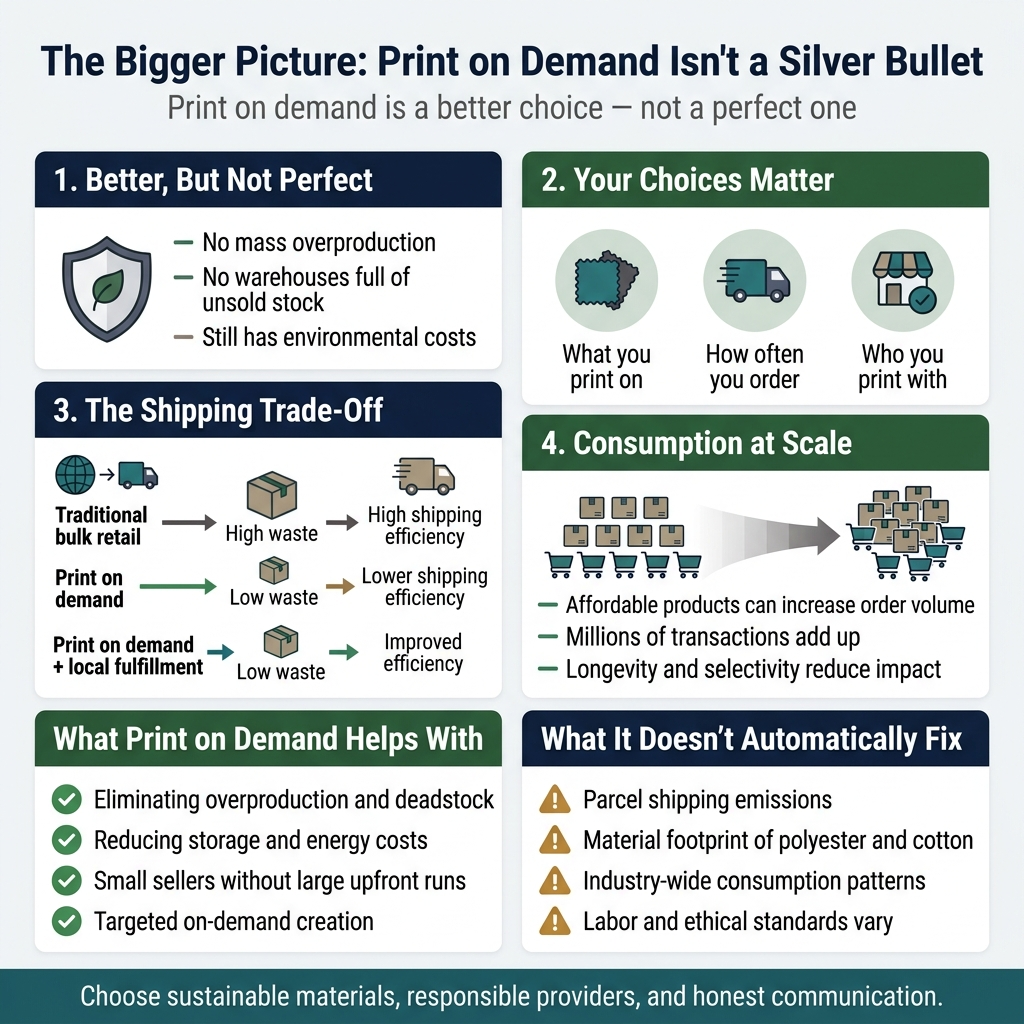
Print on demand framed as a better, though not perfect, sustainable clothing choice.
Print on Demand Is a Better Choice — Not a Perfect One
Choosing print on demand over traditional retail or fast fashion is genuinely a step in the right direction. But if you’re hoping it completely solves your environmental footprint as a creator or shopper, you’ll want to recalibrate those expectations. The model is structurally smarter — no mass overproduction, no warehouses full of unsold stock — but it still operates inside a larger system that has its own set of pressures and problems.
The honest truth is that every product you sell or buy has a cost. Print on demand reduces some of those costs significantly, but it doesn’t erase them.
Your Consumer Choices Still Shape the Outcome
Even within a print on demand model, the decisions you make as a seller or buyer carry real environmental weight.
- What you print on matters. A 100% organic cotton tee printed on demand is very different from a standard polyester blend, even if both are made to order. The base material still goes through the same resource-intensive processes before it ever reaches a printer.
- How often you order matters. Ordering one item at a time — especially with expedited shipping — means more individual packages, more delivery trips, and a higher per-unit carbon footprint. Batching orders or choosing slower shipping makes a real difference.
- Who you print with matters. Not every print on demand provider operates with the same standards. Some invest in renewable energy, water-based inks, and ethical labor practices. Others don’t. You have more power than you think in choosing who gets your business.
The model gives you a more sustainable framework to work within, but it doesn’t make every decision for you.
The Shipping Problem Hasn’t Gone Away
This is one of the most significant ongoing trade-offs you’ll face with print on demand. When a product is made and shipped individually rather than in bulk, the per-unit emissions for transportation tend to be higher. Bulk freight — moving thousands of units at once — is far more efficient on a per-item basis than one-off parcel delivery.
Here’s a rough way to think about it:
| Scenario | Production Waste | Shipping Efficiency |
|---|---|---|
| Traditional bulk retail | High (overproduction) | High (bulk freight) |
| Print on demand | Low (made to order) | Lower (individual parcels) |
| Print on demand + local fulfillment | Low | Improved (shorter distances) |
The good news is that some print on demand platforms are starting to address this by routing orders to fulfillment centers closest to the customer. If you’re shipping a product from a facility 500 miles away instead of across an ocean, that’s a meaningful improvement. When you choose platforms that prioritize local or regional fulfillment, you’re actively reducing that gap.
Consumption at Scale Still Creates Impact
Here’s something worth sitting with: even if print on demand eliminates overproduction waste, it doesn’t cap how much people buy. If a product is affordable and accessible enough, people order more of it. And at the scale of millions of transactions across the industry, that volume adds up.
You might be running a responsible shop with eco-friendly products and thoughtful packaging, but the broader print on demand industry is still part of a consumer economy that encourages buying more. That’s not a reason to abandon the model — it’s just a reason to stay clear-eyed about what it can and can’t do.
If you’re a seller, you can actually push back on this by:
- Designing for longevity. Products that are well-made and timeless get used longer and replaced less often.
- Being selective about your catalog. A smaller collection of things people genuinely love is better than dozens of items that end up unused.
- Communicating your values. When you talk openly about sustainability with your audience, you attract customers who are more intentional in how they shop.
What You Can Reasonably Expect From Print on Demand
Setting realistic expectations helps you make better decisions — and avoid greenwashing yourself or your customers.
Print on demand genuinely helps with:
- Eliminating overproduction and deadstock
- Reducing storage and associated energy costs
- Enabling small sellers to operate without large upfront manufacturing runs
- Allowing more targeted, on-demand creation rather than speculative mass production
Print on demand doesn’t automatically fix:
- The emissions footprint of individual parcel shipping
- The environmental cost of base materials like polyester or conventionally grown cotton
- Industry-wide consumption patterns
- Labor and ethical standards, which vary significantly by provider
The model is a tool. Like any tool, how much good it does depends on how thoughtfully you use it. You can choose sustainable materials, responsible providers, and honest communication with your customers — or you can treat “print on demand” as a marketing badge without doing the harder work behind it.
The difference between those two paths is real, and your choices shape which one you’re actually on.
FAQ
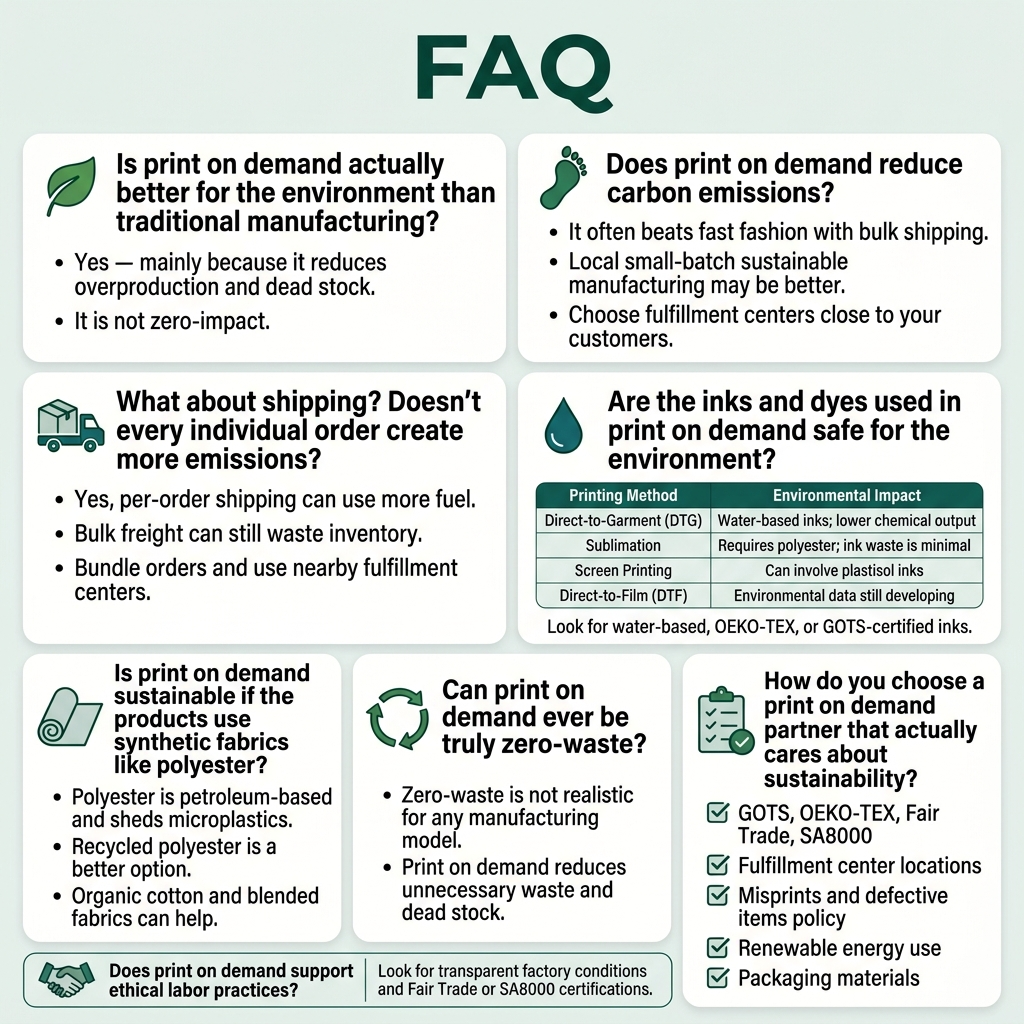
Answers to frequently asked questions about print on demand and its environmental impact.
Is print on demand actually better for the environment than traditional manufacturing?
Yes — but with some caveats. When you compare print on demand to traditional retail manufacturing, the difference is significant. Traditional manufacturing produces items in bulk, often thousands of units at a time, with no guarantee those items will ever sell. Unsold inventory gets discounted, donated, or destroyed. Print on demand flips that model: nothing gets made until someone actually orders it. That alone cuts out a massive source of waste.
That said, “better” doesn’t mean “perfect.” You’re still dealing with shipping emissions, chemical dyes, and synthetic fabrics. The environmental win with print on demand is largely about waste reduction, not zero impact.
Does print on demand reduce carbon emissions?
It depends on what you’re comparing it to. If you’re weighing print on demand against a fast fashion brand shipping containers of pre-made goods across the ocean, yes — print on demand typically comes out ahead because you’re not moving unsold stock around the planet.
But if you’re comparing it to a local, small-batch manufacturer using sustainable materials, print on demand might not win that round. The carbon math gets complicated when you factor in:
- Individual shipping per order (vs. bulk freight)
- Where your fulfillment partner is located
- Whether your customer is across town or across the world
Your best move is to choose a print on demand partner with fulfillment centers close to your main customer base. That shortens the shipping route and cuts emissions meaningfully.
What about shipping? Doesn’t every individual order create more emissions?
This is one of the most common concerns, and it’s a fair one. Shipping one item to one person does use more packaging and fuel per unit than bulk freight. But here’s the thing — those bulk freight shipments are moving inventory that might sit in a warehouse for months or never sell at all. When you account for the full lifecycle, including dead stock disposal, print on demand holds up surprisingly well.
You can also reduce your shipping footprint by:
- Selling to customers in regions where your fulfillment partner operates
- Offering products made at facilities near your buyers
- Encouraging customers to bundle orders when possible
Are the inks and dyes used in print on demand safe for the environment?
This varies a lot depending on the printing method and the supplier you work with. Here’s a quick breakdown:
| Printing Method | Environmental Impact |
|---|---|
| Direct-to-Garment (DTG) | Water-based inks; lower chemical output than screen printing |
| Sublimation | Requires polyester fabric; synthetic, but ink waste is minimal |
| Screen Printing | Can involve plastisol inks with higher chemical content |
| Direct-to-Film (DTF) | Newer method; environmental data still developing |
Your safest bet is to look for suppliers that use water-based, OEKO-TEX certified, or GOTS-certified inks. These have been tested and verified to meet environmental and safety standards. Don’t be shy about asking your supplier directly — a good one will answer you straight.
Is print on demand sustainable if the products use synthetic fabrics like polyester?
Polyester has real downsides — it’s petroleum-based, it sheds microplastics when washed, and it doesn’t biodegrade. So if your print on demand products are made from 100% polyester, that’s a trade-off worth acknowledging.
But you have options. Many print on demand platforms now offer:
- Organic cotton blanks
- Recycled polyester options (made from plastic bottles)
- Blended fabrics with higher natural fiber content
If sustainability matters to your brand or your customers, prioritize suppliers who offer these alternatives, even if they cost a little more. The product you’re proud to stand behind is worth it.
Can print on demand ever be truly zero-waste?
Getting to zero waste isn’t really possible with any manufacturing model right now — print on demand included. Every product requires raw materials, energy, water, and transportation. What print on demand does exceptionally well is eliminate unnecessary waste: overproduction, dead stock, and excess inventory that ends up in a landfill.
So while zero-waste isn’t the right goal to chase, near-zero-waste inventory is very achievable. Every item you sell was made because someone wanted it. That’s a genuinely different relationship with production than most of the fashion and merchandise industry operates on.
How do you choose a print on demand partner that actually cares about sustainability?
Ask questions before you commit. A supplier serious about sustainability will be able to tell you:
- What certifications their facility or products hold (GOTS, OEKO-TEX, Fair Trade, etc.)
- Where their fulfillment centers are located
- What happens to misprints or defective items
- Whether they use renewable energy in their production process
- What their packaging is made from
If a supplier can’t answer these questions clearly, that tells you something. The more transparent a company is about its practices, the more likely they’re actually putting in the work — not just putting green language on their website.
Does print on demand support ethical labor practices?
This is a separate question from environmental sustainability, but they often go hand in hand. Look for suppliers who are transparent about their factory conditions and hold certifications like Fair Trade or SA8000. Your product being made on demand doesn’t automatically mean the person making it is being treated fairly — so it’s worth digging into your supplier’s labor standards the same way you’d look at their environmental ones.
How ethical labor practices factor into print on demand clothing production.
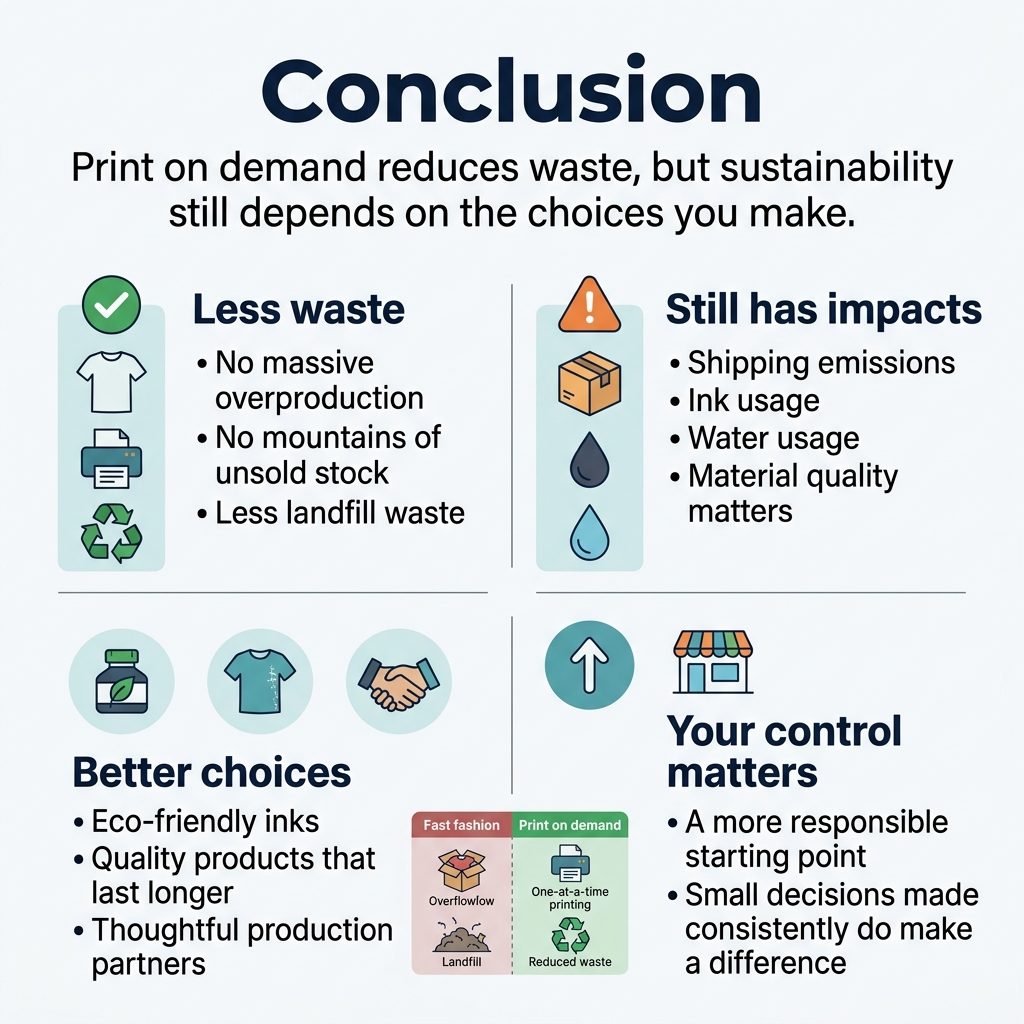
Print on demand is far from perfect, but it does cut out a lot of the waste that makes traditional fashion and bulk printing so damaging. No massive overproduction, no mountains of unsold stock, and no items headed straight to the landfill before anyone even wears them. That alone puts it ahead of the fast fashion model in meaningful ways. But the shipping emissions, the ink and water usage, and the quality of materials still matter — and they’re worth paying attention to.
The real impact comes down to the choices you make within the model. Picking suppliers that use eco-friendly inks, choosing quality products that last longer, and being thoughtful about your production partners all add up. Print on demand gives you a more responsible starting point, but it’s still on you to push it in the right direction. If you’re building a brand or just getting started with a store, use that control to your advantage — because small decisions made consistently do make a difference.
Tell Us What You Think
Does print on demand feel like a real improvement to you, or more of a marketing angle? Let us know in the comments.

-
 Price range: $22.38 through $29.07
 -
 Price range: $22.38 through $29.07
 -
 Price range: $22.38 through $29.07
 -
 Price range: $21.43 through $28.17
 -
 Price range: $22.38 through $29.07
 -
 Price range: $22.38 through $29.07
 -
 Price range: $22.38 through $29.07






Recent Comments