A busy woman’s simplified, organized capsule wardrobe closet.
Stop Wasting Time Staring at a Full Closet With Nothing to Wear
If you’re a busy woman who gets dressed on autopilot most mornings, a capsule wardrobe might be the simplest upgrade you make this year.
This guide is for women who are juggling work, family, and everything in between — and who want to look put-together without spending mental energy on it every single day.
Here’s what we’ll walk through together:
What a capsule wardrobe actually is (and what it isn’t)
The core pieces that do the heavy lifting in any well-built closet
How to mix and match those pieces so you’re never stuck starting from scratch
No fluff, no complicated rules — just a practical starting point you can actually use.
Key Takeaways
A capsule wardrobe is a small, intentional set of pieces that all mix and match easily.
Sticking to a simple color palette is what makes everything work together.
Quality matters more when you own less — every piece gets worn often.
Made-to-order basics fit naturally into a capsule since you’re buying fewer, better pieces on purpose.
What Is a Capsule Wardrobe, Really?
A neatly arranged capsule wardrobe with mix-and-match clothing pieces.
The Difference Between a Capsule Wardrobe and Just Owning Less Stuff
A capsule wardrobe isn’t simply a small closet. Plenty of people own very few clothes and still spend 20 minutes every morning staring at their shelves, unable to pull together an outfit that feels right. The number of items you own isn’t the point — the relationship between those items is.
A capsule wardrobe is a curated, intentional collection of pieces that genuinely work together. Every item earns its place because it fits well, reflects your actual life, and plays nicely with the other pieces around it. When you open your closet, almost anything you grab can pair with almost anything else. That’s the goal.
The term itself was coined by Susie Faux, a London boutique owner, back in the 1970s. She described it as a collection of essential items that don’t go out of fashion and can be complemented with seasonal pieces. Donna Karan brought the concept mainstream in 1985 with her “Seven Easy Pieces” collection — the idea being that a handful of versatile, well-made pieces could carry a woman through every moment of her day.
Decades later, the core idea still holds.
What Actually Goes Into One
There’s no universal list carved in stone. A capsule wardrobe for a woman who works from home looks different from one built around a corporate office environment or a life split between client meetings and school pickups. What stays consistent is the approach:
Every piece fits your body right now — not after you lose ten pounds, not “it’ll work if I wear the right bra.” Now.
Every piece reflects your real life — not the life you wish you had or the one you had five years ago.
Every piece can be worn multiple ways — ideally at least three to five different outfit combinations.
The collection as a whole feels like you — cohesive, not chaotic.
Most capsule wardrobes fall somewhere between 25 and 50 pieces, including shoes and outerwear, though even that range is just a guideline. Some women thrive with fewer. Some need more. The point isn’t hitting a magic number.
How It’s Different From a Minimalist Wardrobe
These two ideas often get tangled together, but they’re not the same thing.
Capsule Wardrobe
Minimalist Wardrobe
Focus
Versatility and intention
Owning as little as possible
Goal
Every piece works with others
Reduce possessions overall
Style driven?
Yes — reflects personal style
Not necessarily
Size
Flexible, based on your life
As small as possible
Outcome
Easy, confident dressing
Less clutter
You can absolutely build a minimalist capsule wardrobe — many women do. But you can also have a capsule wardrobe with 45 pieces and zero interest in minimalism as a lifestyle. The distinction matters because women sometimes abandon the idea when they think they have to pare down to almost nothing to “do it right.” You don’t.
The Quiet Problem It Solves
Think about the actual experience of getting dressed on a hectic Tuesday. You’re already behind. You grab something, it doesn’t feel right, you try something else, nothing seems to go together, you end up wearing the same three things you always wear while the rest of your closet gathers dust.
That experience isn’t about laziness or lack of style. It happens because most wardrobes grow through accumulation rather than curation. A sale item here, a gift there, something you bought for a specific event and never wore again. Over time, you end up with a lot of clothes and almost nothing to wear — because the pieces don’t connect.
A capsule wardrobe solves this not by stripping everything away, but by creating a system where the connections are already built in. When you reach for anything in your closet, the decision of what to pair it with is mostly already made. That mental load disappears, and getting dressed becomes something you do rather than something you survive.
The Myth That It’s Only for Certain Body Types or Budgets
This one comes up a lot, and it’s worth addressing head-on. Capsule wardrobes get associated with a very particular aesthetic — neutral tones, slim silhouettes, expensive basics from Scandinavian brands. That image has made a lot of women feel like the concept wasn’t designed for them.
It wasn’t designed for a body type. It wasn’t designed for a price point. It was designed for a mindset.
You can build a capsule wardrobe entirely from thrifted pieces. You can build one in bold color if that’s your style. You can build one that works for a size 2 or a size 22. The principles — fit, versatility, cohesion, intentionality — apply across the board.
What you’re building is a wardrobe that actually works for your life, your body, and your taste. That looks different for every woman. The framework is just the starting point.
Why a Capsule Wardrobe Works for a Busy Life
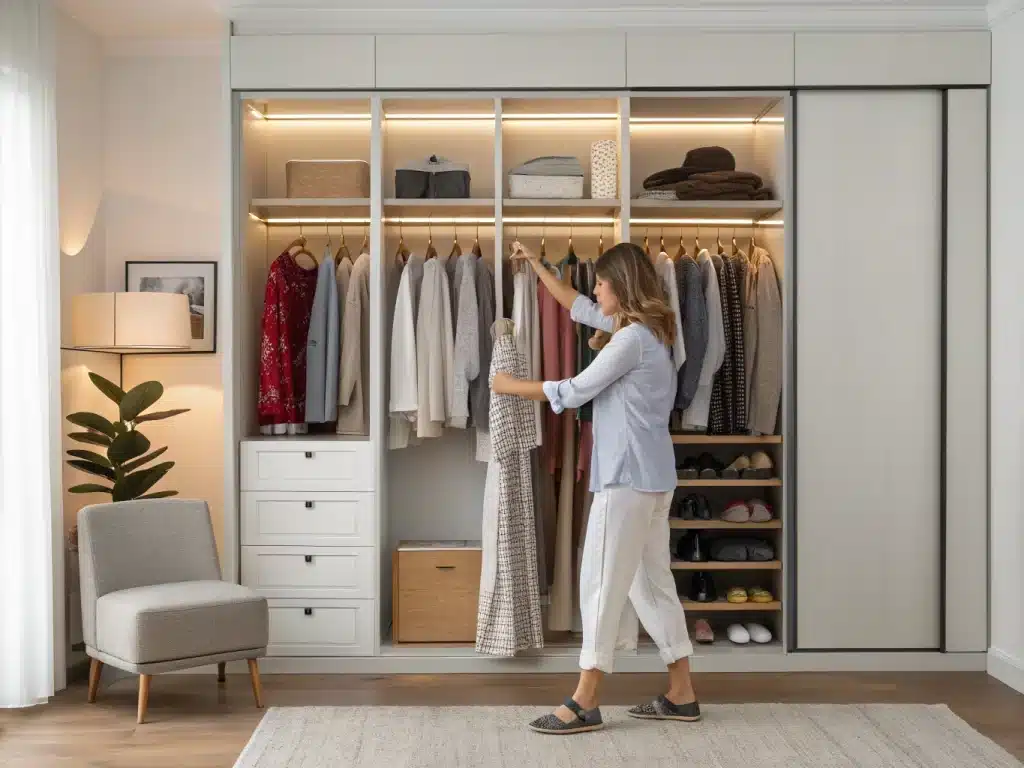
A busy woman quickly choosing an outfit from her capsule wardrobe.
Less Time Spent Deciding What to Wear
Decision fatigue is real, and it hits hardest before 8 a.m. When you’re staring into a closet packed with options — half of which don’t fit right, don’t go with anything else, or you simply forgot you owned — getting dressed stops being a simple task and starts eating into your morning.
A capsule wardrobe cuts through that noise. When every piece in your closet fits well, works for your life, and goes with at least three other things you own, getting dressed becomes almost automatic. You stop cycling through mental calculations like “Does this top work with these pants? Is this too casual? Where even is that other shoe?” and start just… getting dressed.
The Math Behind the Mental Load
Here’s something worth thinking about: a closet with 80 items but no clear system creates far more daily friction than a closet with 30 items where everything connects. The sheer volume of options isn’t helpful — it’s exhausting.
Research on decision fatigue shows that the more choices you make throughout the day, the worse your decision-making gets over time. Your morning outfit choice might seem small, but it’s still drawing from the same mental energy you need for work, parenting, planning, and everything else on your plate.
A capsule wardrobe removes low-stakes decisions from your morning so you can save that mental energy for things that actually matter.
What This Looks Like in Practice
Imagine opening your closet and seeing:
3 pairs of well-fitting pants in neutral tones
5 tops that layer or stand alone
2 blazers or structured jackets
A dress or two that can go casual or dressed up
A reliable pair of everyday shoes and one dressier option
Every single item connects to the others. You don’t need to think hard — you just pick, dress, and go. On the most chaotic mornings, that simplicity isn’t just a convenience. It’s a genuine relief.
Fewer Impulse Buys, More Pieces You Actually Use
Most people don’t have a shopping problem. They have a clarity problem.
Impulse purchases happen when you don’t know exactly what you need. You’re standing in a store or scrolling online, something catches your eye, and your brain convinces you it’ll work somehow. You get home, hang it up, and two weeks later realize it doesn’t go with a single thing you own.
A capsule wardrobe gives you a framework that essentially makes impulse buying much harder — in the best way.
Shopping With Intention Instead of Emotion
When you know your wardrobe well, you shop differently. You’re not looking for something new in a vague sense. You’re looking for a specific gap — maybe a lightweight layer for transitional weather, or a second pair of trousers because you’ve been reaching for your one pair constantly. That kind of focused shopping leads to pieces that actually earn their place in your closet.
Here’s a quick comparison of how shopping changes once you’ve built a capsule:
Before a Capsule Wardrobe
After a Capsule Wardrobe
Buying things because they’re on sale
Buying things because they fill a real gap
Getting excited about a piece with no idea how to wear it
Knowing exactly what it’ll pair with before purchasing
Owning multiples of similar things without realizing
Understanding what you already have
Regular “closet clean-outs” to deal with clutter
Minimal clutter because everything has a purpose
Spending more overall on clothes you barely wear
Spending less, but on pieces that work harder
The “Cost Per Wear” Mindset
One of the biggest shifts that comes with building a capsule wardrobe is how you start valuing pieces. Instead of focusing on the price tag, you start thinking about cost per wear — how much you’ll actually get out of something over time.
A $150 blazer you wear 80 times costs you less than $2 per wear. A $30 trendy top you wear twice costs $15 per wear. The capsule mindset naturally steers you toward quality over quantity, not because it sounds like good advice, but because it genuinely makes your wardrobe work better.
Why Busy Women Especially Benefit
When your schedule is packed, you don’t have time for the mental overhead of managing a bloated closet. You don’t have time to do inventory on what you own, figure out why nothing feels right, or make a mall trip to solve a getting-dressed problem that shouldn’t exist in the first place.
A capsule wardrobe is, at its core, a system. And like any good system, it saves time, reduces stress, and runs quietly in the background — so you can focus on everything else.
A few things that shift once you’re working from a capsule:
You stop buying things just because they’re a good deal
You feel more confident in what you’re wearing because every piece was a deliberate choice
Getting dressed on tired mornings or during stressful weeks feels manageable, not overwhelming
You spend less time thinking about clothes overall — which is kind of the whole point
The goal isn’t to have less. The goal is to have exactly what you need, nothing more, nothing less — so your closet works for you instead of adding to your mental load.
The Core Pieces Every Capsule Wardrobe Needs
Core capsule wardrobe essentials laid out together.
A Few Reliable Tops
Tops do the heavy lifting in any capsule wardrobe. The goal here isn’t to have a lot — it’s to have the right ones — the kind of timeless pieces you can throw on without thinking and still look put-together.
Aim for five to seven tops across a few categories:
Fitted or relaxed white tee – This is the backbone of so many outfits. It tucks into trousers, layers under blazers, and works with everything from jeans to midi skirts.
One or two neutral button-down shirts – A crisp white or soft blue chambray shirt is endlessly useful. Wear it open over a tank, fully buttoned into a skirt, or knotted at the waist with wide-leg pants.
A simple knit top or lightweight sweater – Polished enough for meetings, comfortable enough for everything else. Go for a solid color in a neutral like camel, cream, or navy.
One slightly elevated blouse – Something with a subtle detail — a soft ruffle, an interesting neckline, or a draped silhouette. This is the piece that makes a simple bottom feel like an intentional outfit.
A casual tee in a muted color – Not every day calls for polish. A dusty rose, sage green, or soft grey tee keeps things effortless on lighter days.
What to Look For in Tops
The fabric and fit will make or break whether you actually reach for these pieces. Look for:
Feature
Why It Matters
Natural or blended fabrics
Breathe better, wrinkle less harshly, and last longer
A consistent neckline across most tops
Makes layering easier and more cohesive
Neutral or muted tones
Pairs with everything without clashing
A fit that works untucked and tucked
Gives you more outfit options from one piece
Skip trendy graphic tees or statement prints for your core pieces — those are fun, but they limit what they’ll work with.
One or Two Versatile Bottoms
You genuinely don’t need ten pairs of pants. You need the right two or three that cover your life across different settings.
Tailored trousers in a neutral – Black, navy, camel, or stone. A well-fitted pair of trousers can go from a client meeting to a dinner without missing a beat. These are probably the single most versatile bottom you can own.
Dark wash straight-leg or slim jeans – Not skinny, not distressed, not overly casual. A clean, classic silhouette in a dark rinse dresses up more easily than you’d expect. Pair with heels and a blazer for a polished look, or sneakers and a tee for a casual one.
A simple skirt – A midi skirt in a solid color or subtle texture adds femininity without being fussy. A-line or straight cuts work best because they’re universally flattering and easy to style.
How Many Bottoms Do You Actually Need?
Bottom Type
Outfits It Supports
Best For
Tailored trousers
8–12+ combinations
Work, evenings, smart casual
Dark wash jeans
10+ combinations
Everyday, weekends, casual work
Midi skirt
6–8 combinations
Warm seasons, evenings, variety
If you’re working with a tighter budget or closet space, start with just the trousers and jeans. Add the skirt once you’ve built around the base.
One thing worth paying attention to: make sure the rise and waist of your bottoms work consistently across your tops. A high-rise trouser and a cropped knit will always look styled. A mid-rise pant with a shorter tee can look accidental. Small details like that are what separate a capsule wardrobe from just a collection of clothes.
A Layering Piece for Every Season
Layering pieces are what tie a wardrobe together. They’re also the pieces that handle weather transitions, unexpected temperature changes, and the eternal battle between office air conditioning and the outside world.
Every capsule wardrobe needs at least two to three layering pieces that span the seasons:
A well-cut blazer – This is non-negotiable. A blazer in a neutral color — black, camel, or grey — instantly elevates any outfit underneath it. It works over a tee for smart-casual, over a blouse for work, and even over a simple dress for cooler evenings.
A lightweight cardigan or longline knit – Perfect for layering in transitional weather or for indoor-outdoor days. Choose something in a neutral that doesn’t compete with what’s underneath.
A structured coat or trench – If you live somewhere with real winters or rainy seasons, a trench coat earns its place every single time you wear it. A camel wool coat works the same way in colder climates — throw it over anything and it looks intentional.
Matching Layers to Seasons
Season
Go-To Layer
Spring
Lightweight cardigan or denim jacket
Summer
Linen blazer or lightweight kimono-style layer
Autumn
Structured blazer or knit jacket
Winter
Wool coat or trench with a scarf
A few rules that make layering work effortlessly:
Match the weight of the layer to the outfit — a chunky knit over a silk blouse looks off; a tailored blazer doesn’t.
Keep the color palette consistent — if your tops are mostly neutrals, your layers should be too.
Length matters — a longer layer over a shorter bottom creates a clean, proportional look.
Layering pieces also do something else that’s easy to overlook: they give you outfit variety without adding more clothes. The same trousers and tee become three different looks depending on whether you add the blazer, the cardigan, or the coat. That’s the whole point of a capsule — more combinations, fewer decisions.
How to Choose Pieces That Mix and Match Easily
Coordinated capsule wardrobe pieces in a simple color palette.
Stick to a Simple Color Palette
“Designer Tip: Pick two neutrals and one accent color, then make every new purchase pass the test: does it talk to at least three pieces I already own?” — Elena M.
The secret weapon of every great capsule wardrobe is restraint — specifically, keeping your colors intentional and limited. When every piece you own can talk to every other piece, getting dressed stops being a puzzle and starts being effortless.
A good rule of thumb is to build around two neutrals and one or two accent colors. That’s it. Everything else follows from there.
How to Choose Your Palette
Start by looking at what you already reach for. Most people naturally gravitate toward a narrow color range without realizing it. If your closet is full of navy, white, and tan, that’s your palette telling you something. Work with it rather than against it.
Here’s a simple framework to follow:
Primary neutral: This is your anchor — black, white, navy, camel, or grey. It shows up in your trousers, blazers, and coats.
Secondary neutral: Something that pairs easily with your primary — cream, stone, olive, or charcoal. It fills in your tops, layering pieces, and bags.
Accent color(s): One or two colors that reflect your personality and bring life to the palette — a dusty rose, a deep burgundy, a warm terracotta.
Neutral Palette Examples That Work Well Together
Primary Neutral
Secondary Neutral
Accent Colors
Black
White
Camel, red
Navy
Cream
Rust, forest green
Charcoal grey
Stone
Blush, cobalt
Camel
Off-white
Olive, burgundy
The beauty of a controlled palette is that you can grab any top, any bottom, and any layer — and it works. No more standing in front of your closet wondering if that shirt actually goes with those trousers.
A Note on Prints and Patterns
Prints can absolutely live in a capsule wardrobe — they just need to follow the same color rules. A striped top in navy and white? Perfect. A floral blouse that pulls in your accent burgundy? Great. The moment a print introduces a color that doesn’t exist elsewhere in your wardrobe, it becomes a problem piece — one that works with almost nothing else you own.
Stick to patterns that use colors already in your palette and they’ll feel just as versatile as your solids.
Prioritize Fit and Fabric Over Trends
Trends are designed to expire. They exist to keep you buying — and that cycle is exactly what a capsule wardrobe is built to break. When you shift your focus from what’s in right now to what fits me beautifully and holds up over time, the whole concept of a capsule starts to click.
Why Fit Is Non-Negotiable
A perfectly tailored piece in a simple fabric will always look more polished than a trendy piece that doesn’t fit your body well. Always. No exceptions.
When something fits the way it should, it:
Requires no adjusting throughout the day
Photographs well and looks intentional
Gives you confidence without thinking about it
Works across more occasions because it reads as “put together”
If you’re buying pieces that need constant tugging, don’t lay flat, or feel uncomfortable by midday — they don’t belong in your capsule, regardless of how great they looked on the hanger.
Fit tips by garment type:
Trousers: The waistband should sit without gaping. The hem should hit cleanly without bunching.
Blazers: Shoulders should sit exactly at your shoulder point — not drooping, not pulling.
Tops: The shoulder seam lands on your actual shoulder, not sliding off or sitting mid-arm.
Dresses: Bodice darts, if present, should point toward your bust, not drift to the side.
If something is close but not quite right, a good tailor is worth every penny. A $30 alteration can turn a good piece into a great one.
How to Evaluate Fabric Quality
Fabric quality is what separates a piece that looks good on day one from a piece that still looks good in year three. Here’s what to look for when you’re shopping:
Signs of good quality fabric:
Has weight and substance — it doesn’t go limp or lose shape after washing
Doesn’t pill after minimal wear
Feels smooth and consistent — no thin spots or uneven weave
Drapes well — follows the body without clinging or ballooning
Fabrics worth investing in:
Wool and wool blends — for blazers, trousers, coats. Resistant to wrinkles, holds its shape, breathes well.
Cotton poplin and broadcloth — for shirts and blouses. Crisp, durable, easy to care for.
Ponte fabric — for dresses and trousers. Holds its structure throughout the day without restricting movement.
Silk or silk alternatives (like Tencel) — for elevated tops and blouses. Drapes beautifully and photographs well.
Fabrics to be cautious with:
Thin polyester that goes sheer or loses shape quickly
Fabric blends with very low natural fiber content — they tend to pill and look worn fast
Heavily structured fabric that requires dry cleaning after every wear
Trends vs. Timeless: How to Tell the Difference
When you’re holding a piece in a store and wondering if it belongs in your capsule, ask yourself: Would this look dated in two years? If you hesitate, it probably would.
Trend-Driven
Timeless
Neon or season-specific colors
Classic neutrals and muted tones
Logo-heavy or branded prints
Clean lines, minimal detailing
Exaggerated proportions
Balanced, classic silhouettes
Fast-moving micro-trends
Styles that have been around for decades
Timeless doesn’t mean boring. A well-cut white shirt is never boring. A perfectly fitted black trouser is never boring. These are the pieces that make you look like you have your life together — even on the days when you absolutely do not.
Made-to-order clothing pieces built for a capsule wardrobe.
Why Quality Matters More When You Own Less
When your wardrobe is small by design, every single piece carries more weight. There’s nowhere to hide a mediocre blouse behind seventeen other options. Each item you own gets worn regularly, which means cheap construction, poor fabric, and bad fit show up fast — and they show up often. That’s exactly why we at Honeh make every capsule-friendly piece to order, with fabric and fit that’s built to earn its place in regular rotation.
Think about it this way: if you own 30 pieces and wear each one roughly once a week, that’s a lot of mileage. A fast fashion top that looks fine on the hanger but pills after three washes will drag down every outfit it touches. A well-made shirt in a quality fabric? It gets better with wear and holds its shape season after season.
This is exactly where made-to-order clothing earns its place in a capsule wardrobe. When a garment is made specifically for your measurements, you get:
A fit that actually works for your body — no pulling at the shoulders, gaping at the waist, or dragging hems
Better construction — seams that hold, stitching that doesn’t unravel, and details that stay intact
Longer wear life — quality materials and careful construction mean the piece ages gracefully instead of falling apart
The fit piece alone is huge. Off-the-rack sizing is designed around an average body that most real women don’t have. A capsule wardrobe built on pieces that fit perfectly means you’re not constantly adjusting, layering to hide things, or second-guessing how you look. You just get dressed and go — which is the whole point.
The Real Cost of Cheap Clothing
There’s a math problem hiding inside fast fashion that’s easy to miss. A $25 top sounds like a good deal until you buy three replacements over the same period a $90 well-made shirt would have lasted. Stretched out over a few years, the cheap option often costs more.
Item
Cost
Wears Before Replacing
Cost Per Wear
Fast fashion blouse
$25
~20
$1.25
Quality made-to-order blouse
$95
~200+
$0.47
The numbers shift quickly. A higher upfront investment in fewer, better pieces ends up being the more practical choice — and the more sustainable one too, since less clothing ends up in landfill.
Made-to-Order Fits a Capsule Wardrobe Perfectly
The made-to-order model is almost designed for the capsule wardrobe mindset. You’re not buying from a rack of what’s available right now. You’re choosing exactly what you need, in the right fabric, in the right color, made to your measurements. That specificity means every piece you add is intentional. Nothing gets bought on impulse because something cute caught your eye. You’re building, not accumulating.
Choosing Fewer, Better Things Instead of More
The hardest part of building a capsule wardrobe isn’t editing down — it’s resisting the pull to keep adding. Once you’ve cleared space in your closet and feel the relief of getting dressed from a curated collection, it’s tempting to add “just a few more things.” Before long, the capsule becomes a full closet again.
Choosing fewer, better things is a practice. It requires a small shift in how you think about clothing.
Ask Different Questions Before You Buy
Instead of “Do I like this?” try asking:
Does this work with at least three things I already own?
Will I still want to wear this in two years?
Does it fit me right now, as I am today?
Is the quality good enough to last?
These questions slow down the decision, which is exactly what a capsule wardrobe needs. Fast decisions lead to impulse buys. Intentional questions lead to pieces you’ll actually wear.
What “Better” Actually Means
Better doesn’t automatically mean more expensive — though quality does tend to cost more. Better means:
Fabric that breathes, drapes well, and holds its shape — natural fibers like cotton, linen, silk, and wool tend to outperform synthetics for longevity and comfort
Construction you can see — even stitching, finished seams, buttons that are securely sewn on
Versatility — a piece that works across multiple contexts (office, weekend, dinner out) earns its spot in a capsule wardrobe; a piece that only works in one narrow situation probably doesn’t
Made-to-order pieces check these boxes by default. You’re choosing the fabric, you’re getting the construction that comes with custom production, and because you’re selecting intentionally rather than browsing what happens to be in stock, the pieces naturally tend toward versatility.
A Simple Framework for Adding New Pieces
When you’re deciding whether something earns a place in your capsule, run it through this quick check:
Need — Is there a genuine gap in your wardrobe this fills?
Fit — Does it fit well, or will it require alterations to work?
Longevity — Is the style something that transcends trends?
Quality — Will it hold up to regular wear?
Compatibility — Does it work with what you already own?
If a piece doesn’t pass most of these, it’s not right for your capsule — even if you love it. That’s the discipline that keeps a capsule wardrobe working for you instead of slowly creeping back toward chaos.
The goal isn’t a perfect, minimal aesthetic. It’s a wardrobe where everything fits, everything works together, and getting dressed on a packed Tuesday morning takes about three minutes instead of thirty.
A starter set of capsule wardrobe outfits for a busy week.
A Starter Capsule for a Typical Busy Week
Think of this as your blueprint — not a rigid shopping list, but a real-world example you can adapt to your own life, job, and style. This sample capsule works for a woman who moves between professional settings, casual weekend plans, and the occasional evening out. It’s built on a neutral base with two or three accent colors woven in.
The Color Palette
Before jumping into pieces, the palette holds everything together. This sample capsule runs on:
Neutrals: Black, white, camel, and navy
Accent: Dusty rose and olive green
Every single piece in this wardrobe connects to at least one other through color, which means you’re never stuck staring at your closet wondering what goes with what.
White button-down + black tailored trousers + black mules + structured tote
Dusty rose blouse + navy jeans + black mules + small crossbody
Black shirt dress + navy blazer + low block-heel mules
These three combinations alone cover a full week of professional meetings without repeating an obvious outfit. Swap the blazer on or off depending on how formal the day gets.
Weekend and Casual Days
Black crewneck tee + camel wide-leg linen pants + white sneakers
White relaxed tee + dark-wash jeans + tan sandals
Olive wrap midi dress + white sneakers + camel crossbody
The linen pants and the wrap dress do a lot of heavy lifting here. They look polished but feel like wearing nothing. That’s the sweet spot on a Saturday when you’re running errands but might run into someone you want to impress.
Evening or Dinner-Out Options
Dusty rose blouse + black tailored trousers + black mules
Black shirt dress + statement earrings + small crossbody
You don’t need a separate “going out” wardrobe. These three looks come straight out of the same 22 items and feel entirely different with a swap of shoes and a bag.
Outfit Count From 22 Items
A capsule this size realistically generates 30+ distinct outfits when you factor in layering and accessory changes. Here’s a rough breakdown:
Occasion
Estimated Outfit Combinations
Work / Professional
10–12
Casual / Weekend
10–12
Evening / Going Out
6–8
Total
~30+
What Makes This Capsule Easy to Maintain
Everything Washes or Cares for Simply
Stick to fabrics that don’t demand dry cleaning for every wear. This sample capsule leans on cotton, linen, denim, and jersey — things that can go through a normal laundry cycle or hang-dry without fuss. The silk-touch blouse is the one exception, but choosing a quality polyester-silk blend means you can hand wash it at home in about two minutes.
It Adjusts With the Seasons
Swap the linen pants for wool-blend trousers in winter. Trade the flat sandals for ankle boots. Add a chunky knit instead of the lightweight blazer. The color palette stays the same, so nothing breaks the system — you’re just swapping fabrics to match the weather.
It Has Room to Grow
A capsule isn’t a closed box. Once you’re wearing these 22 items comfortably and you notice a gap — maybe you need a second pair of trousers in a different color, or you want a cozy cardigan for the colder months — you add specifically to fill that gap. You’re building from a place of intention instead of impulse.
Personalizing This Template
This sample leans neutral and professional-adjacent. Your version might look different, and that’s fine. Here are a few swaps based on lifestyle:
Creative field: Replace the tailored trousers with wide-leg printed pants. Swap one of the neutral tees for a graphic tee in your accent color.
Mostly casual life: Drop one dress and swap it for a second pair of jeans in a lighter wash.
Warmer climate: Replace the trench with a linen blazer. Trade the block-heel mules for a pair of strappy leather flats.
Cooler climate: Add a merino wool turtleneck in a neutral and swap the sandals for a low ankle boot.
The skeleton stays the same. You’re just dressing it for your actual life.
FAQ
How many pieces are in a typical capsule wardrobe?
Most capsule wardrobes fall somewhere between 25 and 50 pieces, including clothing, shoes, and bags. The most popular number you’ll hear is 33 — that’s the magic number behind the well-known Project 333 minimalist fashion challenge.
That said, there’s no rule carved in stone. The right number depends on:
Your lifestyle — A woman who works from home needs fewer formal pieces than someone in a client-facing role
Your climate — Living somewhere with distinct seasons means you might rotate seasonal capsules rather than keeping everything out at once
Your laundry habits — If you do laundry twice a week, you can get away with fewer pieces than someone who washes clothes once every two weeks
A good starting point is aiming for 30–35 pieces for a single season. Once you get comfortable editing your wardrobe, you’ll naturally land on the number that works for your life — not someone else’s Pinterest board.
How do I start building a capsule wardrobe?
The best place to start is with what you already own — not a shopping cart.
Step 1: Pull everything out
Empty your closet completely. Yes, everything. This sounds dramatic, but it’s the only way to see what you actually have versus what you think you have.
Step 2: Sort ruthlessly
Create three piles:
Keep — You wear it, it fits well, and you feel good in it
Maybe — You’re unsure; set these aside and revisit in 30 days
Out — Donate, sell, or recycle
Step 3: Identify your gaps
Look at what’s left in your “keep” pile. Do you have five blazers but no good white shirt? Three pairs of jeans but nothing that works for evening? Write down what’s missing.
Step 4: Shop with intention
Only buy what fills an actual gap. Before purchasing anything, ask yourself:
Does this work with at least three things I already own?
Will I still love this in two years?
Does it fit my real life, or the life I imagine having?
Step 5: Get dressed intentionally for two weeks
Live with your new capsule before adding anything else. You’ll quickly notice what’s missing and what you thought you needed but actually don’t.
Can a capsule wardrobe include prints and colors?
Absolutely — a capsule wardrobe doesn’t have to be a sea of beige and grey. The “only neutrals” approach works well for some women, but it’s not a requirement.
The key is making sure your prints and colors play nicely together. Here’s how:
Build a color palette first
Pick 2–3 base neutrals (like navy, camel, or white) and 1–2 accent colors that you genuinely love and that complement each other. When everything shares a color story, getting dressed becomes effortless.
Choose prints that coordinate
A striped top, a small floral, and a subtle plaid can all coexist in the same capsule — as long as they share at least one color from your palette.
Print Type
Why It Works in a Capsule
Classic stripes
Pairs easily with solids and other neutrals
Tonal or tone-on-tone
Adds texture without clashing
Small-scale florals
Versatile and less dominating than large prints
Geometric patterns
Clean lines that mix well with structured pieces
Avoid: Buying trendy prints in loud colorways that only work with one or two other things. Those are the pieces that end up unworn.
A capsule wardrobe with personality and color is still a capsule wardrobe — it just takes a little more care in the curation.
Is a capsule wardrobe cheaper in the long run?
Yes — but not always in the way people expect.
The upfront investment can actually feel more expensive. When you stop buying cheap, throwaway pieces and start buying well-made, versatile clothing, the price tags are higher. A quality pair of trousers that lasts five years will cost more than a fast-fashion version that falls apart in six months.
Here’s the real math:
Approach
Cost Per Item
Items Bought Per Year
Total Spent
Pieces Still Wearable After 3 Years
Fast fashion habit
$30
40
$1,200/year
~5
Capsule wardrobe approach
$120
8–10
~$960/year
~8–10
Over time, buying less but buying better saves you money — and closet space, and decision fatigue.
There are also a few less obvious ways a capsule saves you money:
Fewer impulse buys — When you know exactly what you need, you’re less likely to grab things on sale that don’t fit your wardrobe
Lower dry cleaning and care costs — Fewer items means fewer trips to the dry cleaner
Less waste — You stop buying things you never wear, which means your cost-per-wear on every piece drops significantly
The shift does require a change in mindset — from “how much does this cost?” to “how much will I get out of this?” Once that clicks, the capsule wardrobe approach starts to feel less like a restriction and a lot more like freedom.
A complete capsule wardrobe collection ready to wear.
A capsule wardrobe is not about having less — it is about having exactly what you need. When every piece in your closet fits well, works together, and suits your life, getting dressed stops being a chore and starts feeling effortless. From picking the right core pieces to choosing made-to-order options that actually fit your body, the goal is simple: a smaller closet that works harder for you.
If you have been putting this off, start small. Pick three to five pieces that you reach for constantly and build from there. You do not need to overhaul everything overnight. One good decision at a time is all it takes to create a wardrobe that fits your life — and actually makes your mornings a little easier.
Tell Us What You Think
How many pieces are in your ideal capsule wardrobe? Share your number in the comments — we’re curious.
Share on:
Facebook
X
Pinterest
LinkedIn
Print
Recent Comments
About Elena
I love turning an idea into something someone actually wears. Choosing the fabric, seeing the first sample come together and watching a piece find its person, that’s what makes it worth it.
To provide the best experiences, we use technologies like cookies to store and/or access device information. Consenting to these technologies will allow us to process data such as browsing behavior or unique IDs on this site. Not consenting or withdrawing consent, may adversely affect certain features and functions.
Functional
Always active
The technical storage or access is strictly necessary for the legitimate purpose of enabling the use of a specific service explicitly requested by the subscriber or user, or for the sole purpose of carrying out the transmission of a communication over an electronic communications network.
Preferences
The technical storage or access is necessary for the legitimate purpose of storing preferences that are not requested by the subscriber or user.
Statistics
The technical storage or access that is used exclusively for statistical purposes.The technical storage or access that is used exclusively for anonymous statistical purposes. Without a subpoena, voluntary compliance on the part of your Internet Service Provider, or additional records from a third party, information stored or retrieved for this purpose alone cannot usually be used to identify you.
Marketing
The technical storage or access is required to create user profiles to send advertising, or to track the user on a website or across several websites for similar marketing purposes.




 Price range: $22.38 through $29.07
 Price range: $22.38 through $29.07
 Price range: $22.38 through $29.07
 Price range: $21.43 through $28.17
 Price range: $22.38 through $29.07
 Price range: $22.38 through $29.07
 Price range: $22.38 through $29.07

Recent Comments