
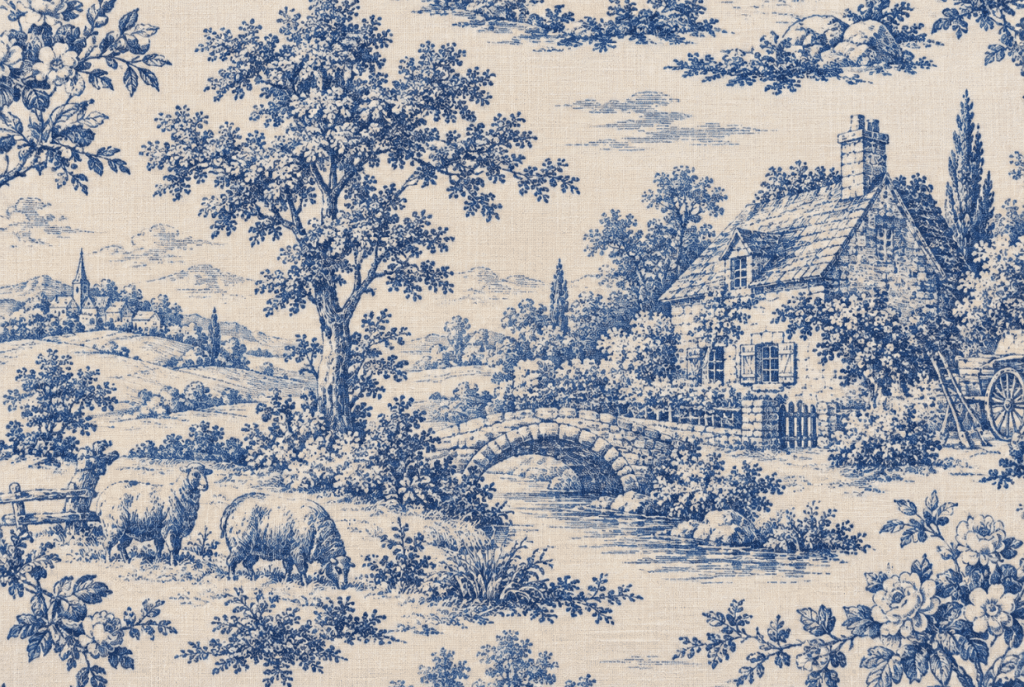
Toile is one of those prints that feels instantly familiar even if you’ve never heard the word before — the single-color, storybook-like scenes of countryside picnics and pastoral landscapes have been showing up on curtains, bedding, and increasingly on clothing for decades. This guide covers what toile print actually is, where its French name comes from, and how to wear it as a piece of clothing rather than just a home decor fabric. Along the way we’ll walk through a quick history timeline, the different fabric bases toile comes in today, and how it compares to other detailed prints like damask and ditsy florals.
What Is a Toile Print, Exactly?
A Single-Color Scene, Not Just a Pattern
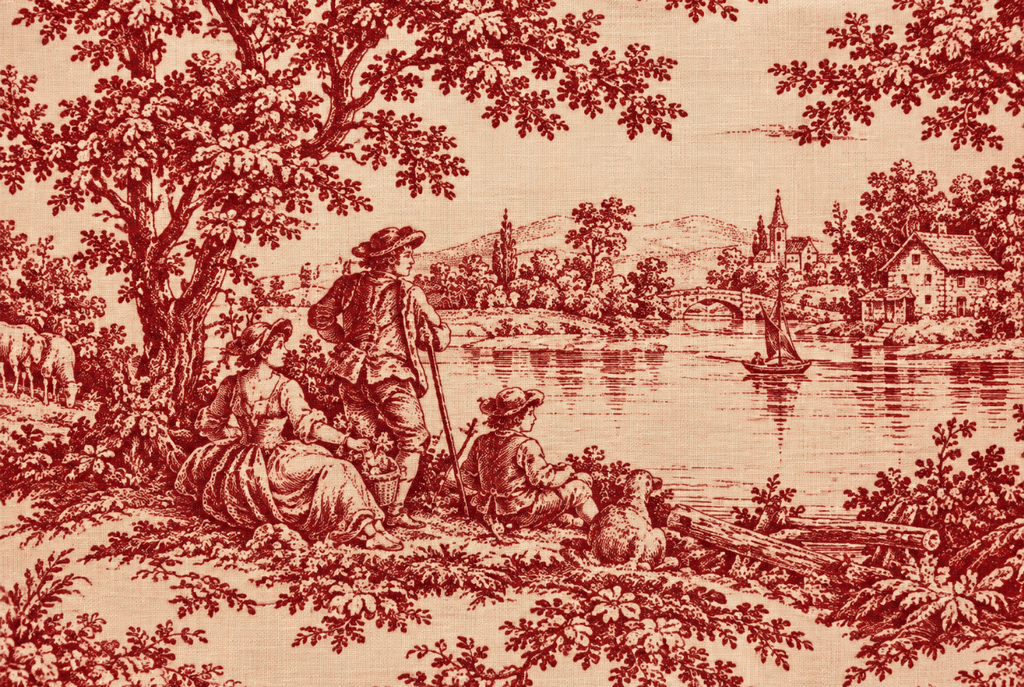
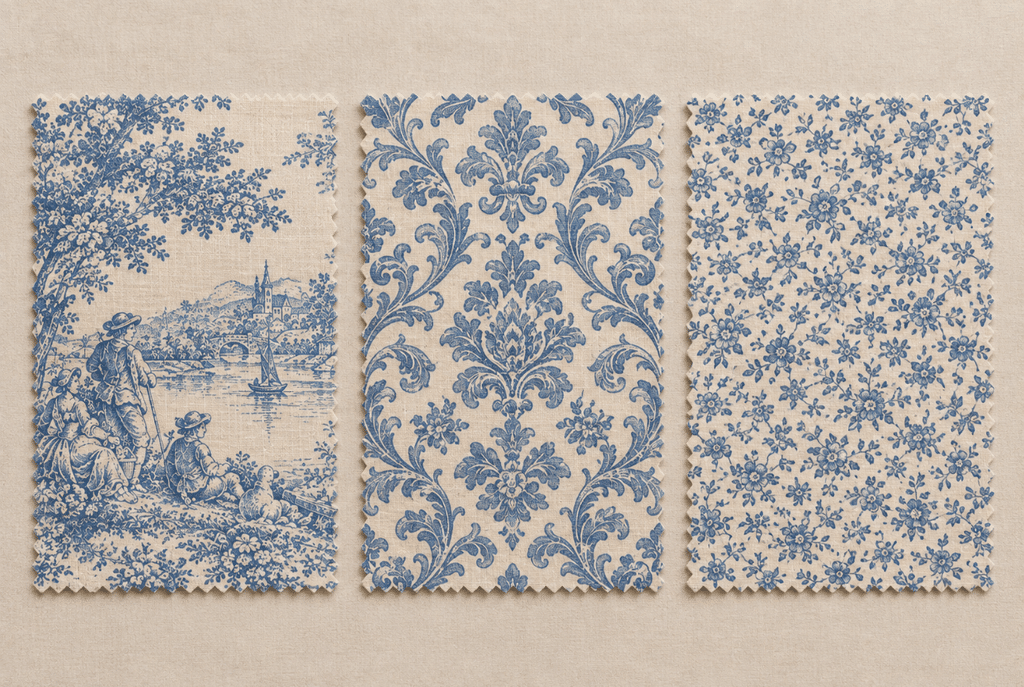
Unlike most prints, which repeat an abstract shape or a simple motif, toile depicts an actual scene — usually pastoral and narrative, like a couple picnicking by a lake, farmers working a field, or a garden party in progress — rendered in a single color against a plain white or off-white background. The most common colors are a deep indigo blue, a dark red, or black, though softer colorways like sage green or dusty pink have become more common in recent years.
Why It Reads as “Vintage” No Matter the Colorway
Because the printing technique and the pastoral subject matter have barely changed since the 1700s, toile carries a built-in vintage, storybook quality even when it’s printed in a completely modern color. That’s part of what makes it such a distinctive print to spot — there’s really nothing else in regular fashion rotation that looks quite like it.
Key Takeaways
- Toile depicts an actual pastoral scene (people, landscapes, florals) in a single color on a plain background, not just a repeating abstract shape.
- Its full name, “toile de Jouy,” means “cloth from Jouy,” a town near Paris where the pattern became famous in the late 1700s.
- The printing technique may have originated in Ireland before France popularized and named it.
- Toile has moved from strictly home decor (curtains, upholstery) into clothing, especially since a fashion resurgence around the year 2000.
Vintage-style toile print fabric shown in a classic colorway.
Where Toile Really Comes From
Not Actually French in Origin
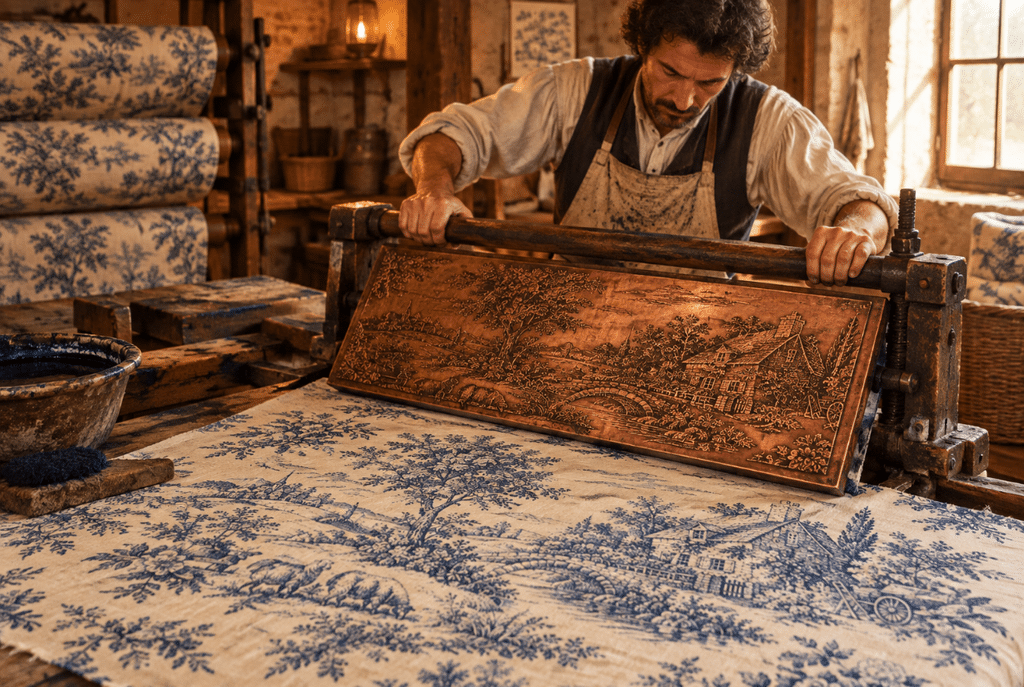
Here’s the twist most people don’t expect: despite its French name and reputation, the copperplate printing technique behind toile was originally developed in Ireland in the mid-18th century. It was only after the technique reached France and became strongly associated with a specific town that the pattern picked up the French identity it’s known for today.
The Town of Jouy-en-Josas
The name “toile de Jouy” literally translates to “cloth from Jouy,” referring to Jouy-en-Josas, a town near Versailles where a printing factory founded by Christophe-Philippe Oberkampf in 1759 became the pattern’s most famous production center. The factory grew significant enough that King Louis XVI granted it the official title of “royal manufacturer” in 1783, and Napoleon later personally visited the workshops and awarded Oberkampf the Legion of Honor. That level of royal and imperial recognition cemented the association between the pattern and that specific French town so thoroughly that the technique’s actual Irish origins are now a footnote most people never hear. Historians researching the technique’s roots have found documentation of Irish copperplate textile printing predating the French factories by roughly a decade, which is why most serious textile histories now credit Ireland as the technical originator even while France gets the cultural credit.
“Toile only works as clothing when you treat the scene like a texture, not a headline. Keep the silhouette simple and let the pattern do the storytelling on its own.” — Elena M.
Historic French toile fabric associated with the town of Jouy-en-Josas.
What’s Actually Depicted in a Toile Scene
Pastoral and Romantic Imagery
Classic toile scenes lean heavily on idyllic countryside life — shepherdesses, couples courting near a fountain, farmers at harvest, hot air balloons, or elaborate garden parties. The scenes are often stitched together from multiple smaller vignettes repeated and mirrored across the fabric, so a single yard of toile might contain a dozen or more distinct little scenes rather than one continuous image.
Modern and Novelty Toile
Contemporary designers have had a lot of fun subverting the traditional pastoral toile format, swapping shepherdesses and lake scenes for modern cityscapes, everyday objects, or even tongue-in-cheek scenes that comment on the pattern’s own history. The underlying format — a single-color, densely detailed scene on a plain background — stays exactly the same even when the subject matter is completely modern.
From Home Decor to the Runway
Centuries as a Home Furnishing Fabric
For most of its history, toile stayed almost exclusively in the home — curtains, upholstery, wallpaper, and bedding were its natural habitat, and it carried an association with formal, traditional interiors that didn’t translate obviously to clothing.
The Fashion Crossover
Toile started appearing meaningfully in clothing collections around the turn of the millennium, when designers began treating the print as a way to bring old-world, storybook romance into modern silhouettes. That crossover has continued in waves ever since, with toile periodically resurfacing on runways and in mainstream fashion as a change of pace from more predictable florals and stripes.
How to Style a Toile Print
Let the Scene Be the Statement
Because a toile scene is so visually busy up close, the print works best on a simple, classic silhouette — a shirt dress, a button-down, or a full skirt — rather than anything with a lot of extra ruffles, seaming, or embellishment competing for attention.
Pairing Toile With Solid Colors
- Blue toile — pair with white, cream, or navy for a crisp, classic look
- Red toile — pair with black or cream for a slightly more formal, vintage-inspired feel
- Sage or dusty pink toile — pair with warm neutrals for a softer, modern take
- Black toile — treat it almost like a textured neutral and pair with any solid accent color
Mixing Toile With Other Prints
Toile is one of the trickier prints to mix with another pattern, precisely because the scene itself already reads as busy. If you want to combine it with something else, a plain stripe or a very small, tonal dot in the same color as the toile is the safest option — anything bolder tends to compete with the scene rather than complement it.
A toile print mixed with other patterns in a styled outfit.
Toile in Kids’ and Home Styling
A Storybook Print for Special Occasion Pieces
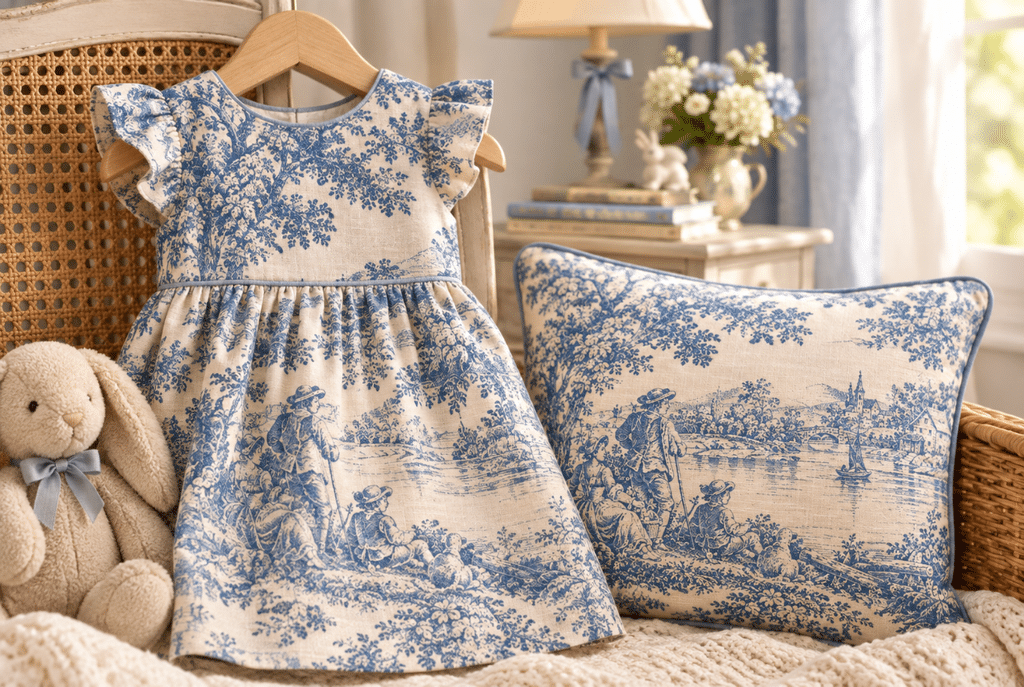
Toile’s classic, storybook quality makes it a natural fit for special-occasion kids’ clothing — think a holiday dress or a christening gown — more than everyday play clothes, simply because the detailed print and its formal history read as slightly dressier than a casual ditsy floral or gingham piece. A toile dress photographs particularly well for milestone moments — a first birthday, a holiday portrait, a christening — precisely because it already carries a timeless, heirloom-like quality that a trend-driven print can’t replicate.
Coordinating Toile Across a Family Photo
Because toile is almost always a single color on a plain background, it pairs easily with solids in that same color for a coordinated family look — similar to the approach in our guide to mommy and me outfits for fall family photos, where one shared element does the coordinating work instead of matching every piece exactly.
We at Honeh reach for toile whenever we want a print that photographs beautifully in natural light without needing much extra styling — the built-in detail in the scene does most of the visual work on its own.
Caring for Toile Print Garments
Keeping the Fine Linework Sharp
Toile’s detailed scenes are made of very fine linework, which means aggressive washing or high heat can blur that detail faster than it would on a bolder, simpler print. Cold water, a gentle cycle, and air drying all help the scene stay crisp for longer — the same core principles covered in our guide to washing and caring for printed cotton jersey clothing.
“If you can no longer make out the small details in a toile scene after a few washes, that’s your fabric telling you the water was too hot — not that the print was low quality to begin with.” — Elena M.
Close-up of the fine linework detail that defines a toile print.
Toile vs. Similar Prints
Toile vs. Damask
Damask is a woven, tone-on-tone pattern built from mirrored, symmetrical motifs (often floral or scroll-based), created through contrasting matte and shiny threads of the same color rather than a printed scene. Toile, by contrast, is a printed (not woven) pattern that depicts an actual narrative scene with people, landscapes, or objects, almost always in a visible contrasting color against a plain background.
Toile vs. Ditsy Floral
Both prints can appear in a single, muted colorway, but a ditsy floral print repeats one small, simple flower shape evenly across the fabric, while toile depicts a much larger, more complex narrative scene that unfolds across a bigger repeat. Ditsy reads as casual and everyday; toile reads as more formal and storybook-like.
Common Myths About Toile, Debunked
“Toile Is Only for Curtains and Bedding”
Toile’s decades-long association with home decor is real, but the fashion crossover that started around the turn of the millennium has been consistent enough that toile clothing is no longer a novelty — it shows up regularly in both mainstream and designer collections.
“All Toile Looks the Same”
While the format (single color, scene-based, plain background) stays consistent, the actual subject matter varies enormously — from strictly traditional pastoral scenes to modern, subversive, or even humorous reinterpretations that keep the format fresh.
“Toile Has to Be Blue or Red”
Blue and red are the most iconic and historically common toile colorways, but the pattern works in essentially any single color — black, sage green, dusty pink, and even yellow toile are all widely available and equally authentic to the format.
A toile print fabric shown in a color other than the traditional blue or red.
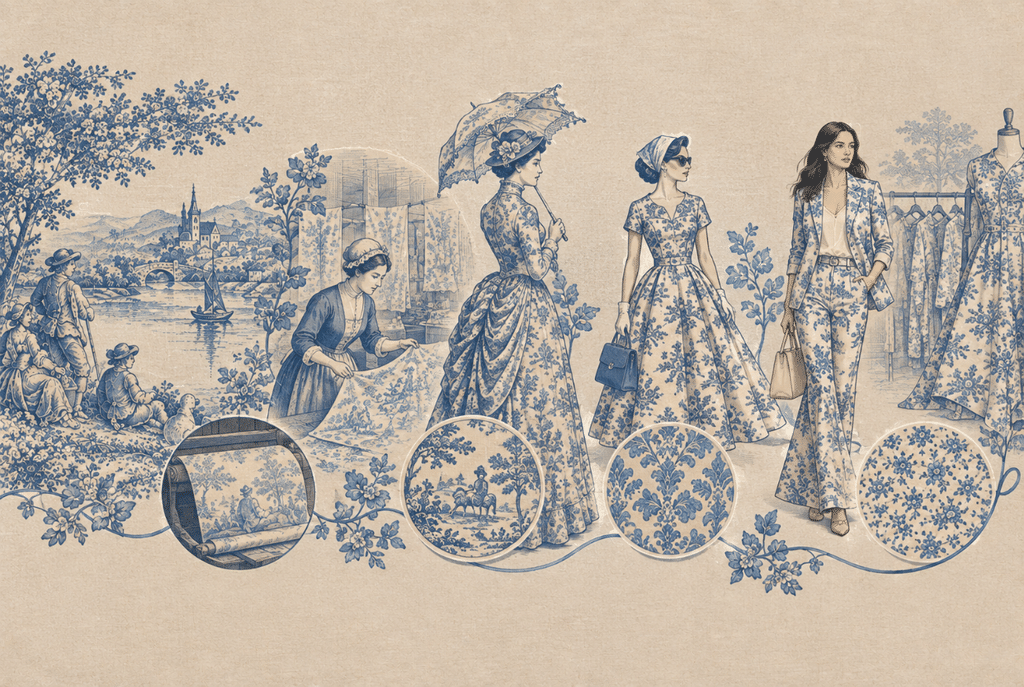
A Quick Timeline of Toile’s History
1750s–1760s: The Technique Travels
Copperplate printing on fabric develops in Ireland in the mid-18th century, allowing much finer, more detailed designs than earlier block-printing methods could achieve. The technique spreads to France not long after, where it finds its most famous home.
1759–1843: The Jouy-en-Josas Factory Era
Christophe-Philippe Oberkampf establishes his printing works in Jouy-en-Josas in 1759, and the factory grows into the pattern’s defining production center for nearly a century, earning royal recognition along the way before eventually closing in 1843.
20th Century: A Home Decor Staple
Toile settles firmly into home furnishings throughout the 1900s, associated with formal, traditional interior design in both Europe and America — curtains, wallpaper, and upholstery being its most common applications.
2000s–Today: The Fashion Crossover
Designers begin incorporating toile into clothing collections more seriously around the turn of the millennium, and the print has resurfaced in fashion in waves ever since, including a notable renewed interest in recent years as shoppers look for prints with genuine historical depth rather than a manufactured trend.
Where to Find Authentic-Feeling Toile
What Separates a Good Toile Print From a Weak One
Because toile depends entirely on fine detail to read well, the quality gap between a good and a mediocre toile print is unusually easy to spot. A well-produced toile holds crisp, legible linework even in the smaller background details — individual leaves, distant figures, architectural elements — while a lower-quality version often blurs those same details into vague shapes the moment you look closely.
Checking the Repeat
A classic toile print typically has a large, non-obvious repeat, meaning the same scene doesn’t repeat so frequently that it reads as an obvious tile pattern up close. If you can immediately spot where the design tiles and re-tiles just a few inches apart, that’s usually a sign of a simplified, lower-cost version of the print rather than a traditional, detailed one.
Why Toile Is Having a Moment Again
A Reaction to Fast, Disposable Prints
Part of toile’s recent renewed popularity seems tied to a broader shift toward prints with real history behind them, rather than graphics designed purely to chase a short-lived trend cycle. A print that has stayed recognizable for over 250 years carries a kind of built-in credibility that a brand-new pattern simply can’t manufacture overnight.
A Natural Fit for Slower, More Intentional Wardrobes
Toile also fits naturally into a slower approach to getting dressed — it’s not a print you’ll want to replace every season, and its formal, storybook quality tends to age well rather than looking dated the way a more of-the-moment graphic print can a year or two later.
Toile Fabric Types to Know
Cotton Toile
The most common and most historically accurate base fabric, cotton toile is breathable and holds fine linework well, making it a solid choice for both clothing and lighter home textiles.
Linen Toile
Slightly heavier and more textured than cotton, linen toile has a more rustic, lived-in feel and works especially well for structured pieces like a shirt dress or a tailored jacket.
Cotton Jersey Toile
A more modern, casual take on the fabric, jersey toile brings the traditional scene-based print into stretchier, everyday-wear territory, though the fine detail in the scene can be slightly harder to preserve on a stretch fabric over repeated wears.
Tell Us What You Think
Would you wear toile as clothing, or does it still feel more like a home decor fabric to you? Tell us your take in the comments.
FAQ
Is toile print French in origin?
The name and the pattern’s fame are French, tied to the Jouy-en-Josas factory, but the underlying copperplate printing technique is generally credited as originating in Ireland in the mid-18th century before France popularized it.
What does “toile de Jouy” actually mean?
It translates literally to “cloth from Jouy,” referring to Jouy-en-Josas, the town near Paris where Christophe-Philippe Oberkampf’s printing factory became the pattern’s most famous production center starting in 1759.
What colors does toile traditionally come in?
Classic toile is most often found in indigo blue, dark red, or black on a white or cream background, though modern versions also come in sage green, dusty pink, and other softer colorways.
Is toile only used for home decor?
No — while toile has centuries of history in curtains, upholstery, and bedding, it has appeared regularly in fashion collections since around the year 2000 and continues to resurface in clothing today.
What’s typically depicted in a toile print?
Classic toile scenes usually show pastoral, romantic imagery — countryside courting couples, shepherdesses, garden parties, or farm life — though modern toile can depict virtually any subject in the same single-color, scene-based format.
How is toile different from damask?
Damask is a woven, tone-on-tone pattern with mirrored, symmetrical motifs, while toile is a printed pattern depicting an actual narrative scene in a visible contrasting color, almost always on a plain background.
Can toile be worn casually, or is it always formal?
Toile leans dressier by nature because of its detailed, storybook quality, but a simple silhouette — like a casual shirt dress — can bring it into more everyday territory without losing what makes the print distinctive.

-
 Price range: $22.38 through $29.07
 -
 Price range: $22.38 through $29.07
 -
 Price range: $22.38 through $29.07
 -
 Price range: $21.43 through $28.17
 -
 Price range: $22.38 through $29.07
 -
 Price range: $22.38 through $29.07
 -
 Price range: $22.38 through $29.07



Recent Comments