
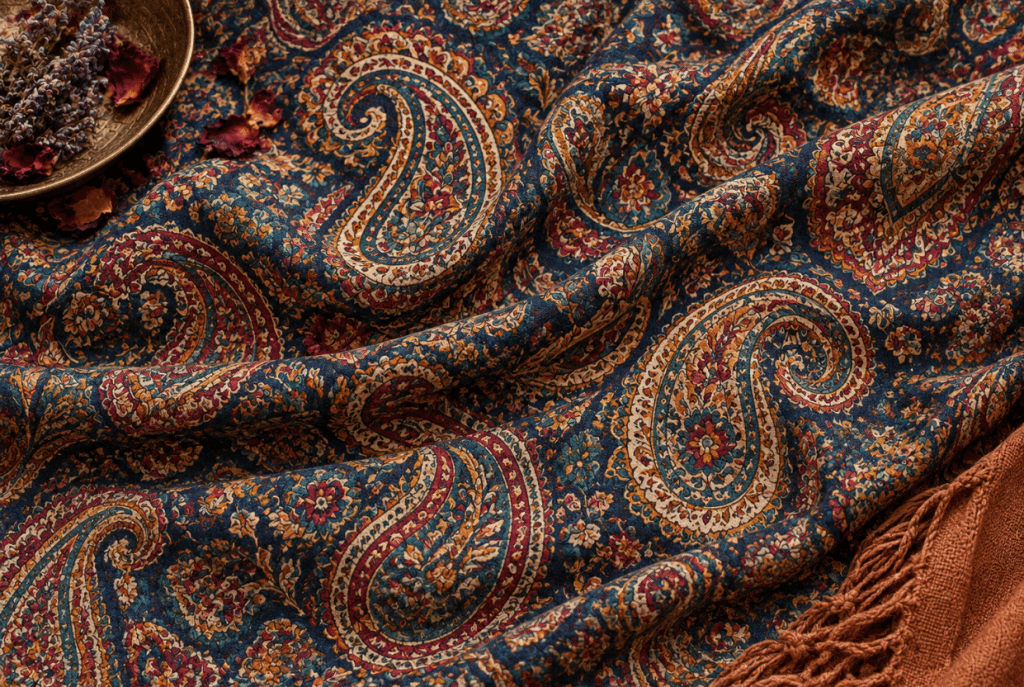
Paisley is one of those prints everyone recognizes on sight but almost nobody can actually name or explain — that curved teardrop shape shows up on scarves, ties, boho dresses, and vintage bandanas alike, yet its backstory spans three continents and about a thousand years. This guide breaks down what a paisley print actually is, how a Persian motif ended up named after a small Scottish town, and how to wear it today without it feeling like a costume from a 1960s themed party.
What Is a Paisley Print, Exactly?
The Teardrop-Shaped “Boteh” Motif
At the center of every paisley print is a single repeating shape: a curved, teardrop-like form with a bent, pointed tip, traditionally called the boteh or buta. Unlike a floral print, which usually depicts a recognizable flower, the boteh is more abstract — historians still debate whether it originally represented the sun, a stylized cypress tree bent by wind, a growing plant shoot, or a phoenix, and no single interpretation has ever been definitively confirmed.
Not Just a Repeating Shape
What makes a print read as “paisley” rather than just any curved motif is the density and intricacy of the pattern inside and around each boteh. Traditional paisley is packed with fine detail — tiny florals, dots, and linework filling the teardrop shape — which is part of why it originally took skilled weavers so long to produce by hand.
Key Takeaways
- Paisley’s signature shape is called a “boteh” — a curved teardrop motif with debated origins in Persian and pre-Islamic Iranian symbolism.
- The pattern traveled from Persia to Kashmir, where it became famous on luxury shawls, before reaching Europe.
- It gets its English name from Paisley, Scotland, a town that mass-produced imitation Kashmir shawls in the 18th and 19th centuries.
- Paisley had a major cultural revival in the 1960s psychedelic movement and remains a boho and vintage-fashion staple today.
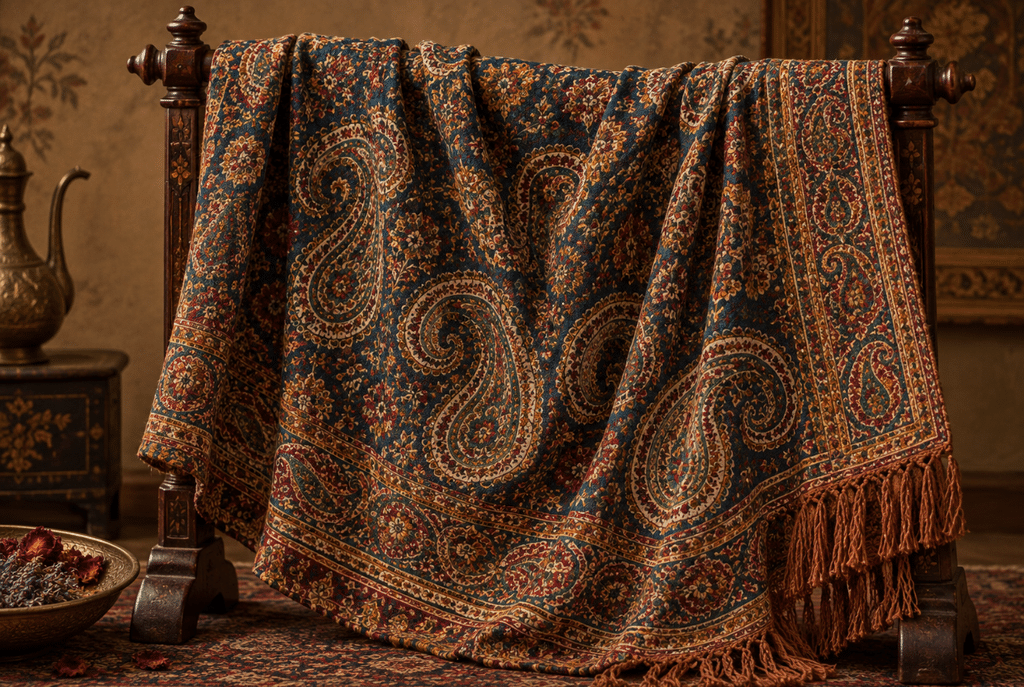
A detailed paisley print pattern showing the boteh teardrop motif.
Where Paisley Really Comes From
Persian Origins and the Boteh Symbol
The boteh motif appears in Persian and broader Islamic textile design as early as the 800s, woven into luxury fabrics like Termeh silk and used to decorate the ceremonial khalat robes worn by Iranian nobility. Some scholars connect the shape to older Zoroastrian and pre-Islamic Iranian religious symbolism — possibly representing the sun, a sacred flame, or a mythical bird — though the exact meaning has been reinterpreted many times across the centuries as the motif traveled.
The Journey to Kashmir Shawls
Around the 1400s, the boteh motif traveled from Persia into Kashmir, where local weavers incorporated it into what became the world-famous Kashmir shawl — an intensely labor-intensive, hand-woven textile that could take months to complete and was prized as a luxury item across Asia and, eventually, Europe.
How a Persian Motif Got a Scottish Name
The Town of Paisley, Scotland
When the British East India Company began importing genuine Kashmir shawls to Britain in the 18th and 19th centuries, their high price and labor-intensive construction meant only the wealthy could afford them. The Scottish town of Paisley became the center of an industry that reproduced the pattern using mechanized jacquard looms, which could replicate the intricate boteh design far faster and cheaper than the original hand-weaving process. The reproductions became so successful and widespread that the English-speaking world eventually just started calling the whole pattern “paisley,” after the town that mass-produced it — rather than by its original Persian or Kashmiri names. By the mid-1800s, the town of Paisley was producing more of these shawls than anywhere else in Britain, and its name had effectively replaced every earlier term the pattern had ever gone by in English — a naming quirk that still confuses people looking up the print’s real origin today.
From Luxury Import to Mass-Produced Middle-Class Staple
This is genuinely one of the more interesting quirks in textile history: paisley’s entire path to becoming a household-name print ran directly through industrial-era counterfeiting and mass production. The original Kashmir shawls stayed a luxury item, but Paisley-produced versions undercut them so effectively that the pattern became accessible to the middle class for the first time — which is exactly what allowed it to spread as widely as it eventually did.
“Paisley was never meant to be simple — it was built to be looked at closely. If you’re wearing it, let it be the only detailed thing in the outfit and keep every other piece plain.” — Elena M.
Paisley print fabric representing its shift from luxury import to everyday staple.
Paisley’s Big Fashion Moments
The 1960s Psychedelic Revival
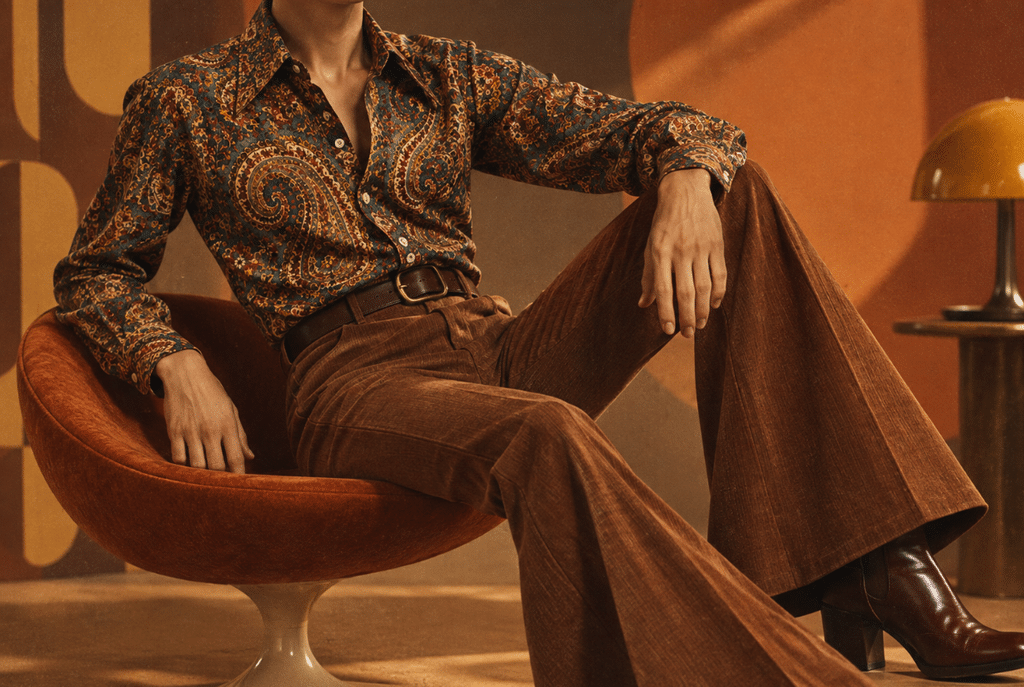
Paisley had already been a popular European print for over a century by the time it found its most famous cultural moment: the 1960s counterculture and psychedelic music scene. Musicians, most famously The Beatles, wore and popularized paisley prints heavily during this era, and the pattern’s intricate, hypnotic repetition fit naturally with the visual language of psychedelic art. That association is so strong that many people today still primarily think of paisley as a “60s print” first, even though its actual history stretches back well over a thousand years before Woodstock.
Paisley Today: Quiet Luxury to Boho Statement
Paisley now moves fluidly between two very different fashion registers. On one end, it shows up in muted, tonal colorways on ties, pocket squares, and tailored blazers as a quiet, almost preppy pattern. On the other, it shows up in saturated jewel tones on flowing dresses and headscarves as a full boho statement piece. Both readings are equally valid — which end of that spectrum you land on mostly comes down to color saturation and the cut of the garment, not the print itself.
How to Style a Paisley Print
Pairing Paisley With Solid Colors
Because a paisley print is already visually dense, the easiest way to style it is to treat it almost like a bold color rather than a “print” in the outfit-planning sense — which means everything else should be simple. A few dependable pairings:
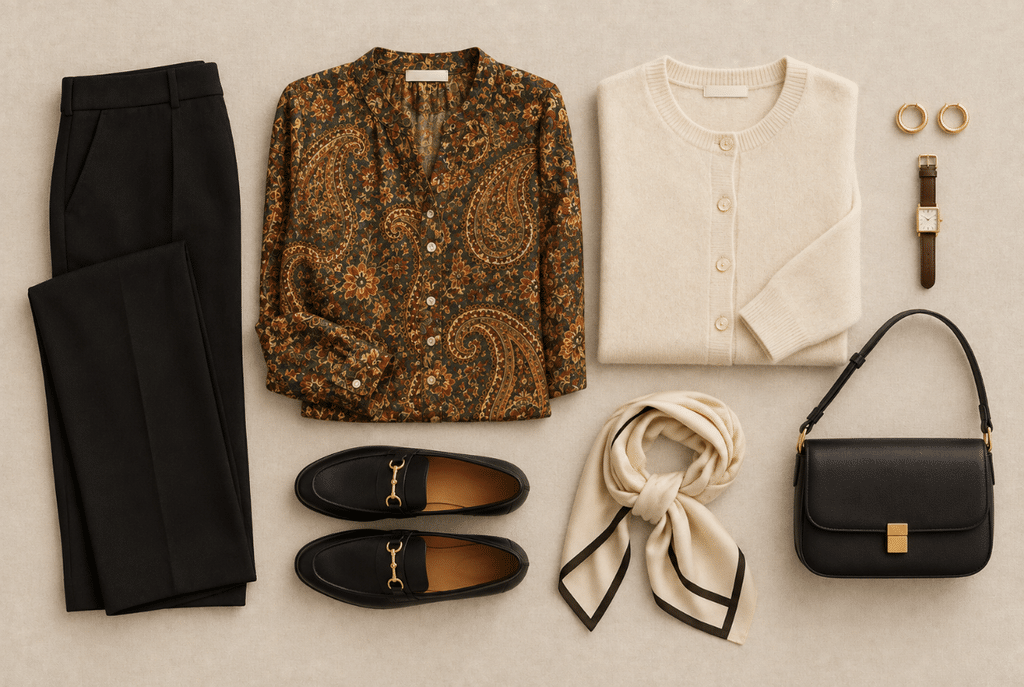
- Jewel-tone paisley (deep red, teal, purple) — pair with black, cream, or camel for a grounded, elevated look
- Earth-tone paisley (rust, olive, mustard) — pair with denim or a warm neutral for an easy boho feel
- Monochrome paisley (navy-on-navy, black-on-white) — wear it almost like a textured neutral, paired with any solid accent color
- Bright, saturated paisley — keep shoes, bag, and jewelry as minimal and neutral as possible
Small-Scale vs. Large-Scale Paisley
A smaller, tighter paisley repeat (common on ties, blouses, and lining fabric) reads as more refined and versatile for everyday wear. A large-scale paisley — where each teardrop motif might be several inches across — makes much more of a statement and works best as the single focal point of an outfit, similar to how an oversized floral or wildflower print needs the rest of the look kept deliberately simple.
Comparing small-scale and large-scale paisley print patterns.
Paisley in Kids’ and Family Styling
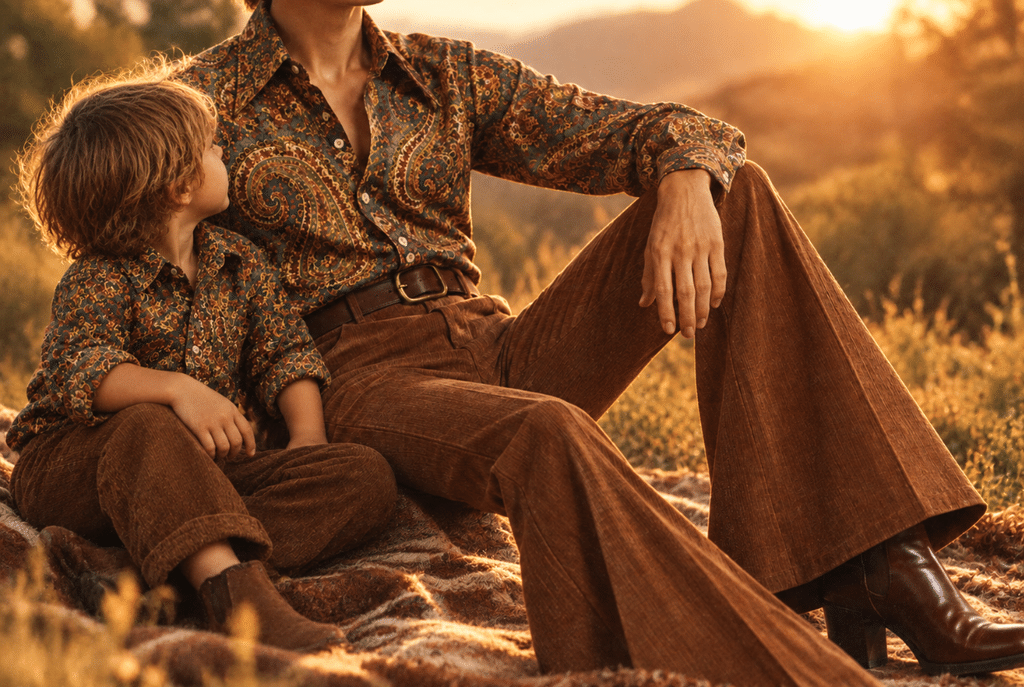
Why Paisley Works for Coordinated Family Looks
Paisley’s dense, busy pattern actually makes it a surprisingly good anchor for a coordinated family outfit, because a single dominant color from the print is easy to echo in a plain piece worn by someone else in the family. The same coordinated-not-identical approach covered in our guide to building a mommy-and-me wardrobe without buying double of everything applies directly here — let one person wear the paisley piece and have everyone else pick up just one of its colors.
This is exactly why we at Honeh treat paisley as one of our go-to prints for family-coordinated pieces — it has enough visual richness to anchor a whole look on its own, without needing anyone else in the photo to match it stitch for stitch.
Caring for Paisley Print Garments
Protecting the Fine Detail in the Print
Because paisley relies on fine, intricate linework to read clearly, harsh washing can blur that detail faster than it would on a simpler, bolder print. Cold water, gentle cycles, and turning the garment inside out all help preserve the crispness of the pattern. Our full breakdown of wash temperatures and drying methods in how to wash and care for printed cotton jersey clothing applies just as well to a detailed print like paisley.
Close-up of fine detail in a paisley print fabric.
Paisley vs. Similar Ornate Prints
Paisley vs. Floral
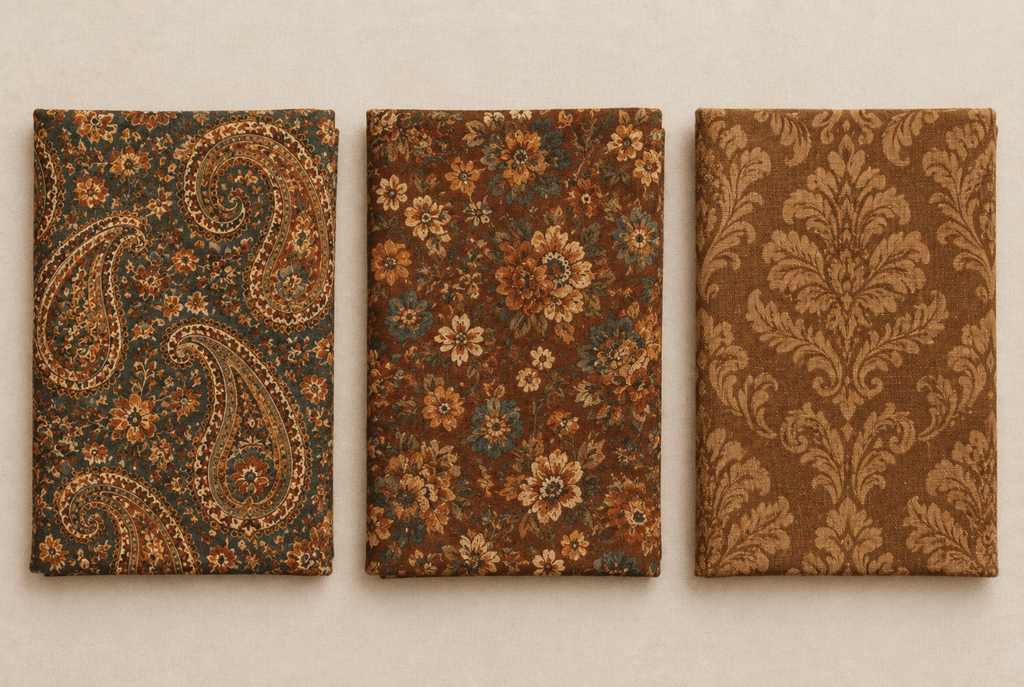
The easiest way to tell paisley and floral apart is to look for the boteh’s signature curved, pointed teardrop outline — a floral print is built from recognizable flower shapes (petals, stems, leaves) arranged in a garden-like layout, while paisley is built from that single repeating abstract motif, even though the inside of each teardrop is often filled with small floral-like detail. Think of paisley as a pattern about the repeating shape itself, and floral as a pattern about depicting actual flowers.
Paisley vs. Damask
Damask is a woven pattern (traditionally in a single color, using contrasting matte and shiny threads of the same shade to create the design) most commonly seen in symmetrical, mirrored floral or scroll motifs. Paisley almost always appears in visible contrasting colors rather than tone-on-tone, and its motif is asymmetrical and curved rather than mirrored and symmetrical, which gives paisley a more organic, flowing feel compared to damask’s formal symmetry.
Common Myths About Paisley, Debunked
“Paisley Is Just a 1960s Hippie Print”
The 1960s psychedelic association is real and lasting, but it’s only one chapter in a story that starts over a thousand years earlier in Persian textile design. Paisley was a symbol of luxury and status in Persia and Kashmir for centuries before it ever reached a guitar strap or a Woodstock poster, and treating it as purely a 60s throwback misses most of its actual history.
“Paisley Only Comes in Bright, Loud Colorways”
Modern paisley shows up just as often in restrained, tonal colorways — navy on navy, black on charcoal, cream on beige — as it does in the saturated jewel tones most people picture. A muted paisley tie or blouse can read as genuinely understated, which is part of why the print has stayed in menswear tailoring rotation for so long without ever feeling like a costume choice.
“Paisley Is Too Busy to Wear Every Day”
A small-scale, tonal paisley piece is genuinely one of the more versatile prints available, precisely because it can read as textured neutral from a normal viewing distance. It’s only the large-scale, high-contrast version of the print that demands the “statement piece” treatment — the smaller, quieter version works into a weekday wardrobe just as easily as a plain blouse would.
An everyday outfit styled with a paisley print piece.
Building a Small Paisley Capsule
Start With a Tonal, Small-Scale Piece
The lowest-risk entry point into paisley is a small-scale, tonal piece — a blouse or scarf in navy-on-navy or black-on-cream — that can slot directly into an existing capsule wardrobe without requiring you to rebuild your color palette around it.
Layer In a Bolder Piece Later
Once the quieter version feels natural, a bolder jewel-tone paisley dress, scarf, or accessory is an easy next step — and because you’ll already know which colors in your existing wardrobe work well with the print, choosing a saturated version becomes far less intimidating.
How Paisley Is Made Today
Woven Jacquard vs. Printed Paisley
Historically, paisley was a woven pattern created on a jacquard loom, the same technology that made the original Scottish imitations of Kashmir shawls possible at scale. Today, most paisley you’ll find on clothing is actually printed rather than woven — dyed directly onto finished fabric rather than built into the weave itself. Woven paisley still exists, mostly on higher-end scarves, ties, and upholstery fabric, and tends to have a slightly raised, textured feel compared to a flat printed version.
Why This Distinction Still Matters
A woven paisley piece generally holds its pattern and color longer than a printed one, since the design is part of the fabric structure rather than sitting on its surface — the same principle covered in our gingham print guide, where woven checks were shown to resist fading and cracking better than printed imitations. If you’re investing in a paisley piece meant to last for years rather than one season, checking whether it’s woven or printed is worth the extra minute.
Paisley Around the World Today
Still a Living Tradition in South Asia
While Western fashion often treats paisley as a decorative print choice, the boteh motif remains an active, living part of textile tradition in Iran, Kashmir, and across South Asia, where hand-woven and hand-embroidered versions are still produced and worn for formal and ceremonial occasions rather than treated purely as a fashion trend.
A Reminder Worth Keeping in Mind
Because of that living history, it’s worth wearing paisley with a little bit of awareness of where it came from — not as a reason to avoid the print, but as context that makes it more interesting to wear. Knowing that the pattern on your scarf traces back through Kashmir shawls to Persian nobility tends to make people appreciate the print more, not less.
Tell Us What You Think
Do you already wear paisley, or does this print feel like new territory for your wardrobe? Let us know in the comments which colorway you’d try first.
FAQ
What does the paisley shape actually represent?
Historians still debate the exact meaning — theories include the sun, a stylized cypress tree, a growing plant shoot, or a mythical bird from pre-Islamic Iranian symbolism. No single interpretation has ever been definitively confirmed.
Why is a Persian pattern called “paisley”?
The name comes from the Scottish town of Paisley, which mass-produced machine-woven imitations of expensive hand-made Kashmir shawls in the 18th and 19th centuries. The imitations became so widespread that the English-speaking world started calling the whole pattern after the town.
Is paisley the same as a floral print?
No — paisley is built from a single repeating curved teardrop motif (the boteh), while floral prints depict recognizable flower shapes arranged in a garden-like layout. Paisley’s inner detail is sometimes floral-like, but the overall shape is distinct.
Is paisley still fashionable today?
Yes — paisley moves between two current fashion registers: muted, tonal paisley in tailoring and menswear, and saturated jewel-tone paisley in boho and statement fashion. Both are considered current rather than dated.
What colors does paisley traditionally come in?
Traditional Kashmir and Persian paisley leaned toward rich jewel tones like deep red, teal, and gold, though modern paisley appears in almost any color combination, including monochrome and pastel versions.
Can paisley be worn in a professional setting?
Yes, especially in its smaller-scale, tonal form — a subtle paisley tie, blouse, or pocket square has been a staple of professional and tailored menswear for generations.
How do I know if a paisley print is high quality?
Look at the fineness of the linework inside each teardrop shape — a higher-quality paisley print holds crisp, detailed inner patterning, while a lower-quality version often looks blurred or simplified at the same scale.

-
 Price range: $22.38 through $29.07
 -
 Price range: $22.38 through $29.07
 -
 Price range: $22.38 through $29.07
 -
 Price range: $21.43 through $28.17
 -
 Price range: $22.38 through $29.07
 -
 Price range: $22.38 through $29.07
 -
 Price range: $22.38 through $29.07



Recent Comments